Hearing Aid Government Scheme in India 2026 – Full List & Eligibility
Hearing Aid Government Scheme in India – Full List
Hearing loss affects millions of people across India, from newborns with congenital hearing impairment to senior citizens facing age-related hearing decline. A good digital hearing aid can cost anywhere from a few thousand rupees to well over a lakh, and for families with modest incomes, this expense is often out of reach. To bridge this gap, the Government of India runs several welfare schemes that provide free or heavily subsidized hearing aids, cochlear implants, and related surgical support. This guide covers the full list of hearing aid government schemes in India, their eligibility criteria, benefits, and the application process.

1. ADIP Scheme (Assistance to Disabled Persons for Purchase/Fitting of Aids and Appliances)
The ADIP Scheme is the largest and most widely used government program for obtaining subsidized or free hearing aids in India. It is run by the Ministry of Social Justice and Empowerment through the Department of Empowerment of Persons with Disabilities (DEPwD). The scheme covers a wide range of assistive devices including hearing aids, wheelchairs, tricycles, crutches, and cochlear implants. Devices distributed under this scheme are typically manufactured by the Artificial Limbs Manufacturing Corporation of India (ALIMCO), a central public sector undertaking that produces aids certified to Indian Standards Institute (ISI) and ISO quality norms.
Eligibility for the ADIP Scheme requires the applicant to be an Indian citizen of any age holding a disability certificate of 40 percent or more. The monthly income of the applicant, or of parents and guardians in the case of dependents, should not exceed the prescribed ceiling. Applicants must also not have received similar assistance for the same purpose within the last three years, except in the case of children below 12 years of age, where the gap is reduced to one year.
The financial assistance under the scheme depends on income level. Persons earning up to Rs. 22,500 per month are eligible for the full cost of the hearing aid or appliance, while those earning between Rs. 22,501 and Rs. 30,000 per month receive 50 percent of the cost as subsidy. For more expensive devices, the Central Government bears half the cost, with the remaining amount contributed by the state government, an NGO, or the beneficiary, subject to approval.
For children requiring cochlear implants due to severe to profound hearing loss, the scheme provides financial support of up to Rs. 7 lakh per unit for children with pre-lingual hearing loss between 1 and 5 years of age, and up to Rs. 6 lakh for children with acquired hearing loss between 5 and 18 years. This support covers the cost of the implant, surgery, and post-operative speech and rehabilitation therapy.
Documents required for ADIP Scheme:
Passport-size photographs
Copy of disability certificate
Address proof such as Aadhaar card, voter ID, or ration card
Copy of income certificate
Self-declaration confirming no similar assistance was received in the last three years
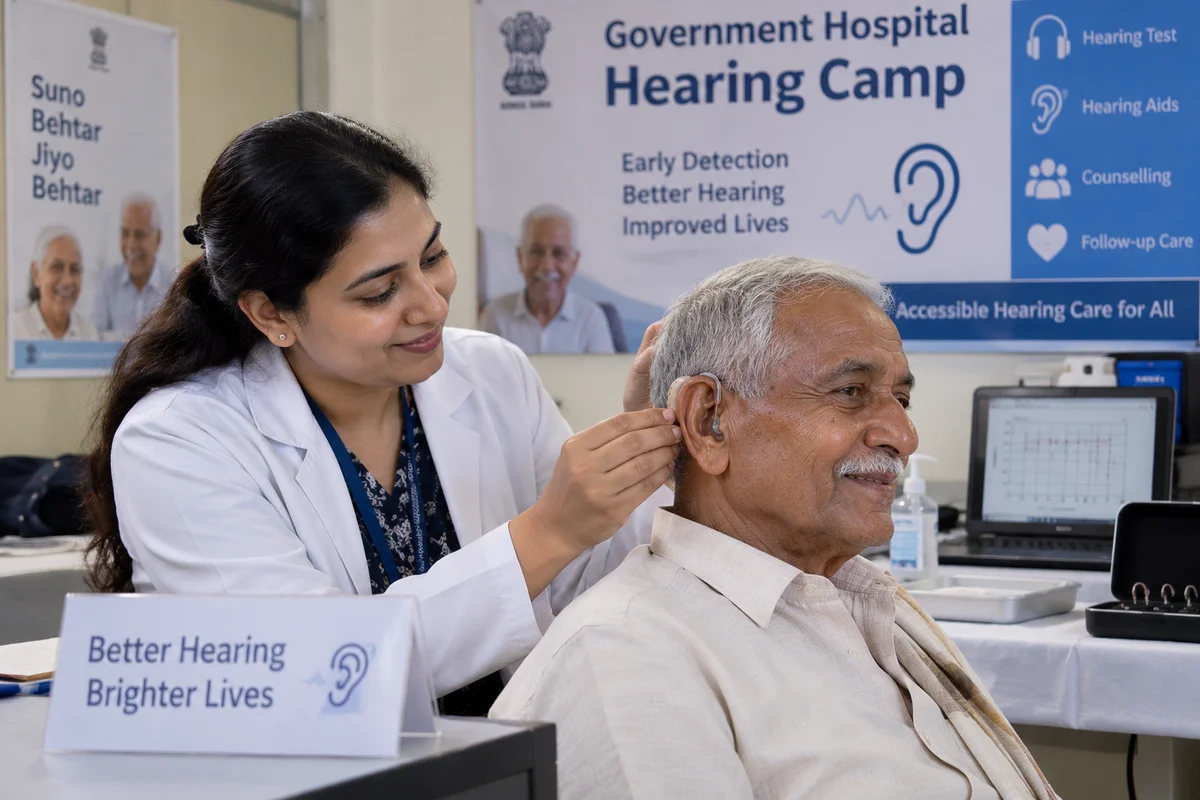
How to apply: Applicants can register through the official ADIP MIS portal under the Department of Empowerment of Persons with Disabilities, or visit an ADIP distribution camp, a District Disability Rehabilitation Centre (DDRC), or an ALIMCO regional centre. Many state governments and NGOs also organize periodic ADIP camps at district hospitals where hearing tests, fitting, and device distribution happen on the same day.
2. Rashtriya Bal Swasthya Karyakram (RBSK)
RBSK is a child health screening programme under the National Health Mission that focuses on early identification of health conditions in children, including hearing loss. Children found with hearing impairment during school or Anganwadi screenings are referred for further diagnosis and treatment, including hearing aids or cochlear implants where needed. Early identification under RBSK helps prevent speech and language delays and improves long-term developmental outcomes for children with hearing loss.
3. Ayushman Bharat – Pradhan Mantri Jan Arogya Yojana (PMJAY)
Ayushman Bharat, also known as the National Health Protection Mission, provides health insurance coverage of up to Rs. 5 lakh per family per year to economically vulnerable households. While the scheme primarily focuses on hospitalization expenses, it can support cochlear implant surgery and related treatment for eligible beneficiaries at empanelled hospitals. Families listed under the Socio-Economic Caste Census or holding a valid Ayushman card should check with their nearest empanelled hospital for hearing-related coverage details.
4. National Programme for Prevention and Control of Deafness (NPPCD)
Run by the Ministry of Health and Family Welfare, NPPCD aims to reduce the burden of hearing loss in India through prevention, early detection, and rehabilitation. The programme strengthens audiology services at the district and community level by training health workers, setting up ENT and audiology units in district hospitals, and conducting community-level hearing screening camps. It works closely with the ADIP Scheme to ensure that identified patients receive timely hearing aids or surgical intervention.
5. State Government Schemes
Several state governments run their own supplementary schemes for persons with hearing disabilities, often in addition to the central ADIP Scheme. These may include free hearing aid distribution camps, travel allowance for beneficiaries attending fitting centres, monthly disability pensions, and priority access in government hospitals. Since benefits and income limits vary from state to state, applicants should check with their respective state social welfare department or district disability office for local scheme details.
6. Educational Scholarships for Hearing-Impaired Students
The Government of India offers pre-matric and post-matric scholarships for students with hearing loss and other disabilities, administered by the Department of Empowerment of Persons with Disabilities and various state education departments. These scholarships help cover tuition fees, hostel charges, and study material costs, reducing the financial burden on families and encouraging continued education for children with hearing impairment.
7. Income Tax Benefits Under Sections 80U and 80DD
Persons with hearing impairment, or their family members supporting a dependent with hearing loss, can claim income tax deductions under Section 80U (for the person with disability) and Section 80DD (for a family member supporting a dependent with disability) of the Income Tax Act. These deductions help offset some of the ongoing costs associated with hearing aids, therapy, and rehabilitation.
8. Skill Development and Employment Support
Various government skill development initiatives, run under the Ministry of Skill Development and Entrepreneurship along with the Department of Empowerment of Persons with Disabilities, support hearing-impaired individuals in gaining vocational training and employment. These programmes aim to improve economic independence and workforce participation among persons with hearing disabilities.
Steps to Access Hearing Aid Government Schemes
To summarize how a person can access these benefits, the general process involves getting a hearing test done at a government hospital or a certified audiology centre, obtaining a disability certificate confirming the extent of hearing loss, applying through the ADIP MIS portal or attending a local ADIP distribution camp, submitting income proof and identity documents, and receiving the hearing aid or cochlear implant support based on income eligibility.
Final Thoughts
Government hearing aid schemes in India, led by the ADIP Scheme and supported by programmes like RBSK, Ayushman Bharat, and NPPCD, make hearing care accessible to thousands of families every year. If you or a loved one is dealing with hearing loss, the first step is getting a proper hearing evaluation at a government hospital or recognized hearing centre, followed by applying for the appropriate scheme based on income and disability certification. Always verify current income limits and scheme details on the official DEPwD or ADIP portal, as these figures are periodically revised.
FAQs
Q1. What is the ADIP Scheme?
The ADIP Scheme is a central government programme that provides free or subsidized hearing aids and other assistive devices to persons with disabilities based on income and disability criteria.
Q2. What is the income limit to get a free hearing aid under ADIP?
Applicants earning up to Rs. 22,500 per month are eligible for a fully free hearing aid, while those earning between Rs. 22,501 and Rs. 30,000 per month receive 50 percent subsidy.
Q3. What documents are needed to apply for a government hearing aid scheme?
You typically need a disability certificate, income certificate, address proof such as Aadhaar card, and passport-size photographs.
Q4. Can children get free cochlear implants under government schemes?
Yes, children with severe to profound hearing loss can receive up to Rs. 7 lakh in financial support for cochlear implants under the ADIP Scheme, depending on age and type of hearing loss.
Q5. How can I apply for the ADIP Scheme?
You can apply through the official ADIP MIS portal, or visit an ADIP distribution camp, District Disability Rehabilitation Centre, or ALIMCO regional centre.
Q6. Does Ayushman Bharat cover hearing aids?
Ayushman Bharat mainly covers hospitalization costs and can support cochlear implant surgery at empanelled hospitals for eligible beneficiaries, though it is not a dedicated hearing aid scheme.
Q7. Are there state-level hearing aid schemes as well?
Yes, many states run additional hearing aid distribution camps and disability welfare benefits alongside the central ADIP Scheme.