One-Ear Deafness Disability Certificate: Percentage, Eligibility and Process in India
Single-sided deafness, also called unilateral hearing loss, affects thousands of people in India. Many of them ask the same question: can I get a disability certificate if only one ear is deaf? The short answer is that it depends on the percentage of disability calculated under government guidelines, and for most people with one-ear deafness the percentage is low.
This guide explains how hearing disability is measured, what percentage one-ear deafness gets, who is eligible, and how to apply. It is written by the team at VR Speech and Hearing Clinic, where audiologists work with patients on hearing assessment, hearing devices and rehabilitation every day.
What Is One-Ear Deafness?
One-ear deafness means one ear has little or no useful hearing while the other hears normally. It can be present from birth or develop later because of infections, head injury, mumps, Meniere’s disease, acoustic neuroma, sudden sensorineural hearing loss or noise exposure.
People with this condition often find it hard to tell where a sound is coming from. They struggle to follow conversation in noisy places and may need to turn their good ear toward the speaker. Even so, the better ear carries most of the day-to-day hearing load, which matters a great deal for disability certification.
Legal Framework: Hearing Disability Under the RPwD Act, 2016
In India, disability certification is governed by the Rights of Persons with Disabilities Act, 2016. The Act recognises hearing impairment under two groups:
Deaf: persons with hearing loss of 70 dB or more in the speech frequencies in both ears.
Hard of hearing: persons with hearing loss of 60 dB to 70 dB in the speech frequencies in both ears.
The wording “both ears” is important. The Act and the assessment guidelines notified in 2018 look at overall hearing function, not just the weaker ear.
How the Disability Percentage Is Calculated
Doctors do not simply declare a person “50% deaf”. The percentage comes from a formula based on pure tone audiometry, a test that measures the quietest sounds a person can hear.
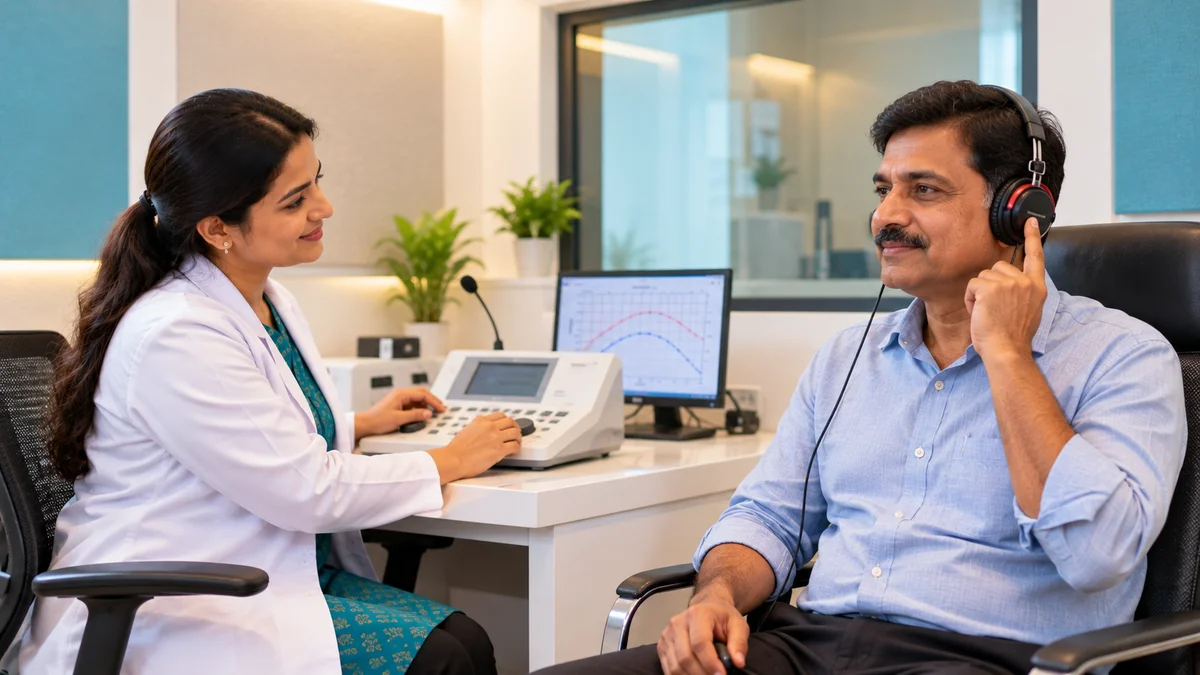
Step 1: Pure tone average. The audiologist measures hearing thresholds at 500, 1000, 2000 and 4000 Hz in each ear and averages them. This gives a decibel (dB) value for the better ear and for the worse ear.
Step 2: Convert to a percentage of impairment. Each ear’s average is matched to a percentage in the table given in the guidelines.
Step 3: Apply the weighted formula. The final disability is calculated as:
(5 × percentage of the better ear + percentage of the worse ear) ÷ 6
The better ear is given five times the weight of the worse ear. That is why one-ear deafness rarely produces a high percentage.
What Percentage Does One-Ear Deafness Get?
Consider the most extreme case of single-sided deafness: the better ear is completely normal (0% impairment) and the worse ear has profound loss (100% impairment).
(5 × 0 + 100) ÷ 6 = about 16.7%
So even a totally deaf ear alongside a normal ear gives a maximum of roughly 17% hearing disability. For milder one-sided loss, the figure is lower still, often close to zero.
Is One-Ear Deafness Eligible for a Disability Certificate?
Under the RPwD Act, a person with benchmark disability is one with at least 40% of a specified disability. Most government benefits tied to the UDID card, including reservation in jobs and education, travel concessions and pension schemes, require this 40% threshold.
Because unilateral deafness with a normal opposite ear works out to about 17% at most, it generally does not qualify as a benchmark disability. In practical terms:
You may still be assessed, and the medical authority records your actual percentage.
A certificate showing a percentage below 40% may exist, but it usually does not unlock the main benefits.
The picture changes if the better ear also has some hearing loss. If both ears are affected, the combined percentage can rise, and you may cross 40%.
Rules and local practices can differ across states and departments, so confirm with the medical board or the issuing authority before assuming you are eligible or ineligible.
When Both Ears Are Affected
Suppose someone has profound loss in one ear and moderate loss in the other. Because the better ear carries five times the weight, even moderate loss in it raises the final figure substantially. This is why a full evaluation of both ears matters, and why people who believe they have “only one deaf ear” are sometimes surprised to find mild loss in the other ear as well.
Tests Required for Hearing Disability Assessment
The medical authority usually asks for objective, reliable tests, such as:
Pure tone audiometry (PTA): the main test for threshold calculation.
Speech audiometry: checks how well speech is understood.
Impedance audiometry (tympanometry): checks middle ear function.
BERA (brainstem evoked response audiometry): an objective test used when behavioural testing is unreliable, especially in children or doubtful cases.
OAE (otoacoustic emissions): often used for infants and young children.
The test must be done in a sound-treated room with calibrated equipment. Reports from a qualified audiologist carry more weight and reduce the chance of rejection or retesting.
Step-by-Step Process to Apply for a Hearing Disability Certificate
Get a complete hearing evaluation. Visit an ENT specialist and an audiologist for PTA and any other tests needed. Keep the original reports.
Register on the UDID portal. The Unique Disability ID project is the national system for disability certificates. Fill in your personal details, disability type and upload a passport-size photo, signature and documents.
Select a hospital or medical authority. Choose a government hospital or notified medical board near you and book an assessment slot.
Attend the medical board assessment. An ENT specialist, and in many cases an audiologist, will examine you and may repeat tests to confirm results.
Receive your certificate and UDID card. If the percentage is certified, the system generates a disability certificate and a UDID card. Processing times vary by state and hospital.
Documents Usually Required
Aadhaar card or other identity proof
Address proof
Recent passport-size photographs
Signature or thumb impression
Previous medical records and audiometry reports
Hospital referral or prescription, where required
Always check the current checklist on the portal or with the hospital, since requirements can be updated.
Validity of the Certificate
Hearing disability may be certified as permanent or temporary. Permanent certificates are issued when the condition is not expected to change. Temporary certificates carry a validity period after which reassessment is needed, which may apply when hearing could improve with treatment or when assessment in children is still evolving.
Benefits You Can Still Explore With One-Ear Deafness
Even without a 40% certificate, one-ear deafness is a real medical condition with real effects. You can consider:
Hearing devices: a CROS or BiCROS hearing aid picks up sound from the deaf side and routes it to the good ear, improving awareness and speech understanding in noise. A bone-anchored hearing system is another option for suitable candidates.
Medical treatment: early treatment of sudden hearing loss, infections or fluid in the ear can sometimes recover hearing.
Hearing protection: protecting the good ear from loud noise is vital, since it is doing most of the work.
Workplace and classroom adjustments: sitting with the good ear toward the speaker, reducing background noise and using captions or written notes help in daily life.
Counselling and listening training: audiologists can teach strategies for localisation difficulty and listening in noisy places.
How VR Speech and Hearing Clinic Can Help
At VR Speech and Hearing Clinic, patients can get complete audiological evaluation, including pure tone audiometry, speech audiometry, tympanometry and BERA, with clear reports that medical boards and doctors can rely on. The team also guides patients on documentation, explains what their results mean in terms of disability percentage, and advises on suitable hearing solutions such as CROS and BiCROS systems, along with speech and listening therapy where needed.
If you are unsure whether your hearing loss will qualify, an accurate baseline test is the best first step. It tells you exactly where you stand before you invest time in the application process.
Key Takeaways
Disability percentage is calculated with a weighted formula that gives the better ear five times the importance of the worse ear.
One-ear deafness with a normal opposite ear gives a maximum of about 17%, below the 40% benchmark disability threshold.
Eligibility improves if the better ear also has hearing loss.
The application runs through the UDID portal, with assessment by a medical board.
Even without a certificate, hearing devices and therapy can improve daily life significantly.
Disclaimer: This article is for general information and is not medical or legal advice. Disability rules and procedures may change, so confirm with a qualified audiologist, ENT specialist or the issuing authority.
FAQs
1. Can I get a disability certificate for deafness in one ear?
You can be assessed, but a normal opposite ear typically produces a disability of about 17% at most, which is below the 40% benchmark needed for most government benefits.
2. What is the disability percentage for one-ear deafness?
Under the weighted formula, total loss in one ear with a normal other ear comes to roughly 16.7%. Partial loss gives a lower percentage.
3. What is the formula for calculating hearing disability?
Five times the better ear’s impairment percentage, plus the worse ear’s percentage, divided by six.
4. What is the minimum percentage for a disability certificate benefit?
Most benefits require at least 40% of a specified disability, known as benchmark disability under the RPwD Act, 2016.
5. Which tests are needed for a hearing disability certificate?
Pure tone audiometry is essential. Speech audiometry, tympanometry, BERA and OAE may also be requested depending on age and the doctor’s advice.
6. Where do I apply for a hearing disability certificate?
Register on the UDID portal, then attend assessment at a government hospital or notified medical board.
7. Is the hearing disability certificate permanent?
It can be permanent or temporary, depending on whether the condition is expected to change.
8. Can a hearing aid help one-ear deafness?
Yes. CROS and BiCROS hearing aids and bone-anchored systems can improve hearing awareness and speech understanding in noise.
9. Can the percentage increase if my other ear also loses hearing?
Yes. Loss in the better ear raises the final percentage significantly because it carries more weight in the formula.
10. Should I get tested before applying?
Yes. A proper audiological evaluation shows your likely percentage before you begin the application.