Free Hearing Aids for Low-Income People in India | Govt Schemes 2026
Free Hearing Aids for Low-Income People in India – Government Schemes & How to Apply
Hearing loss can quietly take away a person's ability to communicate, work, learn, and connect with family. For many low-income families in India, the cost of a good digital hearing aid feels completely out of reach, since prices can range from a few thousand rupees to well over a lakh. Fortunately, the Government of India and several state governments run dedicated welfare schemes that provide free or heavily subsidized hearing aids to eligible citizens. This guide explains every major government hearing aid scheme available in India, who qualifies, what documents are needed, and the exact steps to apply.
Why Government Hearing Aid Schemes Matter
Untreated hearing loss affects far more than just the ears. Children with hearing impairment can fall behind in speech and language development. Working adults may struggle to keep their jobs. Senior citizens often become isolated from family conversations. Since good quality hearing aids are expensive, many low-income households simply go without treatment for years. Government schemes exist precisely to close this gap, ensuring that financial hardship never becomes the reason someone is left unable to hear.
The ADIP Scheme – India's Primary Hearing Aid Program
The most important national program for hearing aids is the ADIP Scheme (Assistance to Disabled Persons for Purchase/Fitting of Aids and Appliances), run by the Ministry of Social Justice and Empowerment. This scheme provides assistive devices, including hearing aids, to persons with disabilities across the country, and is implemented through government hospitals, NGOs, and empanelled distribution camps.
Who is eligible for ADIP:
Must be an Indian citizen of any age
Must hold a disability certificate confirming at least 40% benchmark hearing disability (a UDID card also works)
Monthly family income should fall within the limit set by the scheme, which is periodically revised; those with the lowest incomes typically receive 100% free assistance, while those slightly above the lowest bracket may receive partial subsidy
Applicant should not have received similar assistance for the same purpose in the last three years (this condition is relaxed to shorter periods for young children, since their needs change quickly as they grow)
What ADIP provides:
Under this scheme, beneficiaries can receive digital hearing aids manufactured and supplied through recognized government-linked manufacturers. In addition to the hearing aid itself, the scheme also covers essential ear-related surgical correction where needed before fitting a device, along with a small transport allowance and boarding support for beneficiaries travelling from rural areas to attend distribution camps.
Cochlear Implants for Children:
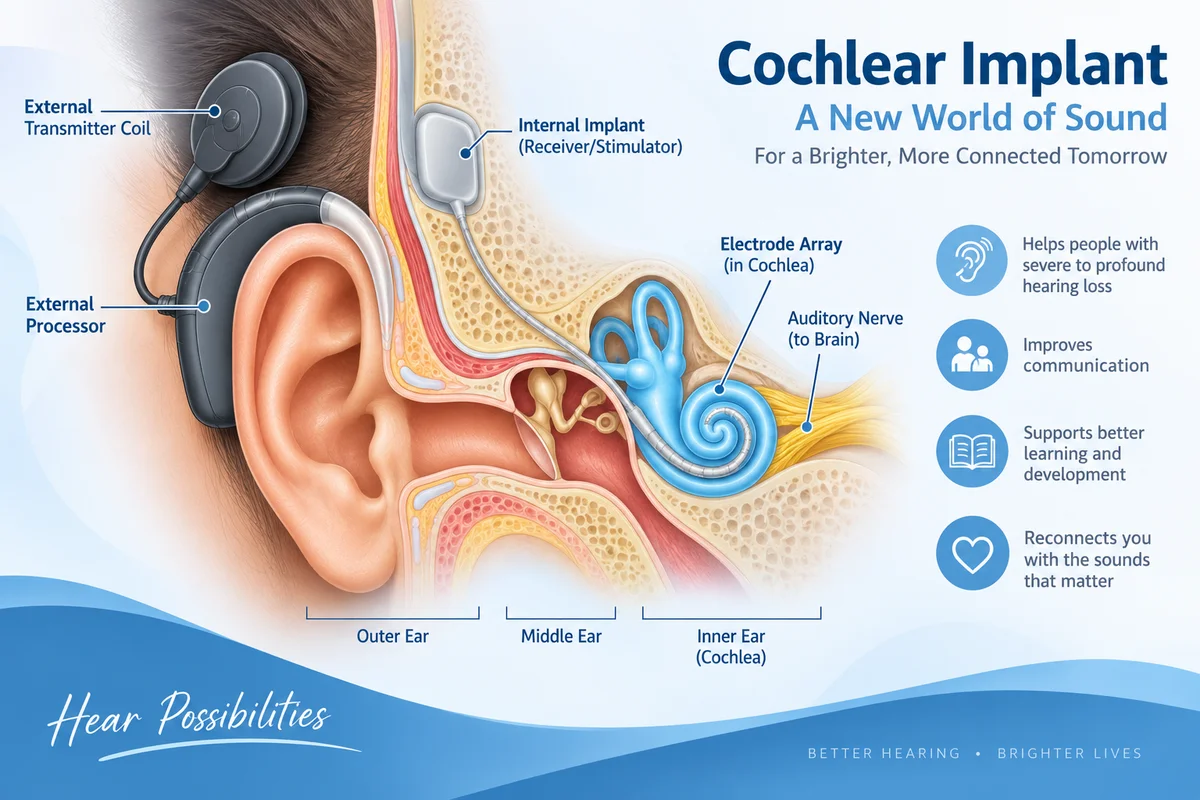
For children with severe pre-lingual or acquired hearing loss who need more advanced intervention than a hearing aid, the scheme also extends financial support toward cochlear implant surgery, mapping, therapy, and rehabilitation, recognizing that early intervention in childhood dramatically improves speech and language outcomes.
RBSK – Rashtriya Bal Swasthya Karyakram
For children specifically, the Rashtriya Bal Swasthya Karyakram (RBSK) plays a vital role. This national child health program focuses on early screening and identification of health conditions in children aged 0 to 18, including hearing loss. Children identified with hearing impairment through school and anganwadi screenings are referred for further evaluation and, where required, connected to free hearing aid or cochlear implant support. Early detection through RBSK helps prevent the speech and language delays that often result when hearing loss goes unnoticed in young children.
NPPCD – National Programme for Prevention and Control of Deafness
The National Programme for Prevention and Control of Deafness (NPPCD) works alongside ADIP by focusing on early detection, prevention, and treatment of hearing loss at the community level. Through this program, many district hospitals conduct hearing screenings and provide free or low-cost hearing aids and related care, particularly for patients from economically weaker backgrounds who may not otherwise access specialist audiology services.
State Government Hearing Aid Schemes
Beyond the central schemes, many state governments run their own welfare programs and periodic hearing aid distribution camps for seniors, children, and low-income residents. These camps are often organized in partnership with district hospitals, NGOs, and certified hearing care centers, and are especially valuable for people living in rural and semi-urban areas who may not easily reach a metropolitan hospital. Availability and eligibility criteria vary by state, so it is worth checking with the local social welfare department or district disability office for ongoing camps in your area.
Step-by-Step: How to Get a Free Hearing Aid
Get a hearing evaluation: Visit a government hospital, district health center, or a certified hearing clinic for a professional hearing test.
Obtain a disability certificate: If the audiologist or ENT specialist confirms significant hearing loss, they will guide you toward obtaining a disability certificate or UDID card from the appropriate medical board.
Check income eligibility: Gather income proof documents, since the level of assistance (fully free or partially subsidized) depends on the applicant's or family's monthly income.
Apply through the scheme: Applications for ADIP are typically submitted through the implementing agency, which may be a government hospital, an empanelled NGO, or through a distribution camp. Some applications can also be processed online through the relevant disability welfare portal.
Attend the fitting camp or center: Once approved, beneficiaries are called to a distribution camp or center where the hearing aid is fitted and calibrated by an audiologist.
Follow up for children: For young children, parents should maintain contact with the hospital or clinic for regular follow-up, since children need periodic reassessment and device adjustment as they grow.
Documents Usually Required
Aadhaar card or other valid identity proof
Income certificate issued by a competent authority
Disability certificate or UDID card showing benchmark hearing disability
Recent passport-size photographs
Medical evaluation report or audiogram from a recognized hospital or audiologist
Bank account details, in some cases, for scheme-linked reimbursements
What If You Don't Qualify for a Free Scheme?
Not everyone will meet the income or disability percentage criteria for full free assistance. If that happens, many hearing clinics, including ours, offer partially subsidized devices, flexible EMI options, and guidance on which state or NGO-run camps might still apply to your situation. A qualified audiologist can also help you choose a hearing aid that fits both your hearing needs and your budget, even outside government schemes.
Why Consult a Certified Hearing Clinic First
Applying for these schemes usually starts with a proper diagnostic hearing test and a disability assessment, both of which need to be conducted by qualified professionals. A certified audiologist not only helps confirm your eligibility on paper but also ensures that the hearing aid you eventually receive, whether free or subsidized, is correctly fitted and calibrated to your specific type and degree of hearing loss. Skipping this step often leads to poorly fitted devices that people stop using within months.
Final Thoughts
No one should have to live with untreated hearing loss simply because of financial constraints. Between the ADIP Scheme, RBSK, NPPCD, and various state-level initiatives, India has built a fairly wide safety net for low-income individuals, children, and senior citizens who need hearing aids. The key is knowing which scheme applies to your situation and taking the first step: getting a proper hearing evaluation. If you or a family member is struggling with hearing loss, reach out to a certified hearing clinic to get tested, understand your eligibility, and begin the application process for the support you deserve.
Frequently Asked Questions
1. Who is eligible for free hearing aids under the ADIP Scheme?
Any Indian citizen with at least 40% certified hearing disability, whose monthly income falls within the scheme's prescribed limit, can apply. Those with very low income typically receive the hearing aid completely free, while others may get a partial subsidy.
2. Do I need a disability certificate to apply?
Yes. A disability certificate or UDID card confirming benchmark hearing disability, issued by a recognized medical authority, is a mandatory requirement for most government hearing aid schemes.
3. Can children get free hearing aids through government schemes?
Yes. Children are a priority group under both the ADIP Scheme and RBSK. Early screening through RBSK helps identify hearing loss in children, who can then be referred for free hearing aids or, in severe cases, cochlear implant support.
4. How long does it take to receive a hearing aid after applying?
The timeline varies by location and scheme, but it generally takes a few weeks to a few months, depending on document verification, camp scheduling, and device availability.
5. Will I get a premium hearing aid through these government schemes?
Government schemes generally provide standard, good-quality digital hearing aids rather than premium or advanced models. If you need a more advanced device, you may need to pay the difference in cost.
6. What if my income is slightly above the eligibility limit?
You may still qualify for partial subsidy rather than a fully free device. It's best to check the current income slabs with your local disability welfare office, as these limits are revised periodically.
7. Where can I apply for these schemes?
Applications can be made through government hospitals, empanelled NGOs, district disability offices, or through periodic distribution camps organized by state governments. Some schemes also allow online applications through official disability welfare portals.
8. Can adults with hearing loss also benefit from these schemes?
Yes, these schemes are not limited to children or seniors. Any eligible adult with certified hearing disability and qualifying income can apply for assistance.