Conductive Hearing Loss: Why Bone Beats Air Conduction
Why Does a Person with Conductive Hearing Loss Hear a Tuning Fork Longer Through Bone Conduction Than Air Conduction?
If you have ever visited an audiologist or ENT specialist, you may have seen a small metal fork struck and placed first behind your ear and then in front of it. This simple tool, the tuning fork, helps clinicians quickly learn what kind of hearing loss you may have. One of the most interesting results is that a person with conductive hearing loss hears the tuning fork through bone conduction longer than or equal to air conduction. This article explains why that happens, in plain language.
Understanding How We Hear
Hearing happens in three main parts of the ear.
The outer ear includes the visible ear (pinna) and the ear canal. It collects sound and funnels it inward.
The middle ear includes the eardrum (tympanic membrane) and three tiny bones called the malleus, incus, and stapes. These bones carry and amplify vibrations from the eardrum to the inner ear.
The inner ear includes the cochlea, a fluid-filled, snail-shaped organ lined with sensory hair cells, and the auditory nerve. The cochlea turns vibrations into electrical signals that the brain understands as sound.
Sound normally reaches the cochlea by air conduction, travelling through the outer and middle ear. But sound can also reach the cochlea by bone conduction, where vibrations pass through the skull bones directly to the cochlea, bypassing the outer and middle ear completely.
What Is Conductive Hearing Loss?
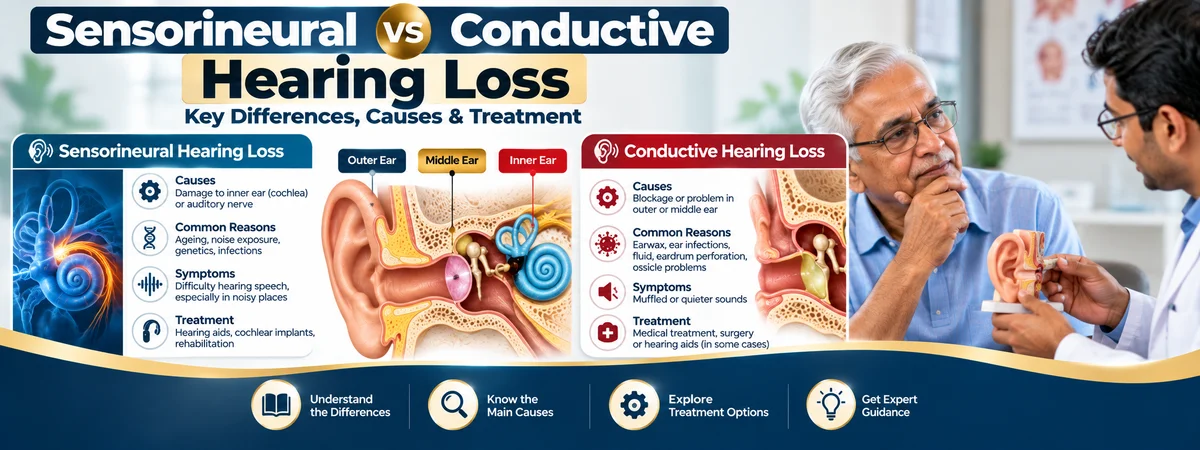
Conductive hearing loss occurs when sound cannot travel efficiently through the outer ear or middle ear to the inner ear. The cochlea and auditory nerve are usually healthy, but something blocks or weakens the path.
Common causes include:
Earwax (cerumen) blockage
Fluid in the middle ear (otitis media with effusion)
Middle ear infections
Perforated or damaged eardrum
Otosclerosis, where the stapes bone becomes fixed
Disruption of the ossicular chain
Foreign objects in the ear canal
Congenital malformations of the ear
Eustachian tube dysfunction
In all these conditions, the problem lies in the sound-conducting mechanism, not in the sensory organ itself.
The Rinne Test: A Quick Introduction
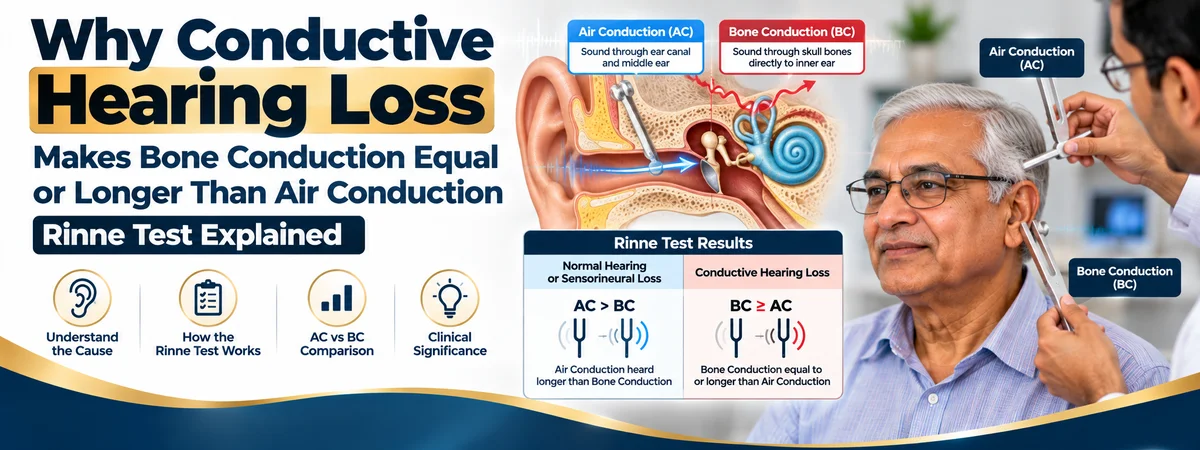
The Rinne test compares air conduction with bone conduction in one ear at a time. The clinician strikes a tuning fork, usually 512 Hz, and places the base on the mastoid bone behind the ear. When you can no longer hear it, the prongs are moved near the ear canal opening. You are asked whether you can still hear it.
Normal hearing (Rinne positive): Air conduction is louder and lasts longer than bone conduction. Typically, air conduction lasts about twice as long.
Conductive hearing loss (Rinne negative): Bone conduction is heard longer than or equal to air conduction.
Sensorineural hearing loss: Air conduction is still better than bone conduction, as in normal hearing, although both are reduced. This is called a false positive or simply Rinne positive.
Why Bone Conduction Is Heard Longer in Conductive Hearing Loss
1. The Cochlea Is Still Healthy
In conductive loss, the cochlea and nerve work normally. Bone conduction sends vibrations straight to the cochlea through the skull, bypassing the damaged outer or middle ear. Because the cochlea functions well, it responds fully to this direct stimulation, so the sound is heard clearly and for a long time.
2. The Air Conduction Pathway Is Blocked or Weakened
Air conduction depends on the eardrum and ossicles working together. When wax, fluid, a perforation, or a stiff stapes interferes, vibrations lose energy before reaching the cochlea. The tuning fork held near the ear canal fades quickly because the weakened pathway cannot deliver it efficiently. Bone conduction, which avoids that pathway, outlasts it.
3. The Middle Ear Normally Provides Amplification
A healthy middle ear boosts sound by roughly 25 to 30 decibels. It does this through the size difference between the eardrum and the stapes footplate, plus the lever action of the ossicles. When the middle ear is damaged, this amplification is lost, creating an air-bone gap. With a large enough gap, bone conduction becomes equal to or better than air conduction.
4. The Occlusion Effect and Reduced Masking
People with conductive loss often hear bone-conducted sound better than expected. A blocked ear canal prevents low-frequency vibrations from escaping, which makes bone-conducted sound seem louder. Also, with the outer and middle ear impaired, less background environmental noise reaches the cochlea, so the bone-conducted tone stands out more clearly.
5. The Air-Bone Gap Explains the Result
In audiology, the difference between air conduction and bone conduction thresholds is the air-bone gap. In conductive loss, bone conduction thresholds are normal or near normal while air conduction thresholds are poor, creating a gap. Generally, an air-bone gap of about 15 to 20 dB or more produces a negative Rinne result. A negative Rinne at 512 Hz usually suggests a gap of at least 20 to 30 dB.
Equal or Longer: What the Difference Means
The result can fall into two categories:
Bone conduction equal to air conduction: This suggests a mild conductive loss, often with an air-bone gap near 15 to 20 dB. The clinician may call it a Rinne equivocal result.
Bone conduction longer than air conduction: This suggests a more significant conductive loss, usually an air-bone gap of 30 dB or more.
The Weber Test Adds More Information
The Weber test places a vibrating tuning fork at the center of the forehead. Normally, the sound is heard equally in both ears. In unilateral conductive hearing loss, the sound is heard louder in the affected ear. This happens because the blocked ear is less distracted by ambient noise and benefits from the occlusion effect. In sensorineural loss, the sound shifts to the better ear.
Together, Rinne and Weber tests help distinguish conductive from sensorineural hearing loss.
Limitations of Tuning Fork Tests
Tuning fork tests are useful screening tools, but they are not a substitute for formal audiometry. Results can be affected by:
The examiner’s technique
Fork frequency and strength
Background noise
Cross-hearing, where the better ear picks up the sound
Patient attention and response
If tuning fork results suggest hearing loss, a full evaluation using pure tone audiometry, tympanometry, and acoustic reflex testing is recommended.
Symptoms of Conductive Hearing Loss
Watch for these signs:
Muffled or dull hearing
Your own voice sounding louder than usual
Hearing better in noisy places in some cases of otosclerosis
Ear fullness or pressure
Ear pain or discharge
Difficulty following soft speech
Turning up the television volume
Recurrent ear infections, especially in children
Treatment Options
Many types of conductive hearing loss can be treated or improved.
Earwax removal: Professional cleaning clears blockages safely.
Medication: Antibiotics or other treatment can resolve infections and fluid.
Ear tube placement: Grommets help drain persistent middle ear fluid, especially in children.
Surgery: Tympanoplasty repairs a perforated eardrum, and stapedectomy or stapedotomy treats otosclerosis.
Hearing aids: Conventional or bone conduction hearing aids can help when surgery is not suitable.
Bone-anchored hearing systems: These devices send sound through bone directly to the cochlea, a natural fit for conductive loss.
Early diagnosis improves outcomes, particularly in children, where hearing affects speech and language development.
When Should You See a Specialist?
Consult an audiologist or ENT specialist if you notice sudden hearing loss, ear pain, discharge, persistent fullness, ringing, dizziness, or if your child is not responding to sounds or is delayed in speech. Do not insert objects into the ear to clear blockages, as this may worsen the problem.
Professional Hearing Care in Chhatrapati Sambhajinagar
If you suspect hearing loss in yourself or a family member, a thorough assessment is the first step. VR Speech and Hearing Clinic offers professional hearing evaluation, audiological testing, hearing aid guidance, and speech therapy support.
Address: VR Speech and Hearing Clinic, Second Floor, Vasantrao Naik Chowk, opposite Hotel Deepali Executive, N-3, CIDCO, Chhatrapati Sambhajinagar, Maharashtra 431003.
Our team helps patients of all ages understand their hearing health and choose the right solution.
Key Takeaway
A person with conductive hearing loss hears a tuning fork through bone conduction longer than or equal to air conduction because the problem lies in the outer or middle ear, while the cochlea remains healthy. Bone conduction bypasses the blockage and delivers vibrations straight to the inner ear, whereas air conduction loses strength along the damaged pathway. This reversal of the normal pattern is called a negative Rinne test and is a classic sign of conductive hearing loss.
Frequently Asked Questions (FAQs)
1. What does a negative Rinne test mean?
It means bone conduction is heard longer than or equal to air conduction, which indicates conductive hearing loss in that ear.
2. Why is air conduction better than bone conduction in normal hearing?
The outer and middle ear collect and amplify sound, making air conduction more efficient than bone conduction.
3. Can sensorineural hearing loss cause a negative Rinne test?
Typically no. In sensorineural loss, air conduction remains better than bone conduction. A false negative can occur in severe unilateral deafness due to cross-hearing.
4. Which tuning fork frequency is used for the Rinne test?
A 512 Hz tuning fork is most commonly used because it balances adequate tone duration with minimal vibrotactile sensation.
5. What is an air-bone gap?
It is the difference between air conduction and bone conduction hearing thresholds on an audiogram. A gap of 15 dB or more suggests conductive involvement.
6. Is conductive hearing loss curable?
Many cases are treatable or reversible, such as wax blockage, infection, and fluid. Others, like otosclerosis, can be corrected with surgery or managed with hearing devices.
7. How does the Weber test differ from the Rinne test?
Rinne compares air and bone conduction in each ear separately. Weber checks for sound lateralization when the fork is placed on the forehead.
8. Where can I get a hearing test in Chhatrapati Sambhajinagar?
You can visit VR Speech and Hearing Clinic at Second Floor, Vasantrao Naik Chowk, opposite Hotel Deepali Executive, N-3, CIDCO, Chhatrapati Sambhajinagar, Maharashtra 431003.