Speech Therapy fo Autism
Personalised speech therapy for autism in Ahilyanagar (Ahmednagar). Build speech, language and social skills at VR Speech and Hearing Clinic.
Book a Free Consultation
We'll call you back. Your details are safe with us.
Every parent looks forward to hearing a child’s first words, their first request for water, their first “I love you.” When a child has autism spectrum disorder (ASD), the road to those moments can look different. Some children begin speaking late. Some repeat phrases they have heard on television. Others communicate through gestures, sounds or pictures instead of words.
With the right support, communication can grow at any age. At VR Speech and Hearing Clinic in Ahilyanagar (Ahmednagar), we provide speech therapy for autism that is gentle, play-based and built around your child’s individual strengths. This page explains how autism affects communication, what therapy involves, and how our clinic near Bhistabag Chowk can support your family.
How Autism Affects Speech and Communication
Autism is a neurodevelopmental condition, and no two children with autism communicate in exactly the same way. Some have a large vocabulary but struggle to hold a conversation. Others understand more than they can say. Some are non-speaking and need other tools to express themselves. A speech-language pathologist looks at the whole picture, not only whether a child is talking.
Common communication differences in children with autism include:
Not responding consistently when their name is called
Limited eye contact, pointing or use of gestures
Delayed first words, or losing words they once used
Repeating words or phrases (called echolalia) instead of creating new sentences
Difficulty taking turns in conversation or staying on topic
Trouble understanding facial expressions, tone of voice, jokes or figurative language
A flat, sing-song, or unusually loud or soft speaking voice
Strong interest in a few topics, with difficulty talking about anything else
Distress when routines change, because the child cannot easily ask or understand what is happening next
Seeing one or two of these signs does not automatically mean a child has autism, and only a qualified specialist can make a diagnosis. But if you notice several, an early assessment is a wise step.
Why Early Speech Therapy for Autism Matters
A young child’s brain is highly responsive to learning, which is why early intervention gives the best chance of building strong communication foundations. Starting therapy in the toddler and preschool years can help children learn to request things, answer questions, follow instructions and connect with family before frustration turns into challenging behaviour.
Many behaviours that worry parents, such as screaming, hitting or running away, are often a child’s way of saying “I need help” or “I don’t want this” when they have no other way to say it. When a child learns a better way to communicate, whether through words, signs, picture cards or a device, these behaviours often reduce.
Speech therapy does not aim to change who your child is. The goal is to give your child a reliable way to share needs, thoughts and feelings, and to take part in family life, school and play. Early support also improves school readiness and independence over time, though it is never too late to begin.
Our Approach to Autism Speech Therapy at VR Speech and Hearing Clinic
Every child’s journey begins with a detailed assessment. We speak with you about your child’s birth and developmental history, daily routines, likes and dislikes, and your main concerns. We then observe your child through play to understand how they understand language, express themselves, interact with others and respond to sounds. Because hearing problems can look like speech delay, hearing is considered as part of the evaluation process.
Based on what we learn, we create an individual therapy plan with clear, realistic goals. We do not follow a one-size-fits-all programme. A three-year-old who is not yet speaking needs a very different plan from a ten-year-old who speaks in long sentences but struggles with friendships.
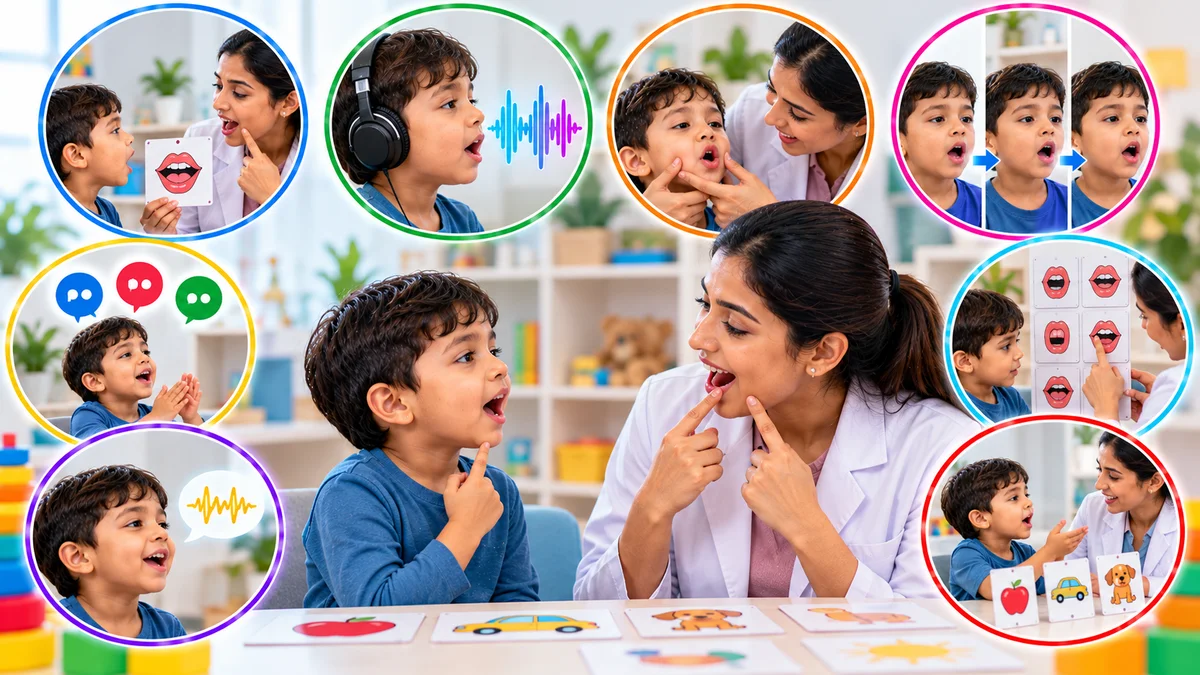
Our sessions are friendly, structured and play-based. We use your child’s favourite toys, books, songs and activities to make learning feel like fun rather than work. Visual supports such as picture schedules and choice boards help children understand what is happening and what comes next, which lowers anxiety and builds cooperation. We celebrate small wins, because progress in autism often happens in small steps.
Skills We Work On in Speech Therapy
Depending on your child’s needs, therapy may focus on:
Understanding language: following simple instructions, learning the meaning of words and answering questions
Expressive language: building vocabulary, forming sentences and asking for what they want
Speech sound clarity: helping others understand your child more easily
Social communication: greeting people, sharing attention, taking turns, starting and ending conversations, and reading body language
Functional communication: asking for help, saying no, making choices and expressing feelings
Meaningful language: moving from repeated phrases to self-generated words and sentences
Voice, tone and rhythm: making speech sound natural and expressive
Augmentative and alternative communication (AAC): gestures, picture exchange, communication boards or speech-generating devices for children who need extra support to be understood
Using AAC does not stop a child from learning to speak. It can reduce frustration and often supports the development of spoken language.
What Happens in a Typical Session
Each visit usually begins with a short, predictable routine so your child feels safe. The therapist then guides your child through play-based activities designed around the current goals, such as sharing a toy, naming objects, answering simple questions or practising a social game. Frequent breaks and rewards keep your child motivated and comfortable.
Parents are always welcome to take part. At the end of each session we explain what we worked on, how your child responded and what you can practise at home. Session length and how often your child should attend depend on age, attention span and goals, and we review the plan regularly as your child grows.
The Parent’s Role: Practising Every Day at Home
Therapy works best when learning continues beyond the clinic. You are your child’s most important communication partner, and everyday routines such as meals, bath time and play are rich learning opportunities. We coach families with simple strategies such as:
Follow your child’s lead and talk about what interests them
Use short, clear sentences and say words slowly
Pause and wait after asking a question so your child has time to respond
Describe what you are doing together, for example, “We are pouring water”
Use pictures, gestures and real objects to support understanding
Offer choices instead of yes-or-no questions
Limit passive screen time and replace it with interactive play
Praise every attempt to communicate, even if it is not perfect
Consistency matters more than perfection. A few minutes of joyful practice each day often achieves more than one long, stressful session.
Working Together with Other Professionals
Autism support often involves more than one specialist. Speech therapy works alongside paediatricians, developmental paediatricians, child psychologists, occupational therapists and special educators. With your permission, we are happy to coordinate with your child’s other professionals and school so everyone uses a similar approach and shares common goals. This team effort gives your child the most consistent support.
Why Families in Ahilyanagar Choose VR Speech and Hearing Clinic
Families should not have to travel long distances for quality care. Our clinic is conveniently located in Ahilyanagar (Ahmednagar) on Pipeline Road near Bhistabag Chowk, making regular visits easier to fit into school and family routines.
Children in Maharashtra often grow up hearing Marathi, Hindi and English together. We understand this and plan therapy around the language or languages your child hears at home, so that learning feels natural and supports connection with family.
Most importantly, we offer a warm, patient and non-judgemental space. We listen to your concerns, explain things in simple language, share honest updates and never pressure you or your child. As a speech and hearing clinic, we look at both speech and hearing health, so nothing important is overlooked.
When Should You Book an Appointment?
Do not wait and watch if you are worried. Consider an assessment if your child:
Is not babbling or using gestures by 12 months
Has no single words by 16 months
Has no two-word phrases by 24 months
Does not respond when called by name
Has lost words or social skills they previously had
Avoids interaction or plays in repetitive ways most of the time
Is older but still hard to understand or struggling to talk with peers
Early evaluation brings clarity and peace of mind, even if the result is simply that your child needs a little extra support.
Book an Autism Speech Therapy Assessment in Ahilyanagar
Your child has a voice, and with the right guidance it can be heard. If you are looking for speech therapy for autism in Ahilyanagar (Ahmednagar), VR Speech and Hearing Clinic is here to help your child take the next step.
VR Speech and Hearing Clinic Shop No. 3, Vitthal Apartment, Pipeline Road, Near Bhistabag Chowk Ahilyanagar (Ahmednagar), Maharashtra 414003
Contact us today to schedule your child’s first assessment.
Frequently Asked Questions (FAQs)
1. Can speech therapy help a child with autism who is not speaking?
Yes. Speech therapy is not only about spoken words. For non-speaking or minimally speaking children, therapists build early communication skills such as eye gaze, gestures, imitation and turn-taking, and may introduce picture cards or other AAC tools. Many children develop more spoken language as their understanding and confidence grow.
2. At what age should speech therapy for autism begin?
As soon as you have concerns about your child’s communication. Therapy can begin in the toddler years, and you do not need to wait for a formal diagnosis. Early support gives a child more time to build skills, but children and teenagers can also benefit greatly at any age.
3. Do we need an autism diagnosis before starting speech therapy?
No. A speech and language assessment can be done whenever there are concerns about speech delay, understanding, social communication or hearing. The assessment helps identify your child’s needs and guides the therapy plan. If autism is suspected, we can advise you on seeing a paediatrician or other specialist for a diagnosis.
4. How long will it take to see improvement?
Every child is different, so there is no fixed timeline. Some families notice small changes, such as better eye contact, more attempts to communicate or fewer frustration outbursts, within the first few months. Regular attendance and daily practice at home make a big difference, and your therapist will review progress with you regularly.
5. Will using picture cards or AAC stop my child from learning to speak?
No. Using pictures, gestures or devices does not prevent speech. In fact, it often lowers frustration and helps children understand that communication gets results, which can encourage them to use words too.
6. How can I support my child’s communication at home?
Talk about everyday activities in short, simple sentences, follow your child’s interests, give them time to respond, offer choices and praise every communication attempt. Your therapist will show you strategies that suit your child and your family’s routine.
7. Where is VR Speech and Hearing Clinic located?
We are at Shop No. 3, Vitthal Apartment, Pipeline Road, Near Bhistabag Chowk, Ahilyanagar (Ahmednagar), Maharashtra 414003.
Visit Us
We'd love to see you in person
Shop no 3 vitthal apartment Pipeline Road · Near Bhistabag Chowk Ahilyanagar (Ahmednagar), Maharashtra, 414003
