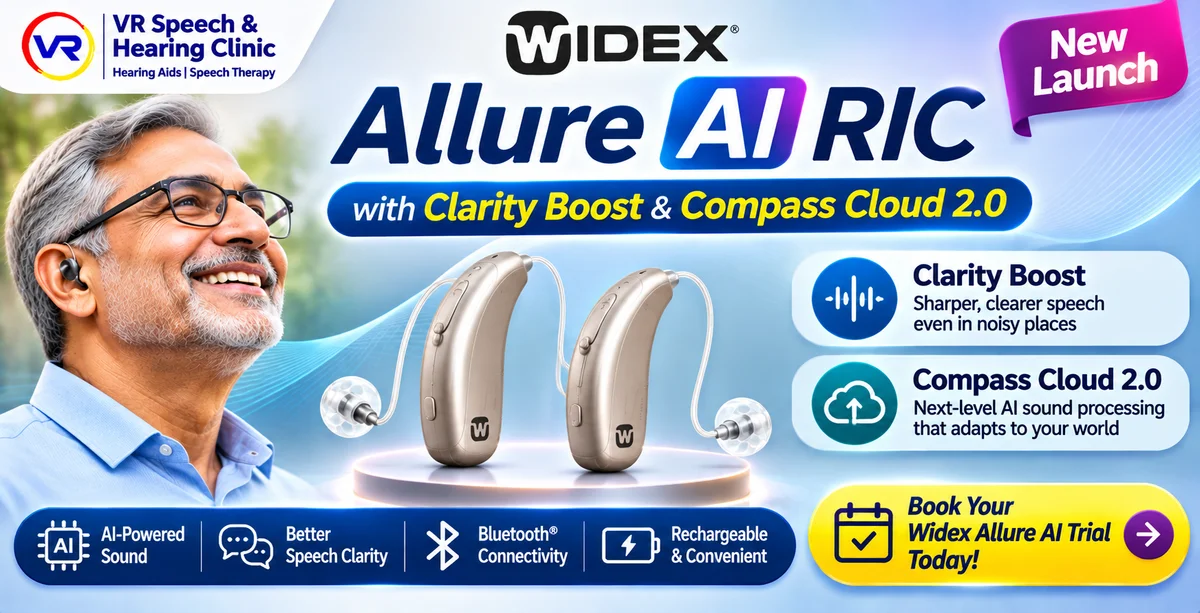
Widex Allure AI RIC with Clarity Boost & Compass Cloud 2.0
Widex Allure AI RIC Hearing Aid Arrives with Clarity Boost and Compass Cloud 2.0
Widex has launched two products designed to work together: the Allure AI RIC RD hearing aid and Compass Cloud 2.0, an upgraded cloud-based fitting platform for hearing care professionals. The Denmark-based brand belongs to the WS Audiology group, alongside Signia and Rexton. Widex has not built an always-on AI hearing aid. Its signature natural, low-delay sound stays as the default, and the wearer chooses when to bring in AI help. For anyone who struggles to follow conversations in restaurants, events or busy public spaces, that approach is worth a closer look.
What Is the Widex Allure AI RIC?
The Allure AI RIC is a receiver-in-canal prescription hearing aid. It builds on the existing Allure platform and the W1 chip, which handles everyday sound processing and connectivity. The new part is a dedicated AI co-processor that does only one job: it powers a program called Clarity Boost.
The standard Allure RIC already scored well in independent lab testing. It earned an A SoundGrade and a 4.6 out of 5 SoundScore, with strong marks for speech clarity in quiet and in noise. Widex had used machine learning before, but mostly in app tools that help wearers compare and fine-tune their settings. Allure AI is the first time AI works directly inside the hearing aid’s sound path.
Clarity Boost: A Turbo Button for Noisy Places
Widex executives compare Clarity Boost to a turbo button. Without it, the device is a complete Widex hearing aid with natural sound and almost no processing delay. When the wearer hits a tough listening situation, they switch Clarity Boost on. When the noise fades, they return to the standard programs.
Wearers can activate it in several ways:
The push-button on the hearing aid
The Widex Allure app
The RC-DEX remote
Smartphone accessibility controls
Tap controls are expected to arrive later this summer.
Widex describes the processing as balanced denoising. The system doesn’t strip every background sound away. It lowers environmental noise while keeping it audible, so the wearer still hears footsteps, traffic, music and the general feel of the room. The aim is clearer speech without the isolated, over-processed sound some noise-reduction systems produce.
The company’s engineers say they could have pushed signal-to-noise ratio (SNR) numbers higher. They chose not to, because a result that looks impressive on a spec sheet doesn’t always sound good to the person wearing the device.
Performance Claims from Widex
According to Widex, Clarity Boost delivers up to 6 dB better output SNR than leading AI-based competitors at realistic noise levels. Widex also reports:
Speech understanding equal to or better than competing AI hearing aids
Up to 26% better intelligibility for moderate-to-severe hearing loss
Up to 14% better intelligibility for mild-to-moderate hearing loss
95% of wearers noticing improved speech in noise
97% describing the sound as natural and clear
These are manufacturer figures. Independent lab results from HearAdvisor were still pending at the time of the original reporting. A reviewer who tried the device for a couple of days found it impressive in a crowded, loud music venue, with directionality and speech-in-noise performance comparable to the best deep neural network hearing aids he had used. That is an early impression from a short trial, not a verdict.
Dual-Chip Design and the Latency Challenge
Allure AI uses a dual-chip architecture, similar to the approach in the Phonak Infinio and ReSound Vivia. The W1 chip runs the main Allure processing. The AI co-processor takes over when Clarity Boost is active. In that mode, the signal goes through beamforming and AI-based denoising, then returns to Widex’s usual compression and hearing-loss compensation.
Widex’s VP of Innovation describes three constraints that shape every hearing aid:
Noise reduction and directionality
Device size and power consumption
Processing delay and sound quality
A hearing aid has only about 10 milliseconds between sound entering the microphone and leaving the receiver. That leaves no time to send audio out to a phone or the cloud and back. The AI has to run inside the device itself.
To meet that limit, Widex uses a linear recurrent neural network (L-RNN). This neural network is built to follow how sound changes over time while needing fewer parameters than some earlier deep neural network designs. The AI hardware fits into the same body size as the previous Allure RIC.
Battery Life, Charging and Connectivity
Allure AI is rated for up to 32 hours of use, including up to 6 hours of AI processing or streaming. Charging options include a standard charger, a Charge & Clean charger and Qi wireless charging.
Connectivity covers:
Made for iPhone (MFi)
ASHA for Android
LE Audio
Hands-free calling
Telecoil support
The hearing aid is Auracast-ready, so it will need a firmware update before it can connect to Auracast broadcasts in public venues.
Compass Cloud 2.0: Smarter Fitting for Clinicians
Compass Cloud 2.0 is the professional counterpart to the new hearing aid. It is the updated version of the first cloud-based fitting software in the industry. The original release leaned toward simplicity and quick first fits. Experienced clinicians asked for more control, and version 2.0 responds to that. It still serves busy clinics that want an efficient workflow, but it now offers deeper options for providers who want to customize fittings.
The update brings a refined fitting rationale based on thousands of real-world fittings, along with personalization tools meant to improve first-fit acceptance. Other additions include:
Adaptation Manager: smoother onboarding for new wearers
SmartSpeak: spoken status updates
Expanded Data Logging: insight into wear time and listening environments
Sound Class Adjustments: more targeted follow-up care
Transfer Settings: easier configuration across fittings
Because the platform lives in the cloud, new features arrive automatically without interrupting clinic work. Widex says it has added features every couple of months since launch. It reports a provider satisfaction rating of 4 out of 5 and has shared a roadmap of more than 15 planned updates. The full benefits of Allure AI, including fitting Clarity Boost, require Compass Cloud 2.0. Older Widex products continue to use the previous fitting software.
The Bigger Strategy Behind the Launch
Allure AI and Compass Cloud 2.0 arrive alongside the Sound Preference initiative, which studies why people like different hearing aid sound. Some wearers want strong processing, and others prefer a more natural signal. Widex is keeping its natural-sound identity, using AI only where it gives a clear benefit, and giving clinicians a platform that can evolve quickly.
What This Means for People with Hearing Loss
Noisy places are the most common complaint among hearing aid users. A hearing aid that sounds natural most of the time and offers extra help on demand could suit people who care about sound quality, music or environmental awareness but still want a boost in tough settings. The right device depends on the person’s hearing loss, lifestyle and fitting quality, so the best next step is a professional evaluation.
At VR Speech and Hearing Clinic, our team can help you understand your hearing needs, compare current hearing aid technology and decide whether features like on-demand AI noise reduction fit your daily life. Book a consultation to find out which solution suits you.
FAQs
What is the Widex Allure AI RIC?
It is a receiver-in-canal prescription hearing aid from Widex with a dedicated AI co-processor that powers Clarity Boost, an on-demand program for noisy environments.
What does Clarity Boost do?
Clarity Boost uses beamforming and AI-based denoising to improve speech understanding in loud settings while keeping some background sound audible.
Is Allure AI always using artificial intelligence?
No. Everyday listening uses the natural, low-delay Widex sound. The wearer turns Clarity Boost on when needed.
How do I activate Clarity Boost?
You can use the hearing aid push-button, the Widex Allure app, the RC-DEX remote or smartphone accessibility controls. Tap controls are expected later.
How long does the battery last?
Widex rates it for up to 32 hours, including up to 6 hours of AI use or streaming.
Does it support Auracast and telecoil?
It has a telecoil and is Auracast-ready, though a firmware update is required to enable Auracast.
What is Compass Cloud 2.0?
It is Widex’s updated cloud-based fitting software. It gives hearing care professionals more precise fitting tools, personalization options and regular feature updates.
Do I need a professional to get Allure AI?
Yes. It is a prescription hearing aid and must be fitted by a hearing care professional.