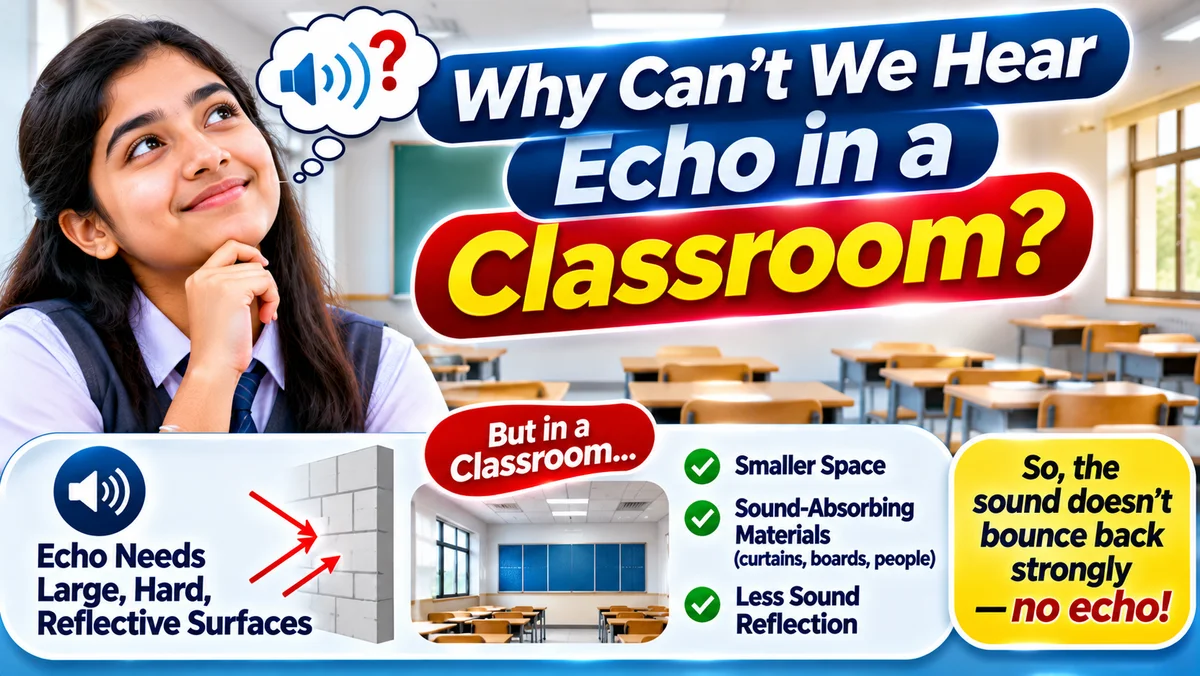
Why Can't We Hear Echo in a Classroom?
Clap your hands in an empty hall or shout toward a distant cliff, and your own voice returns a moment later. Do the same in a classroom and nothing comes back. The sound seems to die on the spot. So why can't we hear the echo produced in a classroom? The answer lies in the physics of sound, the way the human ear handles time, and the design of the room itself. Understanding it helps students, teachers and parents, and it also reveals why poor classroom acoustics can quietly damage listening and learning. This guide from VR Speech and Hearing Clinic explains it in plain language.
What Is an Echo?
An echo is a reflected sound that reaches your ear as a separate, distinct repetition of the original sound. When a sound wave strikes a large, hard surface such as a cliff, a tall building or the wall of a huge empty hall, part of it bounces back. If the reflected wave arrives late enough, your brain registers it as a second sound rather than a continuation of the first.
Sound travels through air at roughly 343 metres per second at room temperature. That is fast, but it is not instant. This tiny travel time is the key to everything that follows.
Two Conditions Needed to Hear an Echo
For a person to hear a clear echo, two conditions must be met.
First, the reflected sound must reach the ear at least 0.1 second after the original sound. This is linked to persistence of hearing: the brain holds on to a sound impression for about one tenth of a second. Two sounds arriving closer together than that blur into one.
Second, the reflecting surface must be large and hard enough to send back a strong sound wave. A soft or small surface absorbs or scatters sound and returns very little energy.
The Calculation Behind the Minimum Distance
Using the speed of sound, we can work out how far away an obstacle must be. In 0.1 second, sound travels about 34.3 metres (343 multiplied by 0.1). But an echo involves a round trip: the sound travels to the wall and then back again. So the distance to the wall is half of that figure, about 17.2 metres.
This is the commonly accepted minimum distance for hearing an echo in air at 20 °C. Because the speed of sound rises slightly with temperature, the exact number shifts a little on hot or cold days, but it always stays close to 17 metres.
Why a Classroom Is Too Small to Produce an Echo
A typical classroom measures roughly 6 to 10 metres in length. Suppose you stand at the front and the back wall is 8 metres away. The sound travels 16 metres in total, which takes about 0.047 second. That is less than half of the 0.1 second the brain needs to separate two sounds.
The reflected sound therefore arrives almost on top of the original, and your ear fuses them into one slightly longer, fuller sound. No distinct repetition is heard. To hear a true echo, the wall would need to be more than 17 metres from the speaker, closer to the size of a large auditorium, gymnasium or cathedral.
Echo vs Reverberation: What You Actually Hear in a Classroom
Although you do not hear an echo in a classroom, sound still bounces around. Sound waves reflect off walls, ceiling, floor, windows and whiteboards many times in quick succession. Each reflection arrives within a fraction of a second, so the repeated reflections blend together and make the sound linger. This lingering effect is called reverberation. The time it takes for sound to fade by 60 decibels is known as reverberation time, or RT60.
An echo is a single, separate repeat. Reverberation is a smooth tail of overlapping reflections. A short reverberation time keeps speech clear and crisp. A long one makes words smear together, which is why a hard-surfaced classroom can feel confusing even when no echo is heard. Acoustic standards for learning spaces generally recommend a reverberation time of about 0.6 seconds or less in typical-sized classrooms.
How the Brain Helps: The Precedence Effect
The human auditory system has a clever shortcut called the precedence effect, also known as the Haas effect. When the same sound arrives from different directions within roughly 30 to 40 milliseconds, the brain treats the first arrival as the true source and suppresses the later reflections.
This is why you can pinpoint a teacher's voice at the front of the room even though it is bouncing off several walls at once. In a normal classroom, most early reflections fall inside this window, so they slightly strengthen the sound instead of creating a distracting repeat.
Why Furniture and Surfaces Reduce Echo Even Further
Real classrooms are full of sound absorbers. Students' bodies, clothing, school bags, wooden desks, curtains, notice boards, bookshelves and acoustic ceiling tiles all soak up part of the sound energy. Each time a wave meets one of these, it loses strength, so by the time it returns it is much quieter than the original.
This is why an empty classroom on the first day of school sounds more boomy than the same room full of children. Hard, bare surfaces such as tile, glass and concrete reflect more sound and increase reverberation, while soft, porous materials reduce it.
Why This Matters for Hearing and Learning
Not hearing an echo does not mean the acoustics are good. Poor classroom acoustics are linked with listening fatigue, reduced attention and difficulty understanding speech, especially for students seated at the back. Children are affected more than adults because their auditory systems and language skills are still developing, and they need a clearer signal to fill in missing words.
Students with mild or fluctuating hearing loss, auditory processing difficulties, speech and language delay, attention challenges, or those learning in a second language are especially vulnerable. Even a small amount of background noise combined with reverberation can turn a clear lesson into partial guesswork.
Signs a Child May Be Struggling to Hear in Class
Teachers and parents should watch for these warning signs:
Frequently asking for words or instructions to be repeated
Turning one ear toward the speaker or sitting very close to the teacher
Misunderstanding directions, especially in noisy settings
Tiredness or frustration after a day of listening
Falling grades or reluctance to take part in discussions
Delayed or unclear speech and language development
These signs do not always point to a room problem. They can also indicate a hearing, speech or language concern that deserves professional attention.
How VR Speech and Hearing Clinic Can Help
If a child struggles to follow lessons, the cause may be the room, the ear, or both. A hearing evaluation can show whether hearing sensitivity is normal, while a speech and language assessment can reveal whether understanding or expression is affected. Where listening difficulty in noise is the main concern, further assessment can help identify possible auditory processing problems.
At VR Speech and Hearing Clinic, our focus is on identifying concerns early and guiding families toward practical solutions. Early support can protect confidence, communication and academic progress. Our team can also advise parents and teachers on classroom listening strategies tailored to each child's needs. If you have noticed any of the signs above, book a consultation with VR Speech and Hearing Clinic today.
Simple Ways to Improve Classroom Listening
You do not need a full renovation to make a classroom easier to hear in. Small changes help:
Seat students with listening difficulties near the teacher, away from noisy doors, windows and fans
Add curtains, rugs, soft notice boards and wall hangings to absorb sound
Fit rubber or felt pads under chair and desk legs to cut scraping noise
Keep doors closed and reduce background noise from corridors and playgrounds
Face the class while speaking, use a steady pace and repeat student questions
Support spoken instructions with written or visual cues
Conclusion
We cannot hear the echo produced in a classroom because the room is too small. The walls are well under 17 metres away, so reflected sound returns in less than 0.1 second and blends with the original. What students experience instead is reverberation, and when it is too long it can make speech harder to understand. If you are concerned about how a child hears or follows lessons, VR Speech and Hearing Clinic is here to help with expert evaluation and caring guidance.
Frequently Asked Questions (FAQs)
1. Why can't we hear an echo in a classroom?
The walls are less than 17 metres away, so reflected sound returns in under 0.1 second. The brain merges it with the original sound instead of hearing a separate repeat.
2. What is the minimum distance to hear an echo?
About 17.2 metres from the reflecting surface in air at 20 °C, based on a speed of sound of 343 metres per second and a 0.1 second delay.
3. What is the difference between echo and reverberation?
An echo is a distinct, delayed repetition of a sound. Reverberation is the persistence of many overlapping reflections that blend into the original sound and make it linger.
4. Can poor classroom acoustics affect learning?
Yes. Excess reverberation and background noise reduce speech clarity, increase listening fatigue and make it harder for children to follow lessons, especially those with hearing or language difficulties.
5. When should my child have a hearing test?
Consider a test if your child often asks for repetition, struggles in noisy places, shows delayed speech, or has declining school performance. A professional evaluation gives clear answers.