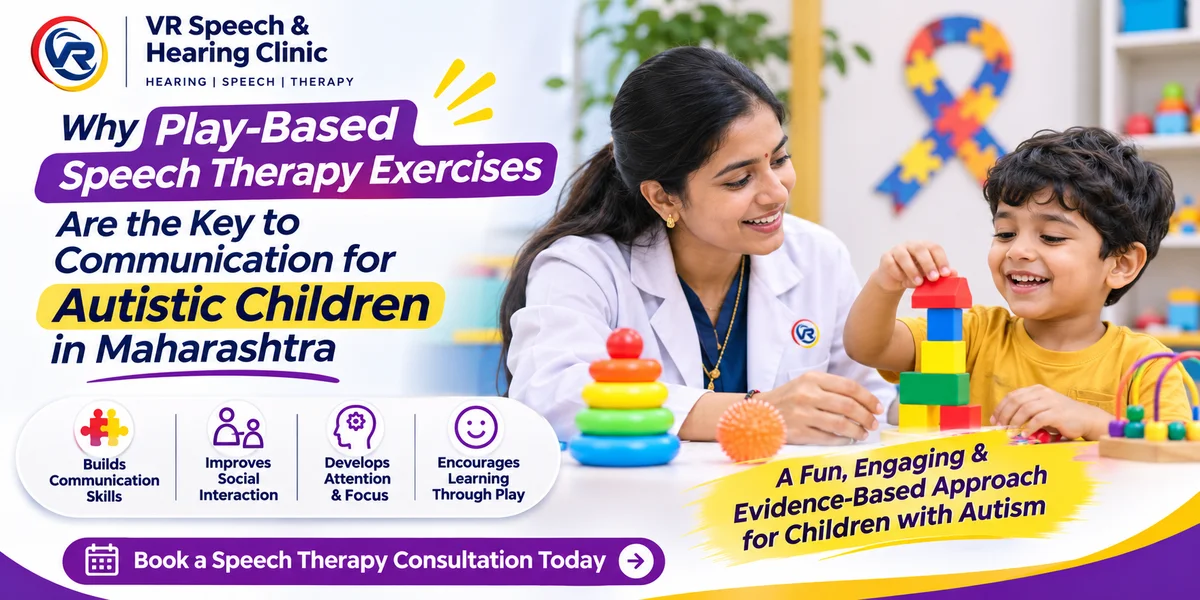
Why Play-Based Speech Therapy Exercises Are the Key to Communication for Autistic Children in Maharashtra
The Role of Speech Therapy in Navigating Autism in Maharashtra
A child who pulls a parent's hand toward the refrigerator is already communicating. The work of speech therapy is to give that intention a word, a sign, or a picture — something the world outside the home can understand too. For families across Maharashtra, from Mumbai's crowded housing societies to smaller towns in Vidarbha, that work usually begins with a diagnosis, and in India that diagnosis is frequently made using the Indian Scale for Assessment of Autism (ISAA), a validated indigenous tool for clinical evaluation. Unlike imported checklists, it was built for the behaviors and family structures clinicians actually see here.
The demand for ASD therapy in India is growing significantly, with the market projected to reach ₹1,893.2 crore by 2034.
That growth matters only if the therapy delivered is the right kind. Structured communication work is being refined and measured — expert-rated communication module sessions have achieved item-content validity index (I-CVI) values between 0.86 and 1.00, and researchers have studied oral placement therapy using B-ARM chewing tubes alongside speech therapy across a 3-month duration. The exercises below translate that rigor into play, as children learn language naturally during activities like playing and snacking.
Foundational Oral Placement and Sound Imitation Exercises
Before words arrive, the jaw, lips, and tongue need stability and awareness. Many autistic children have a strong sensory drive — biting, mouthing, chewing on clothing — and that drive can be redirected into useful motor practice rather than suppressed. Oral placement therapy for children works on this principle: give the mouth organized input, and sound production becomes easier to control. Research evaluating B-ARM chewing tubes combined with speech therapy over a 3-month period reflects how this physical groundwork is being studied formally.
Animal noises. Moo, meow, and bhau-bhau are low-pressure phonemes. The child is playing, not performing, which removes the demand that often triggers shutdown.
Chewing tubes. Used under guidance, they provide rhythmic sensory-motor feedback on the molar surfaces and help build jaw grading.
Essential vowels. Sustained "aa," "ee," and "oo" in front of a mirror, paired with exaggerated mouth shapes the child can copy.
Blowing bubbles. Breath control, lip rounding, and shared attention in one activity — and the bubbles supply their own reward.
Lip rounding with straws. Sipping thick drinks like mango lassi through a narrow straw strengthens the same muscles used for "oo" and "w."
Integrating Communication Strategies into Daily Play
Motor readiness is only useful if the child has a reason to speak. The strongest communication strategies for autism work by engineering that reason into ordinary moments.
The Power of Choice. Hold up two snacks — chikki and a banana — and wait. Offering a genuine choice forces a decision, and a decision invites a label, a point, or a picture card. The child controls the outcome, which is the whole point. Keep choices to two items at first; four options invite overwhelm rather than language.
Motivation-Led Learning. Place a favorite toy visibly out of reach. Not cruelly, and not for long — just long enough that requesting becomes worth the effort. Rote drilling of flashcards rarely transfers to real life, because the child never needed the word in the first place.
Module-Based Play. Structured communication sessions can be designed and then checked by specialists for relevance, with expert-rated communication modules reaching item-content validity index (I-CVI) values between 0.86 and 1.00. For families, the lesson is simpler: follow a plan with a defined sequence rather than improvising differently every day.
Mealtime provides a convenient opportunity for practice. Every bite is a natural request point, repeated several times a day, with no extra scheduling required.
Social Communication and Positive Reinforcement Techniques
Conversation is a social dance before it is a vocabulary test. These exercises build the rhythm of exchange — one person acts, the other responds — and reward the attempt rather than the accuracy.
Reinforcement loops. Reward communication immediately. For some children a hug works; for others, a tickle, a bounce on an exercise ball, or thirty seconds of a favorite song is far more motivating than praise alone. Match the reward to the child's sensory profile.
The waiting game. After asking a question, count silently to ten. Autistic children often need longer processing time, and adults habitually fill the gap before the child can answer.
Mirror mimicry. Sit facing each other and copy the child's sounds and movements first. Being imitated builds the turn-taking loop from the child's side outward.
Picture exchange. Printed cards for water, toilet, outside, and help give a non-speaking child immediate functional power. Laminate them and keep duplicates in every room.
Emotion labeling. Name feelings as they happen — "angry," "tired," "excited" — using exaggerated facial expressions and simple drawings so the vocabulary attaches to something visible.
Keep sessions short and end while the child is still engaged.
Addressing the Intersection of Hearing and Speech in Autism
A child who does not respond to their name might be processing differently or might not be hearing clearly. These two explanations look almost identical from across the room, and families often spend months assuming the first without ruling out the second.
Undiagnosed hearing loss can mimic autism-related communication delays and can also compound them. If sounds reach the brain inconsistently — muffled consonants, missing high frequencies — then every imitation exercise described above is being built on an unstable foundation. Repeated ear infections, fluid behind the eardrum, and congenital hearing differences all occur in autistic children at least as readily as in any other child, and none of them announce themselves clearly in a child with limited speech.
When co-occurring hearing loss is confirmed, properly fitted digital hearing aids can make speech sounds audible and consistent, providing a solid foundation for therapy. Fitting takes patience and repeated adjustment, particularly for children sensitive to touch around the ears.
Expert Tip: Book a professional audiological evaluation before concluding that speech progress has plateaued. For children who find clinics overwhelming — unfamiliar rooms, bright lights, waiting areas — a home-based hearing assessment removes most of the stress and often produces a more accurate picture of what the child can actually hear.
What You Need to Know: Key Takeaways for Families
If you remember nothing else from this guide, hold on to these four points.
Daily beats intensive. Fifteen minutes of play-based practice embedded into snacks, baths, and bedtime routines builds more functional language than one long weekly session the child dreads. Consistency, not duration, drives carryover into real conversation.
Rule out hearing before concluding the plateau is behavioral. When speech progress stalls despite steady effort, an audiologist's assessment should come before any escalation of therapy intensity. Hearing and speech are one system, not two.
Track development with tools built for the Indian context. The Indian Scale for Assessment of Autism (ISAA) is used for clinical evaluation here, and anchoring progress discussions to locally validated assessment keeps expectations realistic rather than imported.
Tailor reinforcement to the sensory profile, not the parenting manual. A reward is only a reward if the child wants it. Deep pressure, movement, music, or a specific texture may motivate far more reliably than verbal praise, and identifying the right one changes how fast everything else moves.
Home exercises support professional care. They do not replace diagnosis or a therapist's ongoing plan.
Taking the Next Step Toward Better Hearing and Speech
The families who see the steadiest progress are rarely the ones doing the most exercises. They are the ones who pair daily at-home speech therapy in Maharashtra with regular professional input — a therapist who adjusts the plan as the child changes, and an audiologist who confirms that every sound the child is being asked to imitate is actually reaching them clearly.
If clinic visits are difficult, home-based hearing assessment and hearing aid fitting let the evaluation happen in the room where your child is already calm. Familiar surroundings mean fewer meltdowns, more cooperation, and results you can trust. Trials and follow-up adjustments can be carried out the same way, so the child never has to re-adapt to a strange environment mid-process.
Clear hearing is essential for effective speech development. Clear, consistent sound input is what makes imitation, labeling, and eventually conversation possible.
Consult a specialist about a hearing evaluation for your child and inquire about home visit options in your area. Whether you are exploring speech therapy for autism in Mumbai or searching for autism printable speech therapy activities to use tonight, the next step is the same: get the hearing checked, then build the language on solid ground.