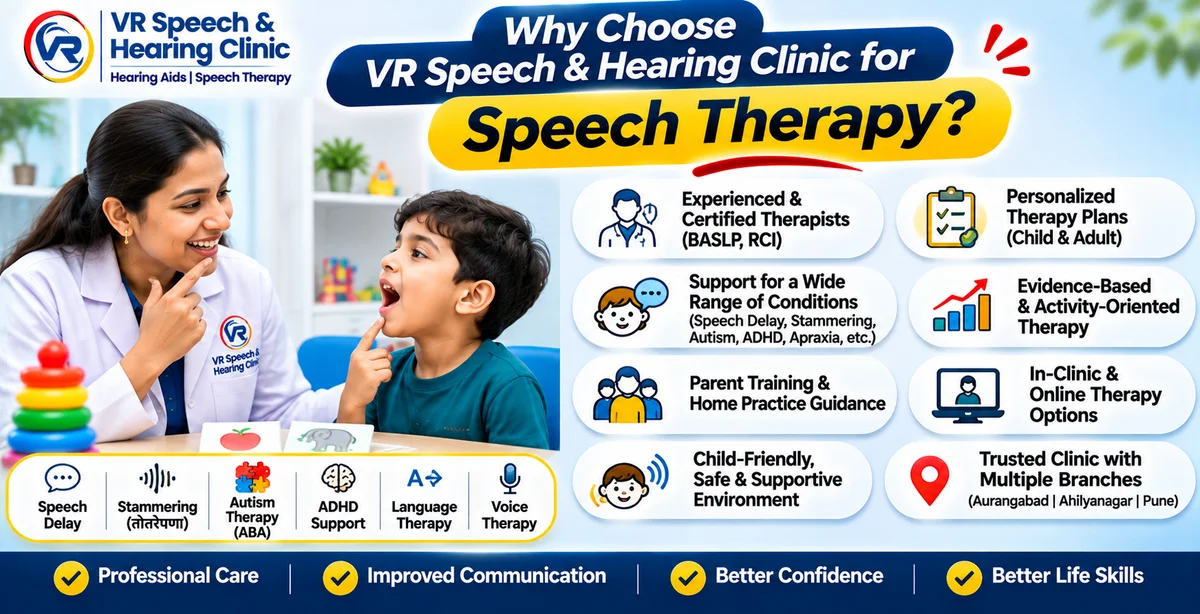
Why Choose VR Speech and Hearing Clinic for Speech Therapy
Why People Choose VR Speech and Hearing Clinic for Speech Therapy
Clear communication shapes how a child learns, how an adult works and how a family stays connected. When speech or language does not develop or function as expected, the right support can change everyday life. That is why many people search for a speech and hearing clinic that offers more than a handful of exercises. VR Speech and Hearing Clinic provides speech therapy built around the individual. It brings together careful assessment, personalised therapy, honest counselling and regular follow-up in one connected journey. Here is why so many families choose the clinic for speech therapy for children and adults, and what you can expect from your first visit.
A Personalised Approach to Speech Therapy
No two people communicate in exactly the same way. A four-year-old with delayed speech, a teenager who stammers and an adult recovering from a stroke each need different support. At VR Speech and Hearing Clinic, therapy begins by listening to the person, to the family and to the concerns that brought them in. Age, medical history, daily communication needs and personal goals all shape the plan.
This is the biggest reason people choose the clinic. Instead of fitting everyone into a fixed routine, the speech therapist designs a programme around what the individual actually needs to say, understand and do in daily life.
Thorough Assessment Before Therapy Begins
Effective speech therapy starts with understanding the problem. The clinic takes a detailed case history, observes how the person speaks, understands and interacts, and chooses assessments according to age, symptoms and clinical need. The goal is not to collect as many test results as possible. It is to select the right tests and read them together, so that strengths, challenges and priorities become clear. Where hearing, language or related conditions may be involved, the assessment looks at those areas too, so nothing important is missed.
Families then receive a plain-language explanation of what the findings mean and what therapy is likely to involve. Knowing what to expect reduces worry and helps parents, partners and carers take an active part in the process.
Support for a Wide Range of Speech and Language Needs
Communication difficulties have many causes and many forms. The clinic supports children and adults with concerns such as:
Speech delay and language delay
Unclear speech and pronunciation errors
Stammering or stuttering
Voice problems such as hoarseness or strain
Communication difficulties linked to autism
Speech and language needs in Down syndrome
Speech concerns related to cleft lip and palate
Speech and language loss after a stroke or brain injury
Communication problems linked to hearing loss
Because each of these conditions affects communication differently, the therapy plan takes the whole person into account, not just the speech symptom.
Child-Friendly Therapy That Keeps Young Learners Engaged
Children learn best when they feel comfortable and motivated. For this reason, sessions for younger clients use structured, goal-oriented activities that feel like play. Each activity has a purpose, whether it is building vocabulary, improving sound production, encouraging turn-taking or strengthening understanding of language.
Parents are treated as partners. They are shown simple strategies to use during everyday routines such as mealtimes, bath time and story time, which helps new skills carry over from the therapy room into real life. Practising at home, even for a few minutes a day, often makes a visible difference.
Where Speech and Hearing Come Together
Speech and hearing are closely linked. A child who cannot hear sounds clearly may struggle to produce them, and an adult may hear speech but still find it hard to understand in a noisy room. Because VR Speech and Hearing Clinic looks after both, hearing can be checked as part of the communication picture rather than as a separate problem.
This joined-up care is a real advantage. Where it is clinically appropriate, assessment can include hearing tests, speech recognition and speech-in-noise measures. The speech therapist and audiologist can then work from the same information. That means fewer repeat appointments, clearer answers and a rehabilitation plan that addresses listening as well as speaking.
Clear Counselling and Family Involvement
Many people arrive with questions. Is this delay normal? Will my child catch up? How long will therapy take? Honest, patient-specific counselling is a core part of the service. Explanations are based on the individual’s own assessment findings, not a generic script, so families understand the reasons behind each recommendation.
Counselling also covers practical matters such as school support, workplace communication, home practice and realistic goals. When families feel informed and included, they make decisions with more confidence and stay committed to therapy for longer.
Follow-Up That Supports Lasting Progress
Speech therapy is rarely a one-visit solution. Progress happens over weeks and months, and goals change as skills develop. The clinic treats follow-up as part of therapy, not an optional extra. Progress is reviewed regularly, activities are updated and guidance is adjusted as the person moves forward. Home programmes and review sessions keep families on track between visits.
This steady, monitored approach keeps therapy focused on outcomes that matter. These might be a child speaking clearly enough to be understood at school, a teenager presenting with greater confidence, or an adult returning to conversations they once avoided.
Speech Therapy for Every Age
Communication support is not only for young children. Adults often hesitate to seek help, assuming speech difficulties are permanent or embarrassing. In reality, therapy can improve fluency, voice quality and clarity at any age. The clinic welcomes:
Toddlers and preschoolers with late talking or unclear speech
School-age children with articulation, language or fluency concerns
Teenagers who want to improve confidence and clarity
Adults with voice, fluency or neurological communication difficulties
Older adults whose communication has changed after illness or hearing loss
Each age group has different priorities, and sessions are adapted accordingly.
Signs It May Be Time to Book an Assessment
If you are unsure whether therapy is needed, an assessment can give a clear answer. You may wish to seek advice if you notice that:
A child uses very few words or is not combining words by around two years of age
Others find it hard to understand a child’s speech
Someone repeats sounds or words, or gets stuck while speaking
A voice is regularly hoarse, weak or strained
A person has difficulty finding words or following conversations after a stroke
Someone often asks others to repeat themselves or seems to mishear speech
Early support usually leads to better progress, so there is no need to wait and worry.
A Comfortable, Trustworthy Experience
Choosing a speech therapist is a personal decision, and trust matters. People return to VR Speech and Hearing Clinic because they feel heard, understood and respected. Sessions are paced to suit the individual, questions are welcomed and progress is explained in simple terms. Whether the client is a nervous toddler or an adult who feels self-conscious about speaking, the aim is to create an environment where communication feels safe.
Why Families Choose VR Speech and Hearing Clinic
To sum up, people choose the clinic for speech therapy because the care is:
Personalised to age, condition and goals
Based on careful assessment and clear interpretation
Connected to hearing care for a complete view of communication
Engaging and child-friendly for younger clients
Supported by counselling and family involvement
Backed by regular follow-up and progress review
Conclusion
Good speech therapy is more than a series of sessions. It is a partnership built on understanding the person, planning with purpose and staying alongside them as they progress. VR Speech and Hearing Clinic brings these elements together, helping children and adults move from uncertainty to clearer, more confident communication.
If you or someone in your family is struggling with speech, language, voice or hearing, take the first step today. Book a speech therapy assessment at VR Speech and Hearing Clinic and start a plan that fits your needs.
FAQs
1. What does a speech therapist do?
A speech therapist assesses and treats difficulties with speech, language, voice, fluency and communication. They create a personalised plan, guide therapy sessions and teach families strategies to practise at home.
2. At what age should a child start speech therapy?
Therapy can begin as soon as a concern is noticed, even in toddlers. Early support usually leads to better progress, so it is best to book an assessment rather than wait and see.
3. How long does speech therapy take to show results?
It depends on the person’s age, condition and consistency of practice. Some children show improvement within a few weeks, while others need longer-term support. Regular follow-up helps track progress.
4. Can adults benefit from speech therapy?
Yes. Adults can receive support for stammering, voice problems, and speech or language changes after a stroke or injury, as well as for general clarity and confidence in speaking.
5. Why is hearing checked when there is a speech problem?
Hearing affects how speech is learned and understood. Checking hearing helps rule out or identify hearing loss as a contributing factor, so the therapy plan addresses the real cause.
6. What should I bring to the first appointment?
Bring any previous medical, hearing or speech reports, a list of your concerns, and feedback from school or the workplace if relevant. For children, notes on when they first spoke can also help.
7. How do I book a speech therapy assessment?
Contact VR Speech and Hearing Clinic by phone or through the clinic’s enquiry form to schedule an appointment at a convenient time.