Tympanometry Test Price in India vs PTA Test: Cost, Differences and Which One You Need
Tympanometry Test Price in India vs PTA Test: Cost, Differences and Which One You Need
If you have searched for the tympanometry test price in India, you probably have a bigger question: what is this test, and do I need it on top of a regular hearing test? Many patients at VR Speech and Hearing Clinic ask us exactly this. The short answer is that tympanometry and the PTA (pure tone audiometry) test look at two different parts of your hearing. This guide explains both tests, what affects their cost and how to decide which one you need.
Quick Summary
Tympanometry checks how well your eardrum and middle ear move.
The PTA test measures the softest sounds you can hear at different pitches.
Tympanometry is painless and needs no response from you.
Prices vary by clinic, city and what is included in the package.
PTA is the base test for hearing aid decisions. Tympanometry is added when there is a reason.
What Is a Tympanometry Test?
Tympanometry, also called impedance audiometry, is a quick middle-ear test. It shows how freely the eardrum moves when the air pressure in the ear canal changes gently. A healthy eardrum moves easily. If fluid, pressure problems or stiffness are present, the movement changes, and the machine records this as a graph called a tympanogram.
Tympanometry does not tell you how softly you can hear. It tells your audiologist how the middle ear is working, which helps explain why hearing may be reduced.
How Is Tympanometry Done? Does It Hurt?
It does not hurt, and you do not need to respond to anything. Most people feel only slight pressure and hear a low humming tone. The steps are simple:
The audiologist checks the ear canal to make sure it is clear.
A soft probe tip is placed at the opening of the ear canal to create a seal.
Air pressure changes smoothly while a tone plays.
The machine records how the eardrum responds and draws the graph.
Both ears are tested one after the other, and the whole measurement usually takes only a few minutes. Stay still, and avoid talking, swallowing or moving your head during the test, because this can disturb the reading. This is why the test works well for children and for adults who find other tests tiring.
How Much Does a Tympanometry Test Cost in India?
There is no single fixed price across the country. The cost depends on several factors:
Stand-alone test or package: A single test is often charged differently from a full assessment with consultation.
Type of centre: Hospital ENT departments, diagnostic labs and audiology clinics set their own charges.
Additional tests: Speech audiometry or other measures may be billed separately.
City: Rates often differ between metro cities and smaller towns.
As a rough guide, tympanometry in India is generally affordable and commonly falls somewhere between a few hundred rupees and around ₹1,500, depending on the centre and what is included. Treat this only as an estimate. The best approach is to ask the clinic for the amount in writing and check exactly which tests the price covers. A low price for one test can end up higher than a complete package once extras are added.
What Do Type A, B and C Tympanogram Results Mean?
The result is a graph, and audiologists describe its shape using broad labels. These are patterns, not diagnoses.
Type A: A clear peak near normal pressure. The eardrum and middle ear are moving as expected.
Type B: A flat line with no clear peak. This means very little eardrum movement. There can be several reasons, so it is read together with your symptoms and, where needed, a doctor’s opinion is advised.
Type C: A peak shifted towards negative pressure. The middle ear may not be equalising pressure well, which can happen around a cold or congestion.
Sub-types such as As and Ad also exist. Whatever the letter, the result is always interpreted along with your PTA findings and your symptoms.
What Is the PTA Test?
Pure tone audiometry is the standard hearing test. You sit in a quiet room and wear headphones. You hear tones at different pitches and volumes, and you signal each time you hear one. The softest level you can hear at each pitch is recorded on a chart called an audiogram.
The PTA test usually takes about 20 to 30 minutes. It shows the degree of hearing loss, whether it affects low or high pitches and whether both ears are equally affected. It is also the foundation for programming hearing aids correctly. In India, the PTA test is often cheaper than people expect, and many clinics offer it free or at a low cost.
Tympanometry vs PTA: What Is the Difference?
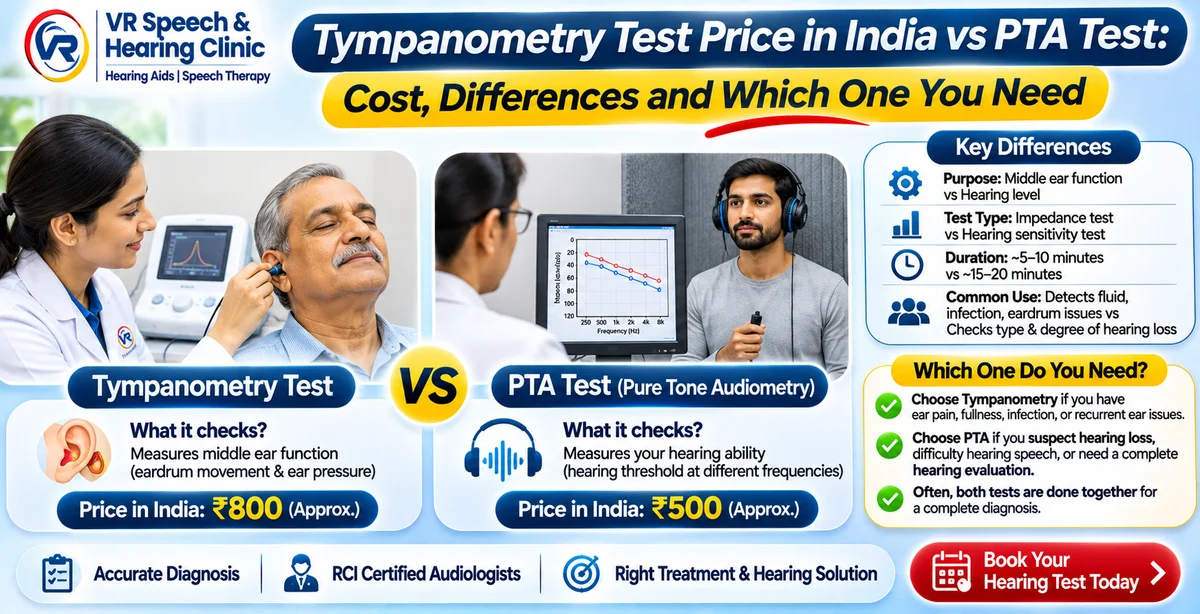
Think of it this way: tympanometry checks the machinery of the middle ear, while PTA checks what you actually hear.
What is checked: Tympanometry looks at middle-ear and eardrum movement. PTA looks at the softest sounds you can hear at different pitches.
Your role: In tympanometry you only sit still. In PTA you respond every time you hear a tone.
Setup: Tympanometry uses a probe at the ear canal opening. PTA uses a soundproof room, headphones and an audiometer.
Time: Tympanometry takes a few minutes. PTA takes around 20 to 30 minutes.
Result: Tympanometry gives a tympanogram. PTA gives an audiogram.
A tympanogram helps show where to look, and the audiogram shows how much hearing support may be needed. Together they give a much clearer picture than either one alone.
Do You Need Both Tests Before Buying a Hearing Aid?
The PTA test is essential for every hearing aid decision. Without an audiogram, a device cannot be programmed accurately for your hearing loss.
Tympanometry is added when your audiologist wants middle-ear information. This may be because you feel a blocked or full ear, you have had a recent cold or ear infection, or your audiogram shows a pattern that suggests a conductive component. So the simple rule is PTA always, tympanometry when there is a reason.
Who Should Ask About Tympanometry?
You may want to raise it with your audiologist if you notice any of the following:
A feeling of fullness or pressure in the ear that does not clear
Hearing that drops and returns around colds
Muffled hearing after flying or a sinus problem
A child who responds less than before or often complains of ear discomfort
A PTA result where air and bone conduction readings do not match
A sudden drop in hearing is different. It needs prompt medical attention and should not wait for a routine appointment.
When Should You See an ENT Specialist First?
A flat or unusual tympanogram can go along with conductive hearing loss, where sound struggles to pass through the outer or middle ear. Audiologists test hearing and recommend hearing solutions, but they do not treat ear disease or prescribe medicines. If your results point to a medical cause, you will be advised to consult an ENT specialist first. Hearing aids come into the picture afterwards, if hearing support is still needed.
Why Choose VR Speech and Hearing Clinic?
At VR Speech and Hearing Clinic, we believe a good hearing journey starts with clear answers. Our audiologists explain each test in simple words, show you your results and tell you honestly which tests you need and which you do not. We discuss the cost in advance, so there are no surprises, and we never push a device before your hearing is properly assessed.
Conclusion
Tympanometry and the PTA test answer two different questions. Tympanometry shows how your middle ear is working, and PTA shows how well you hear. The tympanometry test price in India cannot be pinned to one number, so always ask what is included before you book. If you are unsure which test suits you, visit VR Speech and Hearing Clinic, and our audiologists will guide you step by step.
Frequently Asked Questions
Is the tympanometry test painful?
No. You may feel brief pressure and hear a humming tone while the probe sits at the ear canal opening, but there is no pain.
How long does a tympanometry test take?
The measurement itself usually takes only a few minutes for both ears. The visit is longer if a PTA test and consultation are done as well.
What is the tympanometry test price in India?
It varies by clinic, city and the tests included. Ask for the amount in writing and check what the figure covers.
Is tympanometry the same as a hearing test?
No. Tympanometry checks how the middle ear and eardrum move. A hearing test such as PTA measures the softest sounds you can hear.
Can earwax affect the tympanometry result?
Yes. A blocked ear canal can stop the probe from sealing properly, so the canal is checked first. Excess wax is usually removed by a doctor.
Is tympanometry safe for children?
Yes. It is quick, painless and needs no response, which makes it suitable for children and even infants.