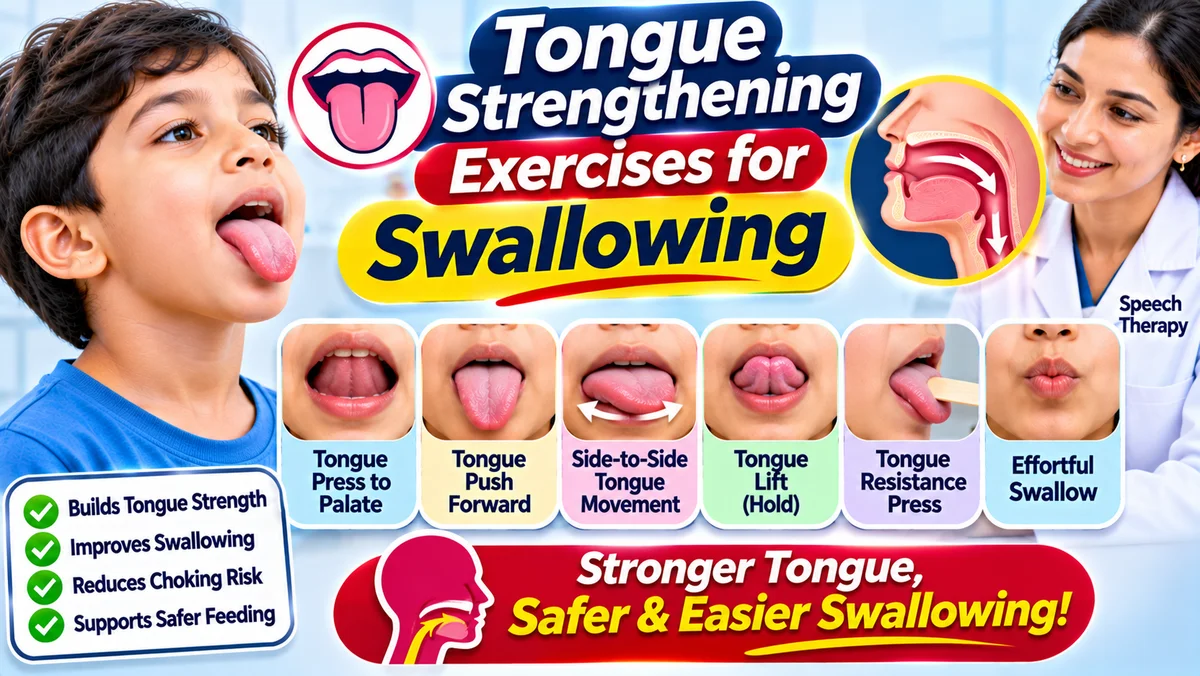
Tongue Strengthening Exercises for Speech Therapy
Tongue Strengthening Exercises for Speech Therapy: A Complete Guide
The tongue is one of the hardest-working muscles in the body. It shapes nearly every speech sound, moves food around the mouth, and triggers the swallow. When it is weak, slow, or poorly coordinated, speech can sound unclear and eating can feel tiring. That is why tongue strengthening exercises are a regular part of speech therapy for children and adults. This guide explains what these exercises are, who they help, and eight practical moves to discuss with a speech-language pathologist (SLP).

What Are Tongue Strengthening Exercises?
Tongue strengthening exercises are targeted movements that build the strength, range of motion, and coordination of the tongue. Most involve pushing the tongue against resistance, such as the roof of the mouth, the inside of the cheek, a clean spoon, or a clinical pressure device. Some also train speed and accuracy, which matter as much as raw strength for clear speech.
One important point: research is mixed on whether strength drills alone fix speech sound errors in children, so SLPs usually pair them with direct sound practice. For adults with swallowing problems or neurological conditions, tongue strength training has stronger support.
Ebook Download स्पीच थेरपी ॲक्टिव्हिटी बुक | मुलांच्या भाषा व संवाद विकासासाठी
Ebook Download बोबडेपणा किंवा तोतरेपणा आहे?
Ebook Download स्पीच थेरपीसाठी मार्गदर्शक
Why Tongue Strength and Control Matter
Clear speech depends on precise tongue placement. Sounds such as t, d, l, n, s, z, r, k, and g all need the tongue to reach exact positions quickly. Swallowing relies on the tongue pressing food and liquid against the palate to move it safely toward the throat. Good tongue control also supports chewing and a healthy resting tongue posture.
Who Can Benefit From Tongue Exercises?
Speech therapy tongue exercises may help:
Children with lisps, articulation errors, tongue thrust, or low oral muscle tone
Adults recovering from stroke or brain injury
People with Parkinson’s disease, ALS, or other conditions that cause slurred speech (dysarthria)
Patients with swallowing difficulty (dysphagia), including after head and neck cancer treatment
People who need to build tongue mobility after a tongue-tie release
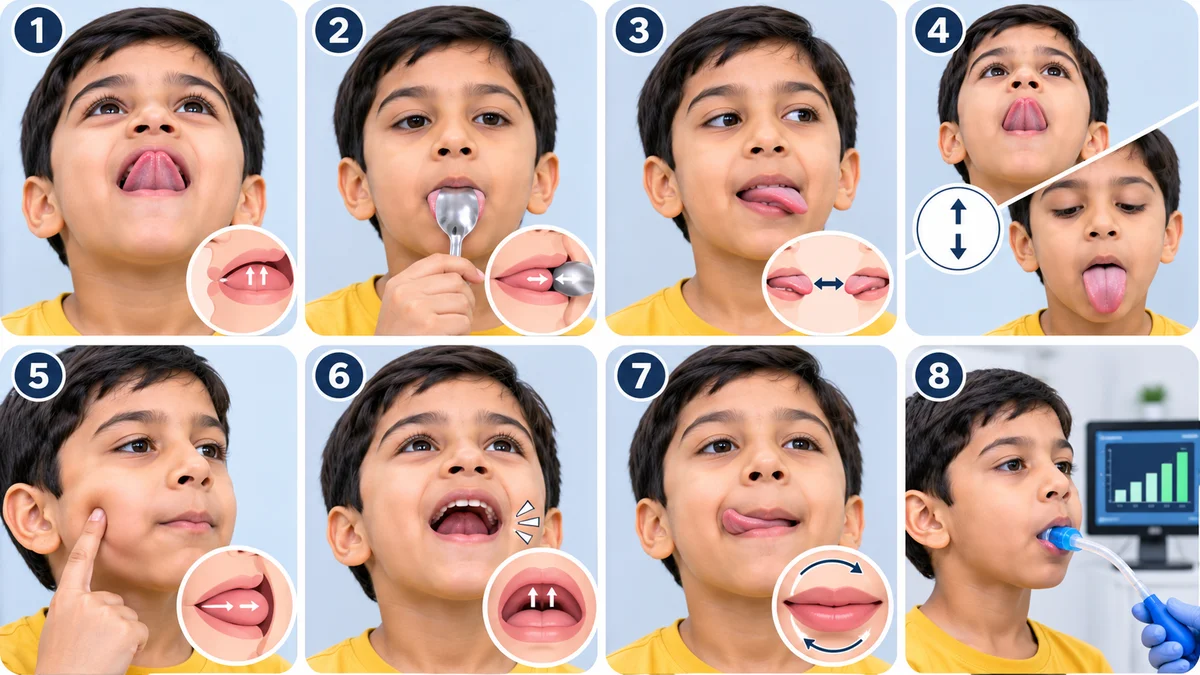
8 Tongue Strengthening Exercises Used in Speech Therapy
1. Tongue Push-Ups
Place the tip of your tongue on the ridge just behind your upper front teeth. Press upward against the roof of your mouth for five seconds, then relax. Repeat ten times. This builds the tongue tip strength needed for t, d, l, and n sounds.
2. Spoon Resistance Press
Hold the back of a clean spoon or a tongue depressor in front of your lips. Push your tongue forward against it while the spoon pushes back gently. Hold for five seconds and repeat ten times. It is a simple way to add resistance at home.
3. Side-to-Side Reaches
Stick your tongue out and touch the left corner of your mouth, then the right. Move slowly and keep the tongue straight. Aim for ten reaches each way, then add speed as control improves. This improves the sideways control used in chewing and in sounds like s and sh.
4. Up-and-Down Reaches
Stretch your tongue tip toward your nose, then down toward your chin. Hold each position for three seconds and do ten rounds. This increases range of motion, which is useful when tongue movement feels limited or after a tongue-tie release.
5. Cheek Push
Press your tongue firmly into the inside of one cheek while resisting lightly from the outside with a clean finger. Hold for five seconds, then switch sides. Do ten repetitions per side. This strengthens the sides of the tongue and the cheek muscles together.
6. Tongue Clicks
Suction your whole tongue to the roof of your mouth, then pull it down to make a clicking sound. Do 15 clicks. This works the middle and back of the tongue and encourages a proper resting position against the palate.
7. Lip Circles
Slowly sweep your tongue tip around the outside of your lips, ten times clockwise and ten times counterclockwise. Keep your head still and your jaw steady. This trains coordination and endurance.
8. Pressure Biofeedback Training
In the clinic, SLPs may use a small air-filled bulb placed on the tongue to measure how hard it presses against the palate. A screen shows progress, which keeps motivation high and lets therapists set precise targets. This is commonly used in swallowing therapy and should only be done with a professional.
How Often Should You Practice?
Short, frequent sessions work best. Aim for five to ten minutes once or twice a day, unless your SLP recommends a different plan. Start with five to ten repetitions of each exercise, rest between sets, and increase gradually. Tracking your practice in a simple notebook helps you notice improvement. Strength gains usually take several weeks of consistent effort.
Safety Tips
Wash your hands and any tools before you begin, and never use sharp objects. Stop if you feel pain, dizziness, jaw clicking, or unusual fatigue. Supervise children and keep the exercises playful, such as using a mirror or turning reps into a game. Check with a professional first if you have had recent oral surgery, a jaw problem, or a medical condition that affects swallowing.
When to See a Speech-Language Pathologist
Book an assessment if speech stays unclear, if you or your child cough or choke while eating or drinking, if there is drooling, or if tongue movement seems limited. A licensed SLP can check how your tongue moves, explain what is causing the problem, and design a plan that fits your goals. Sudden changes in speech, a drooping face, or sudden trouble swallowing can signal a stroke and need emergency medical care.
Final Thoughts
Tongue strengthening exercises can support clearer speech, safer swallowing, and better oral control when practiced consistently and correctly. Start with gentle, simple movements, practice a little every day, and work with a licensed speech-language pathologist to tailor the plan to your needs.
Frequently Asked Questions (FAQs)
How long do tongue strengthening exercises take to work?
Most people need several weeks of regular practice to notice a difference. Progress depends on age, the underlying cause, and how consistently you practice. Your SLP can set realistic timelines after an assessment.
Can tongue exercises fix a lisp?
They can help when weak or poorly controlled tongue movement is part of the problem, but they rarely work alone. Therapy for a lisp usually combines tongue exercises with direct practice of the target sounds.
Are tongue exercises safe for children?
Yes, when they are gentle, supervised, and guided by an SLP. Keep sessions short and fun, use clean tools, and stop if your child shows discomfort.
Do tongue exercises help with swallowing problems?
Tongue strength training has good support for swallowing therapy, especially in adults with dysphagia. It should be guided by an SLP, because swallowing problems have many possible causes.
Can adults do tongue exercises after a stroke?
Yes. SLPs often include tongue exercises in stroke rehabilitation to improve speech clarity and swallowing. Start only with medical clearance and a personalized plan.