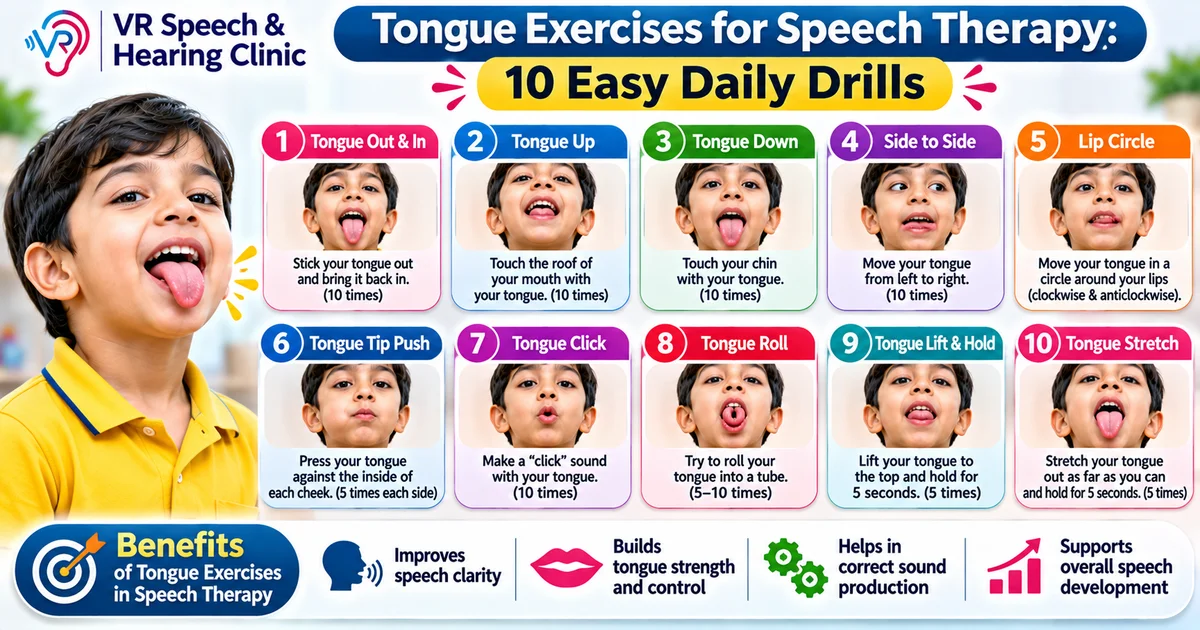
Tongue Exercises for Speech Therapy: 10 Easy Daily Drills
Tongue Exercises for Speech Therapy: A Practical Guide to Clearer Speech
Your tongue is one of the hardest-working muscles in your body. Every time you say “t,” “s,” “l,” or “r,” it moves fast and with great precision. When it is weak, stiff, or poorly coordinated, speech can sound slurred, lisped, or hard to understand. That is where tongue exercises for speech therapy come in.
This guide explains how these exercises work, who can benefit, and ten simple drills you can start at home. It also covers a short daily routine and when to ask a speech-language pathologist for help.
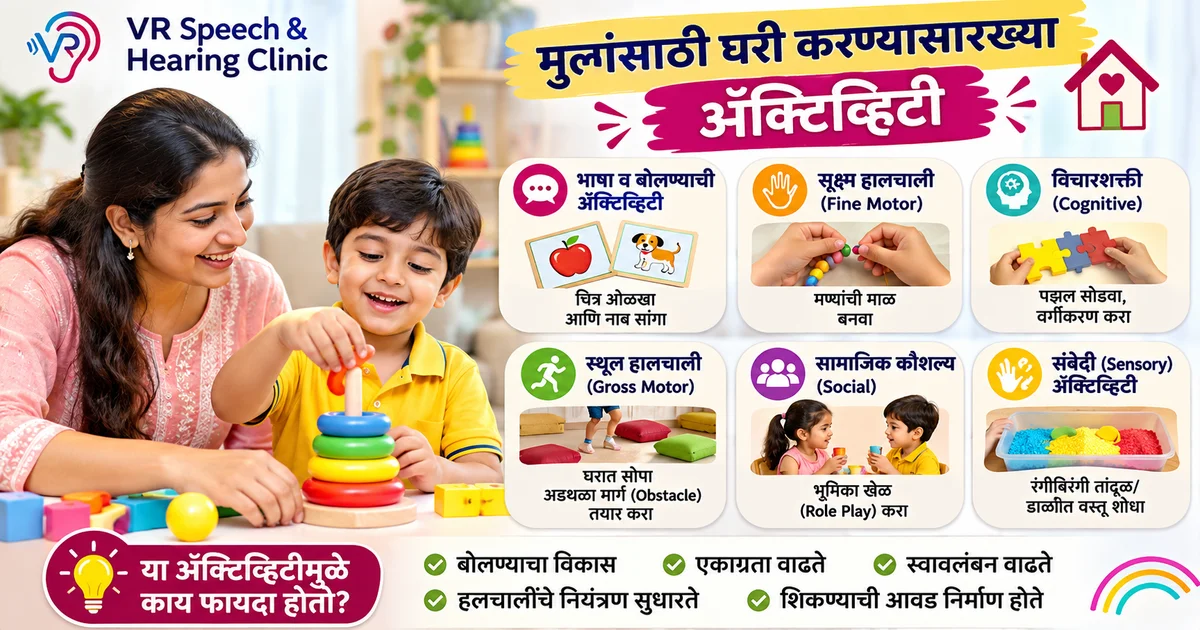
Ebook Download स्पीच थेरपी ॲक्टिव्हिटी बुक | मुलांच्या भाषा व संवाद विकासासाठी
Why the Tongue Matters for Clear Speech
The tongue shapes almost every sound we make. It touches the ridge behind the upper teeth for “t,” “d,” “n,” and “l.” It lifts toward the soft palate for “k” and “g.” It narrows into a groove for “s” and “z,” and it bunches and pulls back for “r.” Four abilities matter most: strength, range of motion, speed, and control.
Tongue exercises, often called oral motor exercises, target those four abilities. Research on exercises done without speech is mixed, so good therapists pair them with real sound practice. That combination is what tends to bring lasting results.
Who Can Benefit from Tongue Exercises?
Tongue exercises are used with many age groups and needs, including:
Children and adults with articulation errors, such as a lisp or trouble with the “r” sound
People with tongue thrust or an immature swallowing pattern
Adults recovering from stroke, brain injury, or mouth surgery
People with Parkinson’s disease or other motor speech conditions (dysarthria)
Anyone regaining tongue movement after a tongue-tie release
Singers, speakers, and English learners working on clarity or accent
Some of these situations need a therapist’s guidance before you start, so use this list as a starting point, not a diagnosis.
Before You Begin: Simple Ground Rules
A few habits make practice safer and more effective:
Practice in front of a mirror so you can see what your tongue is doing.
Do not eat or drink during the exercises.
Aim for a gentle stretch, never pain. Stop if you feel soreness, dizziness, or jaw tension.
Keep your jaw as still as possible so the tongue does the work.
Practice for 5 to 10 minutes, two or three times a day. Short and regular beats long and rare.
Breathe steadily and keep your face relaxed.
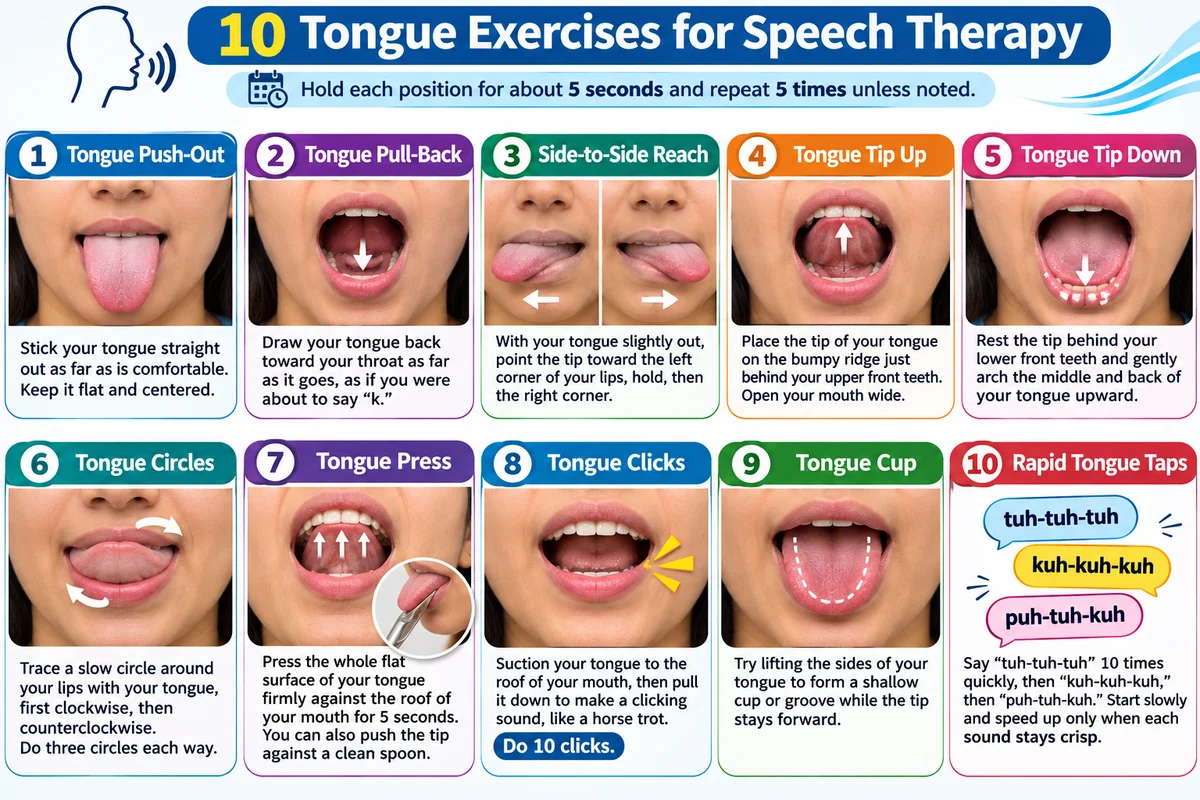
10 Tongue Exercises for Speech Therapy
Hold each position for about five seconds and repeat five times unless noted.
1. Tongue Push-Out
Stick your tongue straight out as far as is comfortable. Keep it flat and centered, without letting it drift to one side. This builds range of motion and helps you notice any weakness or deviation.
2. Tongue Pull-Back
Draw your tongue back toward your throat as far as it goes, as if you were about to say “k.” Relax and repeat. This supports the back-of-tongue sounds “k” and “g.”
3. Side-to-Side Reach
With your tongue slightly out, point the tip toward the left corner of your lips, hold, then the right corner. Keep the movement slow and controlled. This improves the sideways control needed for sounds like “s,” “sh,” and “ch.”
4. Tongue Tip Up
Place the tip of your tongue on the bumpy ridge just behind your upper front teeth. Open your mouth wide while keeping the tip in place. This builds the lifting control used for “t,” “d,” “n,” and “l.”
5. Tongue Tip Down
Rest the tip behind your lower front teeth and gently arch the middle and back of your tongue upward. This separates tip movement from back movement, which helps with clean “k” and “g” sounds.
6. Tongue Circles
Trace a slow circle around your lips with your tongue, first clockwise, then counterclockwise. Do three circles each way. This warms up the whole muscle and improves coordination.
7. Tongue Press
Press the whole flat surface of your tongue firmly against the roof of your mouth and hold for five seconds. You can also push the tip against a clean spoon. This is a basic strengthening exercise, and strength is a key goal for many adults in therapy.
8. Tongue Clicks
Suction your tongue to the roof of your mouth, then pull it down to make a clicking sound, like a horse trot. Do ten clicks. Each click requires the whole tongue to lift and release, which builds elevation and control.
9. Tongue Cup
Try lifting the sides of your tongue to form a shallow cup or groove while the tip stays forward. This shape is important for “s” and “sh.” Some people find it tricky at first, and that is normal. Not everyone can roll their tongue, and you do not need to for clear speech.
10. Rapid Tongue Taps
Say “tuh-tuh-tuh” ten times quickly, then “kuh-kuh-kuh,” then “puh-tuh-kuh.” Start slowly and speed up only when each sound stays crisp. This builds speed and the rhythm of speech movement.
Turn Exercises into Real Speech
Exercises only help if they carry over into talking. Once a movement feels easier, move on to sound practice:
Say the target sound alone, such as “s,” five times.
Say it in simple words, such as “sun,” “soup,” and “bus.”
Move to short phrases and sentences.
Use the sound in everyday conversation.
For tongue-tip sounds, try words like “tiger,” “ladder,” and “noodle.” For back-of-tongue sounds, try “cake,” “goat,” and “monkey.” Go slowly and listen for clear, steady sounds.
A Simple 10-Minute Daily Routine
Warm-up (2 minutes): Push-out, pull-back, and side-to-side reach
Strength (3 minutes): Tongue press, tongue tip up, and tongue cup
Coordination (2 minutes): Tongue circles and tongue clicks
Sound practice (3 minutes): Rapid taps and your target words
Practice at the same times each day, such as after brushing your teeth, so it becomes a habit.
Tips for Making Tongue Exercises Fun for Kids
Children rarely enjoy drills, so turn them into play. Use a mirror and make silly faces together, pretend to be a lizard flicking its tongue, or have your child lick a thin smear of a safe food from their upper lip. Skip that last one if there are any food allergies.
Keep sessions to three to five minutes, praise effort rather than perfection, and join in yourself so your child can copy you. Never force a movement. If your child gets frustrated, stop and try again later.
Common Mistakes to Avoid
Moving the jaw too much. The jaw should stay steady so the tongue learns independent movement.
Rushing. Fast, sloppy movements build bad habits.
Pushing through pain. A stretch is fine, pain is not.
Practicing inconsistently. Muscles respond to regular training.
Doing exercises without speech practice. Always connect movements to real sounds.
Self-diagnosing. The same sound error can have very different causes, so a professional assessment matters.
When to See a Speech-Language Pathologist
Home exercises are helpful, but they are not right for every situation. Consider an evaluation if:
A child’s speech is hard to understand for their age, or a lisp persists beyond the early school years
You notice limited tongue movement, such as a heart-shaped tongue tip when sticking it out
Eating, chewing, or swallowing is difficult
Speech has changed after a stroke, injury, or surgery
Practice at home shows no progress after several weeks
Important: Sudden slurred speech, tongue weakness, or facial drooping can be signs of stroke. Seek emergency medical care right away and do not wait to try exercises.
How VR Speech and Hearing Clinic Can Help
Speech and hearing are closely linked. If you cannot hear sounds clearly, you may not produce them clearly either. At VR Speech and Hearing Clinic, an assessment looks at how you speak, how your tongue and mouth move, and how well you hear, so the real cause of unclear speech is addressed.
From there, a speech-language pathologist can build a personalized plan with the right exercises, the right number of repetitions, and sound practice suited to your age and goals. Progress is tracked over time, and exercises are adjusted as you improve.
Final Thoughts
Tongue exercises for speech therapy can strengthen movement, improve control, and support clearer speech when practiced safely and consistently. Start slowly, use a mirror, stay gentle, and always link movements to real sounds. If progress stalls or you are unsure where to begin, professional guidance can save you time and frustration.
Ready for clearer communication? Book an assessment with VR Speech and Hearing Clinic and take the first step toward confident speech.
Frequently Asked Questions (FAQs)
1. Do tongue exercises really improve speech?
They can help when the problem involves weakness, limited movement, or poor coordination. They work best when combined with practice of actual speech sounds, since research on exercises alone is mixed.
2. How often should I do tongue exercises?
Most people practice two to three times a day for 5 to 10 minutes. Consistency matters more than session length.
3. How long does it take to see results?
It varies with age, the cause of the speech difficulty, and how regularly you practice. Some people notice changes in a few weeks, while others need several months of therapy.
4. Can children do tongue exercises at home?
Yes, with supervision. Keep them short and playful, and have a speech-language pathologist confirm which exercises suit your child.
5. Can tongue exercises fix a lisp?
They can help build the tongue control needed for “s” and “z,” but a lisp usually also needs targeted sound practice. An assessment can identify the exact pattern.
6. Are tongue exercises safe for adults after a stroke?
They are commonly used in stroke rehabilitation, but they should be guided by a therapist because every person’s weakness and safety needs are different.
7. What if I cannot roll my tongue?
That is perfectly normal. Tongue rolling is not required for clear speech, and other exercises can build the same control.