
Tongue Depressor Exercises for Strength: 7 Simple Moves
Tongue Depressor Exercises for Strength: 7 Simple Moves to Build a Stronger Tongue
Your tongue is a group of powerful muscles that helps you chew, swallow, speak clearly, and even keep your airway open. Like any muscle, it can weaken with age, illness, or lack of use. Tongue depressor exercises for strength are a simple, low-cost way to add gentle resistance and train these muscles at home. This guide explains what the exercises are, how to do them safely, and how to build a routine that works.
Ebook Download स्पीच थेरपी ॲक्टिव्हिटी बुक | मुलांच्या भाषा व संवाद विकासासाठी
What Are Tongue Depressor Exercises?
A tongue depressor is a thin, flat wooden stick that doctors use to hold the tongue down during a throat exam. In oral motor and speech therapy, the same tool has a different job: it gives your tongue something light to push against. When you press your tongue into the stick, the muscles work harder, much like pushing against a small hand weight. This is resistance training, and it is the idea behind many tongue strengthening exercises.
Why Tongue Strength Matters
A stronger, more coordinated tongue can support several everyday functions:
Swallowing: The tongue pushes food and liquid toward the throat. Research on tongue-strengthening programs suggests they may improve swallowing function in some people.
Speech clarity: Precise tongue movement shapes sounds like “t,” “d,” “l,” and “s.”
Chewing: The tongue moves food around the mouth so it can be chewed evenly.
Oral posture: Good tongue control helps with resting position and mouth breathing habits.
Airway support: Studies of broader oropharyngeal exercise programs suggest they may reduce snoring and mild sleep apnea symptoms in some adults.
Results vary from person to person, and these exercises are not a replacement for medical treatment.

Before You Start: Safety and Setup
Tongue exercises are gentle, but a few precautions make them safer:
Wash your hands and use a new, clean, disposable tongue depressor each session. Never share one.
Check the stick for splinters or rough edges before every use.
Sit upright in front of a mirror so you can watch your form.
Use light pressure. Your tongue should do the work, not your hand.
Keep the stick toward the front of the tongue to avoid triggering your gag reflex.
Stop if you feel pain, dizziness, or jaw strain.
Speak with a doctor or speech-language pathologist first if you have swallowing difficulty, recent oral surgery, a neurological condition, jaw pain, or a tongue-tie.
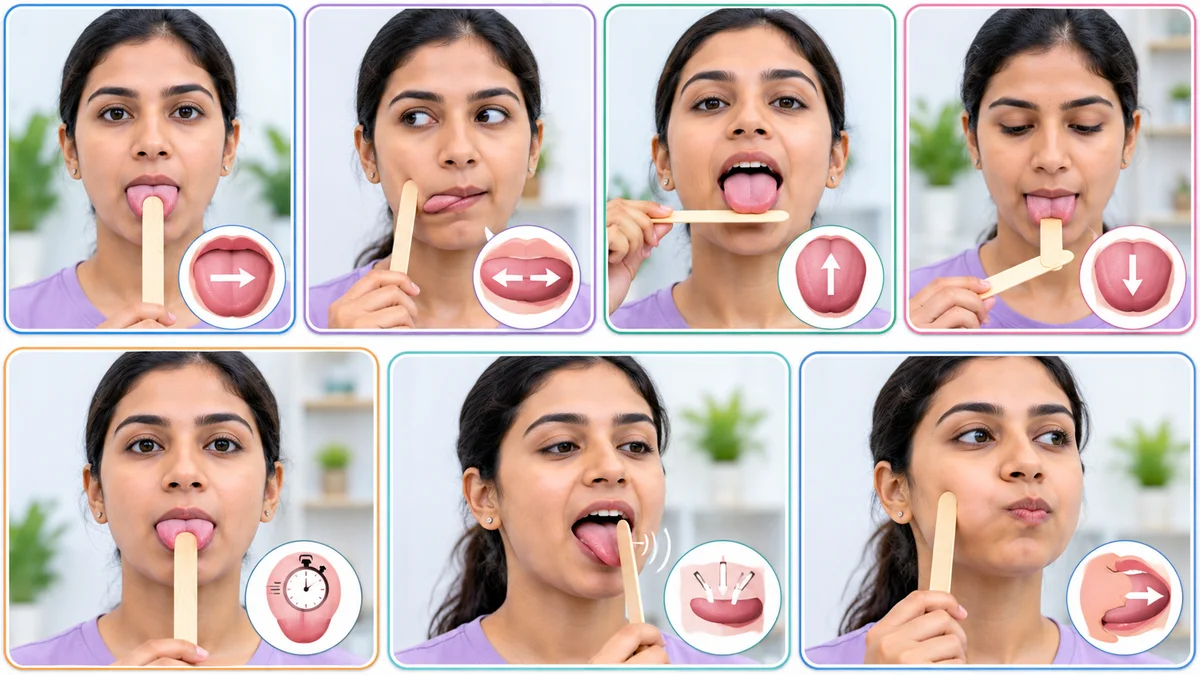
7 Tongue Depressor Exercises for Strength
1. Forward Push
Hold the depressor upright in front of your lips. Stick your tongue out and push the tip firmly but gently against the stick. Hold for 5 seconds, then relax. Repeat 8 to 10 times. This builds forward tongue strength, which supports swallowing and speech.
2. Side-to-Side Resistance
Place the stick at the right corner of your mouth. Push the tip of your tongue to the right against the stick and hold for 5 seconds. Switch to the left side. Do 5 to 8 reps per side. This improves lateral control, which helps you move food during chewing.
3. Upward Lift
Stick your tongue out slightly and place the depressor flat underneath it. Lift your tongue tip upward as the stick offers light downward resistance. Hold for 3 to 5 seconds and repeat 8 times. This targets the muscles used to press food against the roof of the mouth.
4. Downward Press
Place the depressor flat on top of your extended tongue. Press the tongue down against the stick while keeping your jaw relaxed and still. Hold for 3 to 5 seconds and repeat 8 times. This balances the lifting exercise so both muscle groups stay even.
5. Tongue Hold (Endurance)
Extend your tongue and rest the tip lightly against the end of the depressor. Keep it steady for 10 seconds without wobbling. Rest, then repeat 5 times. Endurance matters because the tongue works for long stretches during meals and conversation.
6. Rapid Tip Taps
Hold the stick in front of your mouth and tap the tongue tip against it quickly for 15 to 20 taps. Rest and repeat 3 times. This trains speed and precision, both useful for clear speech.
7. Cheek Push
Press your tongue against the inside of your cheek. Hold the depressor against the outside of your cheek to provide light counter-pressure. Hold for 5 seconds, then switch sides. Do 5 reps per side. This strengthens the side muscles of the tongue.
How Often Should You Practice?
A common starting routine is 2 to 3 sets of 5 to 10 repetitions, with a 3 to 5 second hold on each rep. Practice once or twice a day, four to five days a week. Rest at least one or two days weekly so the muscles can recover.
Begin with light effort for the first week. If the exercises feel easy and pain-free, add a few repetitions or a few extra seconds to each hold. Increase gradually, because tongue fatigue and jaw tension are signs you are doing too much.
Tips for Better Results
Use a mirror to check that your tongue moves straight and your jaw stays still.
Stay consistent. Short daily sessions work better than one long session a week.
Keep a simple log of sets, reps, and hold times so you can see progress.
Sit tall. Good posture supports easier breathing and cleaner movement.
Stay hydrated. A dry mouth makes the exercises uncomfortable.
Common Mistakes to Avoid
The most common mistake is pushing too hard. More force does not mean faster results and can strain the tongue or jaw. Other mistakes include moving the jaw instead of the tongue, holding your breath, skipping rest days, and reusing the same depressor. If you notice soreness that lasts more than a day, reduce your effort and shorten your sessions.
When to See a Professional
Tongue depressor exercises work best as part of a plan guided by someone who knows your needs. If you have trouble swallowing, frequent choking or coughing during meals, slurred speech, or a recent stroke or head and neck treatment, see a speech-language pathologist before starting. A professional can measure your tongue strength, tailor the exercises, and adjust them as you improve.
Final Thoughts
Tongue depressor exercises for strength are an easy, affordable way to train a muscle that plays a big role in eating, speaking, and breathing. With gentle resistance, good form, and steady practice, many people notice better control and endurance over time. Start slowly, listen to your body, and get professional guidance if you have a medical condition.
Frequently Asked Questions
1. Do tongue depressor exercises really build tongue strength?
Resistance-based tongue exercises are widely used in speech and swallowing therapy, and research suggests they can improve tongue strength in many people. Results depend on your starting point, consistency, and health.
2. How long does it take to see results?
Many people notice better control within a few weeks of regular practice. Measurable strength gains in clinical studies are often reported after about four to eight weeks.
3. Can I use something else instead of a tongue depressor?
A clean spoon back or a clean fingertip can provide light resistance. A disposable wooden depressor is popular because it is flat, inexpensive, and hygienic when used once.
4. Are tongue depressor exercises safe for everyone?
They are low risk for most healthy adults when done gently. People with swallowing problems, jaw disorders, oral injuries, or neurological conditions should get approval from a doctor or speech-language pathologist first.
5. How often should I do tongue strengthening exercises?
Most routines suggest once or twice daily, four to five days a week, with rest days in between. Quality and consistency matter more than intensity.