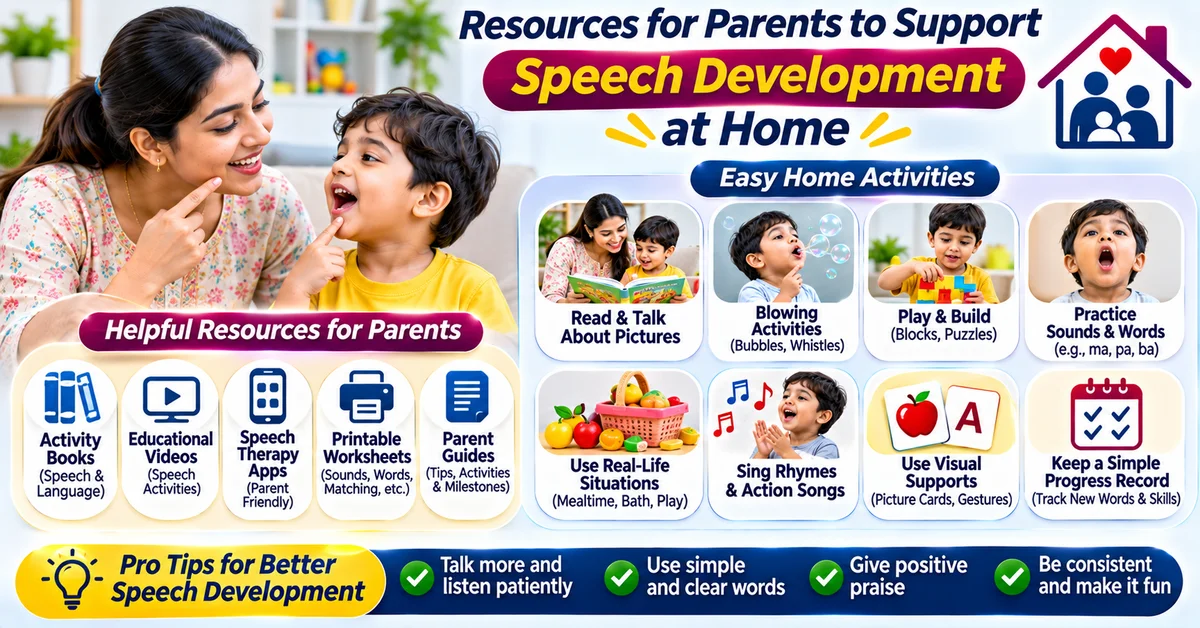
Resources for Parents to Support Speech Development at Home
Every parent remembers the moment they hear a baby’s first word. Behind that moment are months of listening, babbling, copying and connecting. The good news is that you don’t need expensive equipment or a therapy room to support this journey. Speech development at home starts with ordinary routines, playful conversations and the right resources.
This guide covers practical, parent-friendly resources and techniques you can start using today. It also explains when it’s time to ask a speech-language pathologist for help.
Why Home Is the Best Place for Speech Development
Children learn language mostly through the people they love. Your voice, your facial expressions and your responses to their sounds teach more than any app or flashcard can. A child hears thousands of words at home each day, and the quality of those interactions matters more than the quantity.
When you talk, listen and respond warmly, your child learns that communication works. That belief motivates them to keep trying, even when words come out unclear. Home-based practice also fits naturally into mealtimes, bath time, walks and bedtime, so it never feels like homework.
Ebook Download स्पीच थेरपी ॲक्टिव्हिटी बुक | मुलांच्या भाषा व संवाद विकासासाठी
Know the Speech Milestones
Knowing what is typical helps you spot progress and notice concerns early. Every child develops at their own pace, so treat these as general guides, not strict deadlines.
By 12 months: babbling with varied sounds, responding to their name, waving or pointing, and possibly one or two words.
By 18 months: about 10 to 20 words, following simple directions like “give me the ball,” and imitating sounds.
By 2 years: around 50 words, beginning to join two words such as “more milk,” and naming familiar objects.
By 3 years: short three-word sentences, asking simple questions, and speech that familiar people can mostly understand.
By 4 years: telling simple stories, using longer sentences, and being understood by most listeners.
Everyday Routines Are Your Best Resource
You already have the most powerful tools in your home. Turn daily routines into language lessons.
Mealtimes: Name foods, describe textures and offer choices. Ask “Do you want banana or apple?” and wait for a sound, gesture or word.
Bath time: Talk about body parts, water play and actions like pour, splash and wash.
Dressing: Name clothing items and describe what you’re doing. “Socks on. One foot, two feet.”
Shopping and walks: Point out vehicles, animals, colours and people. Let your child point and label what they see.
Bedtime: Share a quiet story or sing a lullaby. Predictable routines help children anticipate and repeat words.
Books and Reading Resources
Reading aloud is one of the best low-cost resources for speech development at home. Choose books that match your child’s stage.
For babies and toddlers, pick sturdy board books with large, clear pictures of everyday objects. For toddlers and preschoolers, look for books with repetitive phrases, rhymes and predictable patterns, since children love to join in with the repeated lines. Interactive books with flaps, textures or sounds keep attention high.
Don’t feel you must read every word. Point to pictures, ask “What’s that?”, make animal sounds and let your child turn the pages. A local library is a great free resource, and picture books in your home language are just as valuable as English ones.
Songs, Rhymes and Music
Rhythm and melody help children remember words and practise sound patterns. Nursery rhymes, action songs and finger plays build vocabulary, turn-taking and imitation. Songs with gestures, such as clapping or counting fingers, support both speech and motor skills.
Try pausing before the last word of a familiar song and letting your child fill in the gap. This simple trick encourages spontaneous speech without any pressure.
Play-Based Toys and Games
Play is how children learn. The best toys for speech development are simple ones that invite conversation.
Pretend play sets such as kitchen toys, dolls and toy phones encourage role-play and sentence building.
Puzzles and shape sorters teach vocabulary and following instructions.
Blocks and building toys support words like up, down, on, in and more.
Bubbles and balloons are excellent for requesting words like “more,” “pop” and “again.”
Picture cards and matching games help with naming, categories and memory.
Sit at your child’s level, follow their lead and describe what they’re doing. Your attention matters more than the toy.
Screen Time and Digital Resources
Educational apps and videos can offer some support when used thoughtfully, but they should never replace real conversation. Children learn language best through back-and-forth interaction, which a screen cannot fully provide.
Health organisations such as the World Health Organization advise avoiding screen time for babies under one and limiting it for young children. If you do use screens, watch together, talk about what you see and choose slow-paced content with clear speech and repetition. Turn off background television during playtime so your child can hear your voice clearly.
Supporting Multilingual Children
Many families speak more than one language, and this is a strength, not a problem. Research shows that bilingual children do not have more speech delays than children learning one language. They may mix languages or have smaller vocabularies in each language at first, but their total vocabulary across both languages is similar to or larger than their single-language peers’.
Speak the language you feel most comfortable in. A rich, natural conversation in your home language builds a strong foundation for learning other languages later.
Simple Techniques Parents Can Use Daily
These strategies are used by speech-language pathologists and are easy to practise at home.
Self-talk: Describe what you are doing. “I’m cutting the apple. Cut, cut, cut.”
Parallel talk: Describe what your child is doing. “You’re pushing the car. It goes fast!”
Expansion: Add a little to what your child says. If they say “ball,” you say “big red ball.”
Wait time: After you ask a question or offer a choice, count silently to five. Children need extra time to process and respond.
Model, don’t correct: If your child says “wabbit,” simply say, “Yes, a rabbit! The rabbit is hopping.” Repeating the right word, without asking for repetition, keeps the experience positive.
Offer choices: “Water or juice?” encourages a word or sound instead of a yes or no.
Don’t Forget About Hearing
Speech and hearing are closely connected. A child who cannot hear clearly will struggle to learn to speak clearly. Frequent ear infections, fluid behind the eardrum, or an undetected hearing loss can all slow speech development.
Watch for signs such as not responding to sounds, turning the television up very loud, or often saying “what?” If you have any doubt, arrange a hearing test with an audiologist. Early detection makes a significant difference.
When to Seek Professional Help
Home resources are powerful, but they are not a substitute for professional assessment when there are concerns. Consider booking an evaluation if your child:
is not babbling or using gestures by 12 months
has no words by 16 to 18 months
is not combining two words by 2 years
is very hard to understand by 3 years
loses words or skills they previously had
does not respond consistently to sounds or their name
stutters with visible tension or struggle for more than a few months
seems frustrated or withdrawn because they cannot communicate
Trust your instincts. Early support is never wasted, and an evaluation can also reassure you when everything is on track.
How VR Speech And Hearing Clinic Can Help
At VR Speech And Hearing Clinic, our team understands that every child and every family is different. We assess speech, language and hearing, explain the results in plain language, and build a plan around your child’s needs. Just as importantly, we coach parents with simple home programmes, so the progress made in therapy carries over into daily life.
Whether you have a specific concern or simply want guidance on supporting your child’s communication, we are here to help you take the next step with confidence.
Final Thoughts
Supporting speech development at home does not require perfection. It requires presence, patience and a willingness to turn everyday moments into conversations. Talk often, read together, sing, play, give your child time to respond, and celebrate every attempt to communicate. If you ever feel unsure, reaching out to a speech and hearing professional is a sign of care, not worry.
FAQs
1. How can I improve my child’s speech at home?
Talk to your child throughout the day, describe your actions, read picture books, sing rhymes, and give them time to respond. Expanding their words slightly, such as turning “car” into “red car,” builds language naturally.
2. At what age should I worry about speech delay?
Consider an evaluation if your child has no words by 16 to 18 months, is not combining two words by age 2, or is very hard to understand by age 3. Any loss of previously learned skills should be checked right away.
3. Does screen time cause speech delay?
Excessive screen time can reduce the face-to-face interaction children need to learn language. Limit screens, watch together, and prioritise conversation, play and reading.
4. Will speaking two languages confuse my child?
No. Bilingual children develop language normally. Speaking the language you are most fluent in at home gives your child the richest language model.
5. Can hearing problems affect speech development?
Yes. Even mild or temporary hearing loss, such as from repeated ear infections, can affect how a child learns sounds and words. A hearing test is a smart first step if speech is delayed.
6. Are speech therapy apps and flashcards enough?
They can supplement learning, but they work best alongside real conversation. If your child shows signs of delay, a professional assessment will give you a clear plan.
7. How do I know if my child needs a speech therapist?
If your child is missing milestones, is hard to understand, stutters, or seems frustrated while communicating, book an assessment. A speech-language pathologist can tell you whether therapy is needed or whether home strategies are enough.