Phonak Eon Launch: Smaller Sphere, Auracast & WindBlock 2.0
Phonak Eon Launch: Smaller Sphere, Auracast and WindBlock 2.0
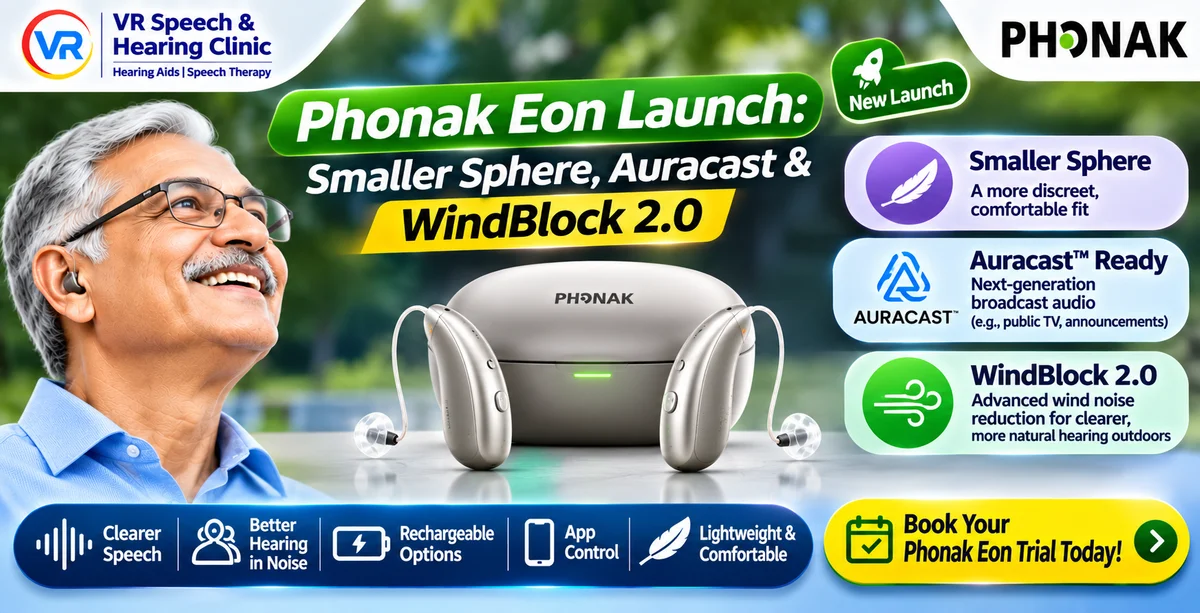
Phonak has unveiled Eon, the third generation of its AI-powered Sphere hearing aids. The headline change is size. The new Audéo Eon Sphere is roughly a quarter smaller than the previous model, yet it keeps the deep neural network speech processing that made the Sphere line popular. Eon also adds Auracast broadcast audio, a smarter automatic sound system, better wind control and longer battery life. Together these make it more than a simple refresh. Here is what’s new, what stays the same, and who should pay attention.
What Is the Phonak Eon Platform?
Eon is built around three ideas: clarity, connectivity and a discreet design. The platform includes three products:
Audéo Eon Sphere: a rechargeable model with AI-driven speech separation.
Audéo Eon R: a conventional receiver-in-canal (RIC) hearing aid for mild to profound hearing loss.
CROS Eon R: a solution for people with unaidable hearing in one ear, such as single-sided deafness.
Eon Sphere keeps the dual-chip approach of earlier Sphere models. A new Hypersonic AI chip runs Spheric Speech Clarity 3.0. Phonak’s ERA chip handles Bluetooth, Roger and Auracast connectivity. The launch also includes WindBlock 2.0, a new fitting formula called APD 4.0, two new chargers, updates to Phonak Target fitting software and refreshed myPhonak and myPhonak Junior apps.
Smaller, Lighter and Longer-Lasting
The most visible upgrade is the physical design. Phonak says Audéo Eon Sphere is 25% smaller and 20% lighter than the previous Sphere generation. That brings it much closer to the size people expect from a standard RIC hearing aid. Size was one of the biggest trade-offs of earlier Sphere models. They delivered excellent speech-in-noise results but needed a bulkier housing and more battery power than rival AI hearing aids.
The new Hypersonic chip and a more efficient speech-processing algorithm let Eon run real-time AI while drawing 37% less power. Phonak now quotes up to 38 hours per charge. Real-world runtime depends on your degree of hearing loss, how much you stream, the noise you spend time in and the age of the battery. In a tougher example from the launch, Phonak cited about 22 hours with 8 hours of streaming and time in noisy settings. Michael Preuss, a Phonak audiology manager with severe-to-profound hearing loss, said his pair still had 20% to 25% charge left after nearly 7 hours in noise and about 5 hours of streaming.
Two chargers are available. The Charger RIC E is a desktop unit, and the ChargerGo RIC I EON is a portable charger with its own battery for use away from an outlet. Eon comes in eight colors, including a new Sienna Red.
Spheric Speech Clarity 3.0 Reaches More Levels
Spheric Speech Clarity 3.0 is the core of Eon Sphere. It uses deep neural network processing to separate speech from background noise in real time, enhance it and rebuild the sound scene. That lets it go beyond ordinary directional microphones when several people or competing sounds surround the wearer.
Phonak cites a signal-to-noise benefit of up to 10 dB in complex group conversations. It also says users are twice as likely to understand every word from any direction compared with the same settings without the feature. Phonak is not claiming a big jump in speech-in-noise performance over Infinio Ultra. The goal was to keep Sphere’s proven performance while delivering it more efficiently in a far smaller device.
What has changed is access. Spheric Speech Clarity was previously limited to the top two performance levels. On Eon Sphere, Sphere Mode is available at Premium 90, Advanced 70 and Standard 50, so more people can use Phonak’s strongest noise-separation technology. Preuss, who has worn hearing aids since childhood, said trying it made him realize that technology, not his hearing loss, had been the real limit in noisy places.
AutoSense OS AI 8.0 Keeps Features Active Longer
Eon introduces AutoSense OS AI 8.0, Phonak’s latest automatic operating system. It analyzes the sound environment up to 700 times per second and blends amplification, directional microphones and noise reduction to suit the moment.
The big change in version 8.0 is knowing when to leave a noisy program. Picture a busy restaurant where the noise dips briefly as people leave nearby tables. Older versions could drop out of the Speech in Loud Noise program during those lulls. AutoSense 8.0 uses a different threshold for leaving the program than for entering it, so a more sustained change is needed before it switches away.
In a Phonak test using the same 30-minute lunchtime recording, Eon produced about 20% more Speech in Loud Noise activation than Infinio Ultra. Clinicians can also adjust how readily Sphere processing engages in Phonak Target, depending on whether a patient wants it in moderate noise or only in very loud settings.
APD 4.0 Targets Changing Environments
Eon also debuts Adaptive Phonak Digital 4.0, the newest version of Phonak’s proprietary fitting formula. A fitting formula decides how amplification is applied across frequencies and input levels. Phonak says APD 4.0 focuses on keeping sound fidelity high as environments change. One example is a conversation beside a coffee machine that suddenly switches on. Eon is designed to adapt automatically, so the wearer doesn’t need to reach for the app or a button.
WindBlock 2.0 Tackles a Persistent Problem
Wind noise is a long-standing complaint among hearing aid users. WindBlock 2.0 is available at every Eon technology level. Phonak says it can reduce microphone wind noise by up to 50 dB and improve signal-to-noise ratio by up to 30 dB in certain conditions. Instead of simply cutting low frequencies when wind appears, it compares the two microphones and favors the one less affected by wind. That reduces buffeting while preserving more speech and environmental sound.
A Phonak research study with 19 experienced hearing aid users compared WindBlock 2.0 with the previous version at different wind speeds and directions. Participants generally preferred the new system for sound quality, comfort, listening effort, naturalness and speech clarity. The advantage was strongest when wind came from straight ahead. Preuss said he noticed the difference while cycling, hiking, running and sitting near office fans. He also said listening to the radio with a car window down was suddenly possible.
Auracast Joins Phonak’s Bluetooth Lineup
Phonak has long stood out for broad compatibility with standard Bluetooth devices, and Eon keeps that “Made for All” approach. It adds Auracast broadcast audio alongside Bluetooth Classic and RogerDirect. Auracast can send audio from compatible public transmitters straight to hearing aids in theaters, airports, conference centers, museums and arenas. Wearers can join a broadcast by scanning a QR code in the myPhonak app or by using the Auracast assistant on compatible smartphones. Hands-free phone and computer calls still work, with the hearing aid microphones picking up the wearer’s voice. Phonak describes Eon as the first hearing aid to combine broad Bluetooth compatibility, RogerDirect and Auracast in one device.
Field-Tested Near the North Pole
To show Eon working outside the lab, Phonak gave a pair to Dr. Amanda Klekowski von Koppenfels, a University of Kent scholar and Arctic adventurer. She wore them on a week-long ski expedition across glaciers in Svalbard, where temperatures fell to about 3°F (-16°C). She said hearing was both a safety matter and a way to stay part of the group. Team members took turns on polar-bear watch, and she spent about 90 minutes alone on duty near midnight. When the group heard a crack and stopped to work out whether it came from the snow or the glacier, she could join the discussion. She also reported holding conversations while skiing through wind and crunching snow.
Availability and Upgrade Options
Phonak Eon is available in the United States through hearing care professionals starting August 24, 2026. Germany, France, the United Kingdom, Australia and other markets follow in September. Unlike Infinio Ultra, which reached existing users through a firmware update, Eon needs new hardware. Its smaller design and new features depend on the Hypersonic chip, so current Infinio and Infinio Ultra devices can’t be upgraded by software alone.
Our Take: An Evolution, Not a Reinvention
Eon is best seen as a substantial evolution of Sphere. Phonak keeps the speech-in-noise strength that made earlier models successful and fixes some of their obvious weaknesses:
A smaller, lighter Sphere design
Spheric Speech Clarity 3.0 down to the Standard 50 level
More consistent AutoSense 8.0 processing
Stronger outdoor performance with WindBlock 2.0
Better sound fidelity from APD 4.0
Auracast added to an already broad connectivity set
For people who liked Sphere’s performance but disliked its bulk, the redesigned housing may be the biggest draw. Whether Eon is worth upgrading to from Infinio Ultra will depend on the individual wearer. Independent lab results from HearingTracker and HearAdvisor are expected soon.
FAQs
What is the Phonak Eon?
Phonak Eon is a new hearing aid platform that includes Audéo Eon Sphere, Audéo Eon R and CROS Eon R. It focuses on speech clarity, wide connectivity and a smaller, more discreet design.
How much smaller is the Audéo Eon Sphere?
Phonak says it is 25% smaller and 20% lighter than the previous Sphere generation.
How long does the Eon battery last?
Phonak quotes up to 38 hours per charge. Heavy streaming and noisy environments shorten this, and one demo example showed about 22 hours.
Does Phonak Eon support Auracast?
Yes. Users can join compatible Auracast broadcasts by scanning a QR code in the myPhonak app or by using the Auracast assistant on a compatible smartphone.
Can I upgrade Infinio or Infinio Ultra to Eon?
No. Eon relies on the new Hypersonic AI chip, so it needs new hardware and can’t be installed as a firmware update.
When can I buy Phonak Eon?
It is available in the U.S. through hearing care professionals from August 24, 2026. Germany, France, the UK, Australia and more markets follow in September.