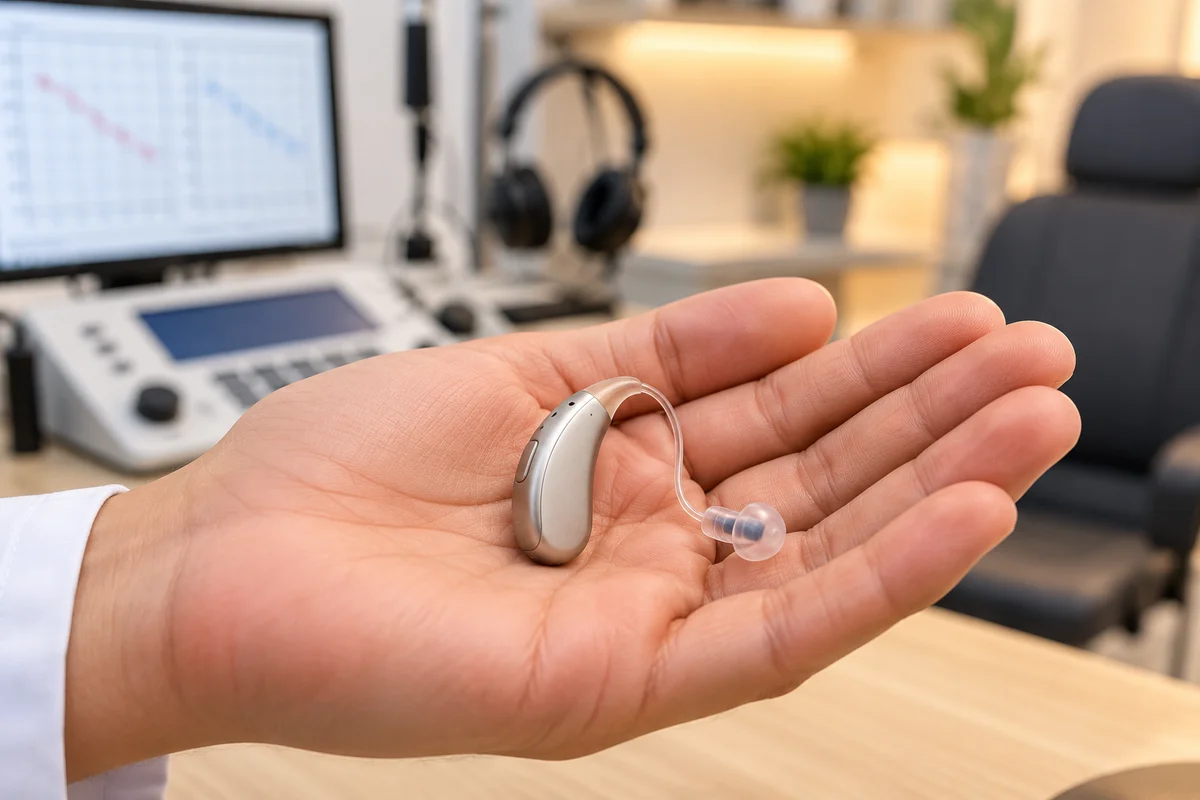
Phonak Audéo Infinio Review: A New Era of Sound
Hearing technology has reached an inflection point. For decades, the fundamental challenge has remained the same: how do you help someone hear the voice across the table when the rest of the room is competing for attention? Phonak has spent years refining its answer to that question, and the Audéo Infinio represents the company's most ambitious attempt yet. Built on an entirely new processing architecture and powered by dual-chip technology, this device does not simply amplify sound. It actively interprets acoustic environments using artificial intelligence, making real-time decisions about what you need to hear and what you do not. For users in India, where pricing transparency and long-term value matter enormously, the Infinio raises a compelling question: does the technology justify the investment? This review breaks down the hardware, the real-world performance, the connectivity, and the practical considerations that will help you decide.

The Evolution of Phonak: Audéo Infinio First Impressions
Phonak has built its reputation on a willingness to rethink hearing aid design with each generation. The Audéo Marvel introduced direct Bluetooth streaming. The Paradise line refined sound quality and added motion sensors. The Lumity series brought SmartSpeech Technology into focus. Each generation solved a specific set of problems, but none attempted to overhaul the underlying processing architecture itself.
The Audéo Infinio breaks from that pattern. Rather than iterating on existing hardware, Phonak built a new platform from the ground up. The result is a device that feels familiar in the hand but operates on fundamentally different principles. The receiver-in-canal (RIC) form factor remains, available in both rechargeable and battery-powered configurations, but the internal processing has changed entirely.
First impressions reveal a device that is lighter than expected, with a refined housing that sits comfortably behind the ear. The charging case is compact and intuitive. But the real story is not the physical design: it is what happens inside when you step into a noisy restaurant or a crowded marketplace in Chhatrapati Sambhajinagar (formerly Aurangabad) and the device begins making decisions on your behalf.
Revolutionary ERA Architecture and the Sphere Infinio Advantage
The Phonak Audéo Infinio is built on what the company calls ERA architecture, which stands for Enhanced Real-time Audio. This is not a marketing label applied to a minor chip upgrade. ERA represents a structural change in how the hearing aid processes incoming sound, distributing tasks across two dedicated processors rather than relying on a single chip to handle everything simultaneously.
Traditional hearing aids use one processor to manage amplification, noise reduction, directional microphones, and connectivity. That single chip must constantly prioritize tasks, which creates compromises. ERA architecture eliminates many of those compromises by splitting responsibilities between two specialized chips, each optimized for a distinct set of functions.
The Power of Sphere Infinio Dual-Chip Processing
The Sphere Infinio dual-chip system is the technical backbone of the Infinio line. One chip handles the core audiological processing: amplification curves, feedback management, frequency compression, and the personalized fitting parameters programmed by your audiologist. The second chip is dedicated entirely to environmental analysis and AI-driven sound classification.
This separation means neither chip is forced to sacrifice performance. The audiological processor delivers consistent amplification without interruption, while the AI chip continuously scans the acoustic environment, identifying speech sources, classifying noise types, and adjusting directional focus. The two chips communicate with each other in real time, creating a coordinated response that a single-chip system simply cannot replicate at the same speed.
DEEPSONIC Chip: Real-Time AI Sound Management
The AI processing chip in the Infinio is called DEEPSONIC. Trained on millions of real-world sound samples, DEEPSONIC uses a deep neural network to classify sounds with a level of granularity that previous Phonak models could not achieve. It distinguishes between, for example, traffic noise and air conditioning hum, or between a single conversation partner and overlapping voices in a group.
DEEPSONIC operates continuously, updating its analysis multiple times per second. This is not a preset system that switches between "restaurant mode" and "outdoor mode." It creates a fluid, constantly adapting sound profile that responds to changes in the environment as they happen. The practical benefit is that users do not need to manually adjust programs or reach for a smartphone app every time the listening situation changes.
Solving the 'Cocktail Party' Problem with AI-Driven Speech Enhancement
The so-called cocktail party problem has been the central challenge of hearing aid design for decades. In quiet environments, most modern hearing aids perform well. The real test comes when multiple sound sources compete for attention: overlapping conversations, clinking dishes, background music, and the general acoustic chaos of social gatherings.
AI-driven speech enhancement in noise is the Infinio's primary weapon against this problem. Rather than simply reducing all background noise uniformly, the system identifies individual speech streams and selectively enhances the one the wearer is focused on. This approach preserves the natural quality of the listening environment while making the target voice significantly more intelligible.
Separating Speech from Background Noise in Real-Time
The DEEPSONIC chip analyzes incoming audio and isolates speech signals based on spectral characteristics, spatial location, and temporal patterns. If you are facing a conversation partner at a restaurant table, the system identifies that voice as the primary target and applies selective amplification to it while attenuating competing sounds from other directions.
This process happens in real time, with latency so low that it does not create perceptible delay. The system also tracks movement: if your conversation partner shifts position or you turn your head, the directional focus adjusts accordingly. For users who frequently visit busy environments like markets, family gatherings, or religious functions, this capability represents a meaningful improvement over previous-generation devices.
Spheric Speech Clarity in Challenging Environments
Phonak calls this feature Spheric Speech Clarity, and it operates differently from the directional microphone systems found in older hearing aids. Traditional directional systems create a fixed beam aimed forward, which helps in one-on-one conversations but fails when multiple speakers are positioned around you. Spheric Speech Clarity creates a dynamic, multi-directional focus that can track and enhance speech from multiple angles simultaneously.
In testing, this translates to noticeably better performance in group conversations. Users report being able to follow a discussion around a dinner table without constantly repositioning themselves. The system is particularly effective in reverberant spaces like tiled kitchens or large halls, where reflected sound typically degrades speech clarity. For users in Indian households, where open floor plans and hard surfaces are common, this is a practical advantage worth noting.
Seamless Connectivity and Universal Bluetooth Integration
Modern hearing aids are expected to function as wireless earbuds in addition to their primary purpose. The Infinio meets this expectation with Bluetooth connectivity for both Android and iPhone devices, supporting direct audio streaming, hands-free phone calls, and integration with voice assistants.
The Bluetooth implementation uses the LE Audio protocol where supported, which offers lower power consumption and improved audio quality compared to older Bluetooth Classic connections. For devices that do not yet support LE Audio, the Infinio falls back to Bluetooth Classic, ensuring compatibility across a wide range of smartphones, tablets, and computers.
Hands-Free Calling for Android and iPhone Users
One of the most requested features among hearing aid users is reliable hands-free calling. The Infinio delivers this for both Android and iPhone, streaming the caller's voice directly to both hearing aids while using built-in microphones to capture the wearer's voice. Call quality is clear on both ends, and the transition between streaming media and answering a phone call is smooth and immediate.
For Android users specifically, the Infinio supports the full range of Google's hearing aid audio streaming protocol, which means direct streaming works on most Android phones running version 10 or later. iPhone users benefit from Apple's Made for iPhone protocol, which has been a standard feature in Phonak devices for several generations. The Infinio handles both ecosystems with equal competence.
Multi-Device Pairing and Stable Streaming Performance
The Infinio supports pairing with multiple devices simultaneously, allowing users to switch between a smartphone and a laptop without manually disconnecting and reconnecting. This is particularly useful for professionals who take calls on their phone while also needing to hear audio from a computer during meetings.
Streaming stability has been a pain point with some competing devices, especially in environments with heavy wireless interference. The Infinio uses an adaptive frequency-hopping protocol that minimizes dropouts. In practical use, streaming music or podcasts remains stable even in crowded areas with many active Bluetooth devices. The connection range is approximately 10 meters in open spaces, which is standard for Bluetooth hearing aids but sufficient for most daily use cases.
Design, Battery Life, and Everyday Wearability
The Infinio is available in multiple receiver power levels, from standard to ultra-power, accommodating hearing losses ranging from mild to severe-to-profound. The housing comes in several color options designed to blend with different skin tones and hair colors. Weight is approximately 2.1 grams for the standard RIC model, making it one of the lighter devices in its class.
Battery life is a critical consideration, especially for users who stream audio frequently. The rechargeable lithium-ion model delivers approximately 16 hours of use on a full charge with moderate streaming, and roughly 20 hours without streaming. A full charge takes about 90 minutes in the supplied charging case, and a 15-minute quick charge provides around 3 hours of use.
For users who prefer disposable batteries, the size 312 battery option provides 4 to 6 days of use depending on streaming habits. In regions where reliable electricity is intermittent, the battery-powered option offers a practical advantage. The total cost of ownership should factor in battery replacement (approximately ₹200 to ₹400 per month for disposable batteries) or the eventual need to replace the rechargeable battery after 3 to 4 years, which typically costs ₹3,000 to ₹5,000 through an authorized service center.
The IP68 rating means the Infinio is dust-tight and can withstand submersion in water up to 1 meter for 30 minutes. For users in humid climates, an electronic drying kit (₹1,500 to ₹3,000) remains a worthwhile investment to extend the device's lifespan.
Defining the Future of Hearing Technology
The Phonak Audéo Infinio is not a minor upgrade. It represents a structural shift in how hearing aids process sound, and the dual-chip architecture and DEEPSONIC AI deliver measurable improvements in the situations that matter most: noisy restaurants, family gatherings, busy streets, and group conversations. The ERA architecture hearing aid technology powering this device sets a new benchmark that competitors will need to answer.
For prospective buyers in India, the Infinio sits in the premium price bracket, typically ranging from ₹2,50,000 to ₹4,50,000 per pair depending on the receiver level and configuration. That is a significant investment, and it is worth comparing this device against alternatives from Signia, Widex, and more affordable Indian-manufactured options from Elkon or Alps if budget is a primary concern. Always consult an RCI-registered audiologist, request a trial period of at least one to two weeks, and ask about warranty terms and after-sales service availability in your city before committing.
The Infinio earns its place at the top of Phonak's lineup. If your primary frustration with hearing aids has been struggling to hear in noise, this device directly addresses that problem with technology that genuinely works. Schedule a consultation with a qualified audiologist to experience the difference firsthand.