Over the Counter Hearing Aids vs Oticon Hearing Aids: What to Know
Over the Counter Hearing Aids vs Oticon Hearing Aids: Which Is Right for You?
Searching for “over the counter hearing aids” is one of the most common first steps people take when they notice their hearing slipping. The idea is attractive. You skip the appointment, order a device, and start hearing better within days. But is a non prescription hearing aid really the right choice, and how does it compare with a professionally fitted brand like Oticon?
In this guide from VR Speech and Hearing Clinic, we explain what over the counter hearing aids are, who they suit, where they fall short, and why many people end up choosing clinically fitted Oticon hearing aids instead.
What Are Over the Counter Hearing Aids?
Over the counter hearing aids, often called OTC hearing aids, are devices sold directly to buyers without a hearing test, prescription, or visit to an audiologist. The category became official in the United States in 2022, when regulators allowed adults with perceived mild to moderate hearing loss to buy certain hearing aids without a professional. Since then, “hearing aid over the counter” has become a popular search worldwide, including in India.
These devices are usually set up by the user through a smartphone app or simple preset programs. Many are small, rechargeable, and lower in price than clinical devices.
An important point for Indian readers: the over the counter category is a US regulatory concept. In India, hearing aids are medical devices, and the safest route is a hearing evaluation by a qualified audiologist. Many products advertised online as non prescription hearing aids are closer to personal sound amplifiers than true hearing aids.
Non Prescription Hearing Aid vs Sound Amplifier
People often confuse these two, so the difference matters.
A hearing aid is designed to compensate for a specific hearing loss. It amplifies only the pitches you struggle with, reduces background noise, and controls feedback.
A personal sound amplifier simply makes everything louder. It does not know your audiogram, so it can over-amplify some sounds and still miss the ones you need. Loud, unfiltered amplification can even be uncomfortable, and prolonged exposure to excessive volume is not good for your ears.
When you shop for a non prescription hearing aid, always check whether the product is built to treat hearing loss or merely to boost volume.
Who Might Consider Over the Counter Hearing Aids?
OTC hearing aids are generally aimed at adults with mild to moderate hearing difficulty. They may be worth considering if:
You struggle a little in noisy restaurants or group conversations.
You turn up the television more than before.
Your hearing loss is the same in both ears and has developed slowly.
You are comfortable setting up devices through an app.
Even in these cases, a hearing test is strongly recommended first. Without one, you cannot be sure the problem is simple age-related hearing loss.
When You Should Not Self-Treat
Skip the over the counter route and see an audiologist or ENT specialist if you notice any of the following:
Sudden hearing loss in one or both ears
Hearing that is much worse in one ear
Ear pain, discharge, or a feeling of blockage
Persistent ringing (tinnitus) or dizziness
Hearing loss that is severe or getting worse quickly
Hearing difficulty in a child
These signs can point to infections, wax impaction, nerve problems, or other conditions that a hearing aid alone will not solve. Early diagnosis protects your hearing and sometimes your overall health.
The Limits of Over the Counter Hearing Aids
Convenience comes with trade-offs. Here is where OTC and non prescription hearing aids commonly fall short:
No proper diagnosis. A hearing test shows the type and degree of loss. An OTC device cannot do this for you.
Limited customization. Most offer a handful of presets. Clinical devices are programmed to your exact audiogram, and fine-tuned over follow-up visits.
Fit and comfort issues. Ear shapes differ. A one-size-fits-most tip can cause discomfort, whistling, or poor sound quality. Professionals select the right dome, mould, or receiver size.
Weaker noise handling. Understanding speech in crowds is the biggest complaint among hearing aid users. Advanced processing in premium devices handles this far better.
Little after-sales support. Cleaning, repairs, adjustments, and counselling all matter for long-term success, and they are rarely included with online purchases.
Why People Choose Oticon Hearing Aids
Oticon is a well-known Danish hearing aid brand with a long history in hearing care. Oticon hearing aids are built around a philosophy often described as supporting the brain’s natural way of hearing. Instead of cutting out background sound aggressively, the technology aims to give your brain a clear, balanced picture of the sound environment so you can choose what to focus on.
Here is why Oticon hearing aids are popular with patients and audiologists alike:
Strong speech understanding in noise. Modern Oticon models use advanced processors and AI-based sound analysis to separate speech from surrounding noise.
Wide range of styles. Oticon offers receiver-in-canal (RIC or miniRITE), behind-the-ear, and custom in-the-ear options, so there is a style for different hearing losses, ear shapes, and budgets.
Rechargeable options. Many Oticon models come with rechargeable batteries, which is convenient for daily use and for older users who find tiny batteries fiddly.
Smartphone connectivity. Compatible models stream calls and audio to your phone and can be adjusted through an app.
Tinnitus support. Some Oticon hearing aids include sound support features that can help people who experience ringing in the ears.
Programmed to you. Every Oticon device is fitted using your audiogram and verified, then fine-tuned as your brain adapts.
Specific models, features, and prices change with each product generation, so your audiologist will recommend the one that matches your hearing loss, lifestyle, and budget.
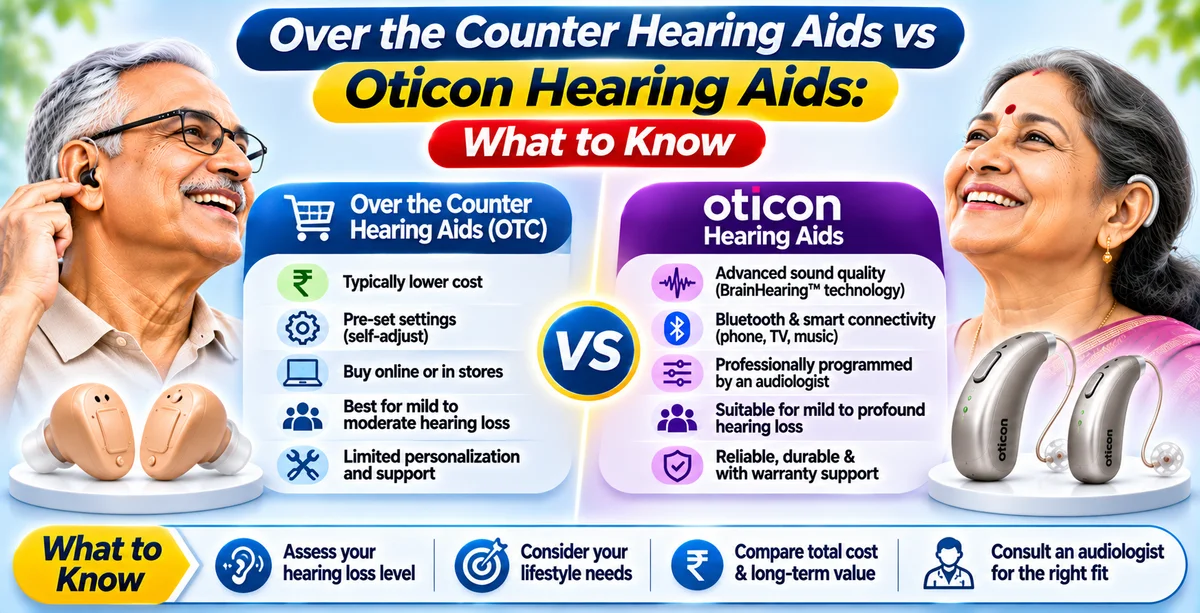
Over the Counter Hearing Aids vs Oticon Hearing Aids: A Quick Comparison
Hearing test: OTC devices need none. Oticon hearing aids are fitted after a full evaluation.
Programming: OTC devices use presets or app-based self-fitting. Oticon devices are programmed to your audiogram and refined at follow-ups.
Best for: OTC suits mild loss. Oticon covers mild to profound loss.
Noise performance: OTC is basic to moderate. Oticon offers advanced AI-supported processing.
Support: OTC is often limited. A clinic provides counselling, adjustments, cleaning, and repairs.
Cost: OTC is usually lower upfront. Oticon costs more but delivers a more tailored, durable solution.
Is Cheaper Always Better?
A lower price can look appealing, but the real cost of a hearing aid is whether you actually wear it and hear well with it. Many people who buy a cheap device without guidance abandon it within weeks because it whistles, sounds harsh, or does not help in noise. Untreated hearing loss can lead to social withdrawal, fatigue, and communication stress, so choosing the right device the first time is usually the better investment.
Tips Before You Buy Any Hearing Aid
Get a hearing test first so you know your type and degree of loss.
Ask for a trial period so you can test the device in your daily life.
Check what follow-up care, adjustments, and servicing are included.
Compare more than one brand rather than buying the first option you see.
Be careful of exaggerated claims such as “restores perfect hearing instantly.”
How VR Speech and Hearing Clinic Can Help
At VR Speech and Hearing Clinic, our approach starts with understanding your hearing, not selling a device. Our audiologist team, led by Vilas Rathod, BASLP, carries out a thorough hearing evaluation, explains your results in simple language, and guides you toward the right solution, whether that is an Oticon hearing aid, another trusted brand, or medical referral when needed.
We offer multi-brand options, trial and fitting support, programming, and after-care so your hearing aid keeps working for you. You can visit our clinics in Chhatrapati Sambhajinagar (Aurangabad), Ahmednagar, Pune, Nashik, Beed, and Jalna, or visit us at our head office at Vasantrao Naik Chowk, N-3, CIDCO, opposite Hotel Deepali Executive, Chhatrapati Sambhajinagar, Maharashtra 431003.
If you have been comparing over the counter hearing aids and are unsure what to choose, book a hearing test with us. It is the fastest way to know whether a simple device would do or whether a professionally fitted Oticon hearing aid will serve you better.
Final Thoughts
Over the counter hearing aids and non prescription hearing aids can feel like an easy first step, but hearing is personal, and no two hearing losses are the same. A proper test, expert fitting, and ongoing support make the difference between a device that sits in a drawer and one that genuinely improves your life. If you want clear, confident hearing, start with an evaluation at VR Speech and Hearing Clinic.
Frequently Asked Questions (FAQs)
1. What are over the counter hearing aids?
Over the counter hearing aids are devices sold directly to consumers without a prescription or audiologist visit, typically meant for adults with mild to moderate hearing loss.
2. Are non prescription hearing aids safe to use?
They can be safe when used correctly for mild loss, but without a hearing test you may miss a medical problem. A professional evaluation is always the safer first step.
3. Are over the counter hearing aids available in India?
The OTC category is a US regulation. In India, hearing aids are medical devices best chosen after an audiologist’s evaluation, and many online “non prescription” products are really sound amplifiers.
4. What is the difference between a hearing aid over the counter and a clinical hearing aid?
A clinical hearing aid is programmed to your audiogram and adjusted by a professional. An OTC device relies on presets or self-fitting and offers less customization and support.
5. Are Oticon hearing aids good?
Yes. Oticon hearing aids are widely trusted for strong speech understanding in noise, rechargeable options, and phone connectivity, and they come in several styles for different needs.
6. Can I buy Oticon hearing aids without a hearing test?
It is not recommended. Oticon hearing aids work best when programmed to your audiogram, so a hearing test and professional fitting give you the best results.
7. Who should avoid over the counter hearing aids?
Anyone with sudden hearing loss, one-sided loss, ear pain or discharge, dizziness, severe hearing loss, or children with hearing difficulty should see a specialist first.
8. How do I know which hearing aid suits me?
Book a hearing evaluation. An audiologist will recommend a device based on your hearing loss, lifestyle, ear shape, and budget.
9. Where can I get a hearing test and Oticon hearing aid fitting?
You can visit VR Speech and Hearing Clinic in Chhatrapati Sambhajinagar, Ahmednagar, Pune, Nashik, Beed, or Jalna for testing, fitting, and follow-up care.