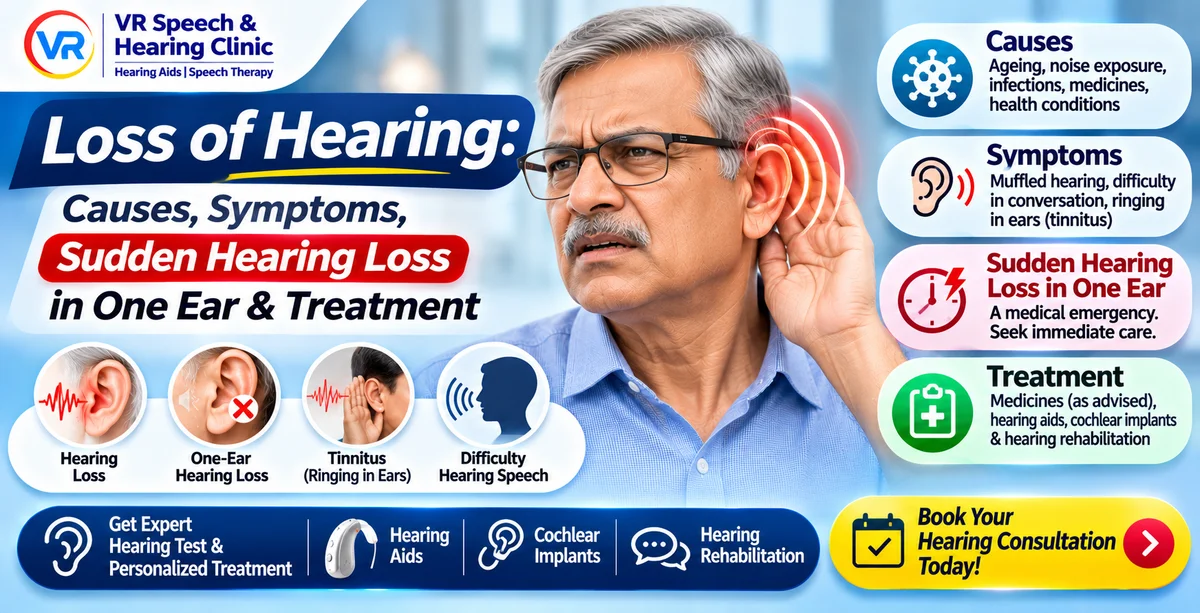
Loss of Hearing: Causes, Symptoms, Sudden Hearing Loss in One Ear & Treatment
Loss of Hearing: Causes, Symptoms, Types and Treatment Options
Loss of hearing can start so quietly that most people don’t notice it. You ask people to repeat themselves, turn the television up a little more each month, or struggle to follow conversations in a busy room. Sometimes it happens overnight: you wake up and one ear feels blocked or silent. Either way, loss of hearing is a health issue that deserves early attention.
At VR Speech and Hearing Clinic, audiologist Vilas Rathod, BASLP, and the team see patients every day who waited too long to get their hearing checked. This guide explains the common causes of loss of hearing, the symptoms to watch for, how it is diagnosed and classified, and what treatment options are available.
What Is Loss of Hearing?
Loss of hearing means you can no longer hear sounds at the levels that a person with normal hearing can. It can be mild, moderate, severe or profound, and it can affect one ear or both. It may be temporary, such as hearing loss due to cold or wax, or permanent, such as nerve damage from ageing or noise.
The degree of loss hearing is measured with a hearing test called pure tone audiometry. The results are shown on a graph called an audiogram, which records the softest sounds you can hear at different pitches. Based on the average thresholds, hearing loss is classed as follows:
Mild: difficulty with soft speech and whispers
Moderate: difficulty following normal conversation, especially in noise
Severe: most speech is missed without amplification
Profound: very little sound is heard, even loud sounds
Types of Hearing Loss
Conductive loss hearing happens when sound cannot pass properly through the outer or middle ear. Common causes include earwax blockage, fluid behind the eardrum, ear infections, a perforated eardrum, or problems with the tiny middle ear bones. Conductive hearing loss is often treatable with medicine or minor procedures.
Sensorineural hearing loss comes from damage to the inner ear or the hearing nerve. Ageing, loud noise, certain medicines, viral infections and genetics are the usual reasons. This type is usually permanent, but hearing aids and implants help greatly.
Mixed hearing loss is a combination of both types.
Asymmetric loss hearing means the two ears have clearly different hearing levels. Because this pattern can occasionally point to a problem with the hearing nerve or inner ear, it should always be evaluated by an audiologist and, where needed, an ENT doctor.
Causes of Loss of Hearing
Understanding the causes of loss of hearing helps you spot risks early. The most common causes include:
Ageing. Gradual loss of hearing with age is the most common cause worldwide. It usually begins with loss of high frequency hearing, which is why people say they hear voices but cannot understand words.
Noise exposure. Long exposure to loud music, machinery, traffic, firecrackers or headphones at high volume damages the sensitive hair cells in the inner ear. This damage is permanent.
Earwax and infections. Blocked wax and middle ear infections are frequent reasons for sudden or temporary hearing loss in children and adults.
Hearing loss due to cold. A cold, sinus infection or allergy can block the Eustachian tube, creating pressure and fluid behind the eardrum. Hearing feels muffled, and the ear may feel full. This usually clears as the cold recovers, but if it lasts more than a week or two, get it checked.
Loss hearing after flight. Rapid pressure changes during take-off and landing can cause ear barotrauma, especially if you fly with a cold. You may feel blocked ears, pain or muffled hearing. Most cases settle in a few days, but persistent loss or ringing after a flight needs professional evaluation.
Medicines. Some antibiotics, chemotherapy drugs and high-dose painkillers can harm the inner ear.
Head injury, diabetes, heart disease and high blood pressure can also affect hearing.
Genetics and birth-related factors can cause hearing loss in babies and children.
Loss of Hearing Symptoms
Common loss of hearing symptoms include:
Asking people to repeat themselves
Trouble understanding speech in restaurants, markets or group settings
Turning the volume of the television or phone higher than others prefer
Feeling that people mumble
Difficulty hearing children’s and women’s voices (a sign of high-frequency loss)
Difficulty hearing deep male voices or distant rumbling sounds (a sign of loss of low frequency hearing)
Ringing, buzzing or hissing sounds in the ears
A feeling of fullness or pressure in the ear
Avoiding social situations because of listening effort
Loss of low frequency hearing is less common and may be linked to certain inner ear conditions. It tends to make voices sound thin or muffled and can come and go.
Loss of Hearing in One Ear
Loss of hearing in one ear can be alarming. You may find it hard to know where sounds are coming from, and conversations on your weaker side become difficult.
Possible causes include earwax, middle ear fluid, infection, a ruptured eardrum, Meniere’s disease, noise injury, a viral illness, or less commonly a growth on the hearing nerve. Whether the problem is loss hearing in the left ear or loss hearing in the right ear, the same rule applies: do not ignore it.
Many people ask about loss of hearing in one ear no pain. Painless loss does not mean harmless. In fact, some of the more serious causes, including sudden sensorineural hearing loss, are painless. Loss of hearing in one ear and ringing together should also be assessed promptly, as this combination is common in inner ear disorders.
Sudden Loss of Hearing in One Ear: An Emergency
Sudden loss hearing one ear, usually developing over a few hours to three days, is known as sudden sensorineural hearing loss. People often notice it on waking up, during a phone call, or while showering. It may come with dizziness, ringing or a feeling of fullness.
This is a time-sensitive condition. Treatment, often steroid therapy under medical supervision, works best when started early, ideally within the first days. If you experience sudden loss hearing, do not wait for it to “settle on its own.” Visit an audiologist and ENT specialist the same day or the next day.
Loss of Hearing ICD 10
If you are looking for the loss of hearing ICD 10 code, ICD 10 is the International Classification of Diseases, tenth revision, used by doctors and insurers to record diagnoses. Hearing loss is classified within the H90 to H91 range, where conductive and sensorineural types, unspecified loss and sudden idiopathic hearing loss each have their own codes. Because the exact code depends on the type, side and cause diagnosed, your doctor or audiologist will confirm the right one for your records and insurance claims.
Loss of Hearing and Dementia
Research over the past decade has linked untreated hearing loss with a higher risk of cognitive decline and dementia in older adults. The brain works harder to decode unclear sound, social isolation increases, and mental stimulation drops. Hearing loss does not directly cause dementia in every case, but treating it early with hearing aids helps keep you connected, active and engaged. If a family member seems confused or withdrawn, get their hearing tested first.
How Loss of Hearing Is Diagnosed
At VR Speech and Hearing Clinic, evaluation usually includes:
Case history: when the problem started, which ear, any ringing, dizziness or infections.
Otoscopy: looking inside the ear canal for wax, infection or eardrum problems.
Pure tone audiometry (PTA): to find the type, degree and configuration of hearing loss.
Speech audiometry: to check how clearly you understand words.
Tympanometry: to assess the middle ear and eardrum movement.
OAE and BERA: advanced tests for infants, children and difficult-to-test patients, or when the hearing nerve needs further assessment.
The results help determine whether you need medical treatment, hearing aids or referral to an ENT specialist.
Loss of Hearing Treatment
The right loss hearing treatment depends on the cause:
Wax removal: safe cleaning restores hearing in blocked ears.
Medication: infections and fluid may respond to medicines prescribed by an ENT doctor.
Steroids: used in sudden sensorineural hearing loss under medical guidance.
Surgery: for eardrum perforation, bone problems or certain structural issues.
Hearing aids: the most common solution for permanent sensorineural loss.
Cochlear implants: for profound loss when hearing aids give limited benefit.
Hearing protection and lifestyle changes: to prevent further damage.
Severe Hearing Loss Hearing Aids
People with severe hearing loss need powerful, well-fitted devices. The best severe hearing loss hearing aids are usually behind-the-ear (BTE) or power receiver-in-canal models with strong amplification, good feedback control, directional microphones and noise management. Rechargeable options, Bluetooth streaming and smartphone control add convenience.
The best device is not just the most expensive one. It is the one programmed correctly for your audiogram, your lifestyle and your comfort. That is why a professional fitting, real-ear verification and follow-up visits matter as much as the hearing aid brand. At VR Speech and Hearing Clinic, multiple leading brands are available, and you can try suitable options with guidance from Vilas Rathod, BASLP.
Can You Prevent Loss of Hearing?
You cannot prevent every cause, but you can lower your risk:
Keep headphone volume below 60 percent and take listening breaks
Wear ear protection in noisy workplaces and at loud events
Never insert cotton buds, pins or sticks into the ear
Treat colds, allergies and ear infections early
Avoid flying with a severe cold if possible, and use gentle pressure-equalising techniques
Get a hearing test yearly after age 50, or sooner if you notice changes
Manage diabetes, blood pressure and cholesterol
When Should You See an Audiologist?
Book a hearing test if you notice any of the following:
Sudden hearing loss in either ear
Hearing difficulty lasting more than two weeks
Ringing with reduced hearing
Hearing differences between ears
Trouble following speech even when people speak clearly
Family members noticing you do not hear well
Get Your Hearing Checked at VR Speech and Hearing Clinic
VR Speech and Hearing Clinic offers professional hearing evaluation, counselling and hearing aid fitting across Chhatrapati Sambhajinagar (Aurangabad), Ahilyanagar (Ahmednagar), Pune, Nashik, Beed and Jalna. Under the guidance of Vilas Rathod, BASLP, each patient receives a clear diagnosis, honest advice and a solution matched to their hearing and budget.
Do not wait until loss of hearing affects your relationships, work or safety. A simple hearing test can give you answers in under an hour.
FAQs
1. What is the most common cause of loss of hearing?
Ageing and long-term noise exposure are the most common causes of permanent loss of hearing. Earwax and infections are the most common reversible causes.
2. Is sudden loss of hearing in one ear an emergency?
Yes. Sudden sensorineural hearing loss should be assessed within days, ideally within 24 to 72 hours, because early treatment gives better chances of recovery.
3. Can a cold cause loss of hearing?
Yes. A cold can block the Eustachian tube and cause fluid buildup, leading to temporary muffled hearing. If it does not clear in one to two weeks, see an audiologist or ENT doctor.
4. Why do I lose hearing after a flight?
Pressure changes during take-off and landing can affect the middle ear, especially with a cold or allergy. Mild cases clear in a few days, but persistent loss, pain or ringing needs evaluation.
5. Can loss of hearing in one ear happen without pain?
Yes. Painless one-sided hearing loss is common and can still be serious, so a hearing test is important.
6. What is the ICD 10 code for loss of hearing?
Hearing loss falls within the H90 to H91 range, with specific codes for conductive, sensorineural and sudden hearing loss. Your doctor will confirm the exact code.
7. Is there a link between loss of hearing and dementia?
Studies show untreated hearing loss is associated with a higher risk of cognitive decline. Early use of hearing aids supports communication and mental engagement.
8. What does loss of high frequency hearing feel like?
Speech sounds like mumbling, especially consonants such as s, f and th. Women’s and children’s voices and birds’ sounds are harder to hear.
9. What are the best hearing aids for severe hearing loss?
Powerful BTE or power RIC hearing aids, correctly programmed and verified, work best. An audiologist should recommend based on your audiogram and lifestyle.
10. Can conductive hearing loss be cured?
Many cases are treatable with wax removal, medicines or surgery. Hearing aids can help when treatment is not suitable.