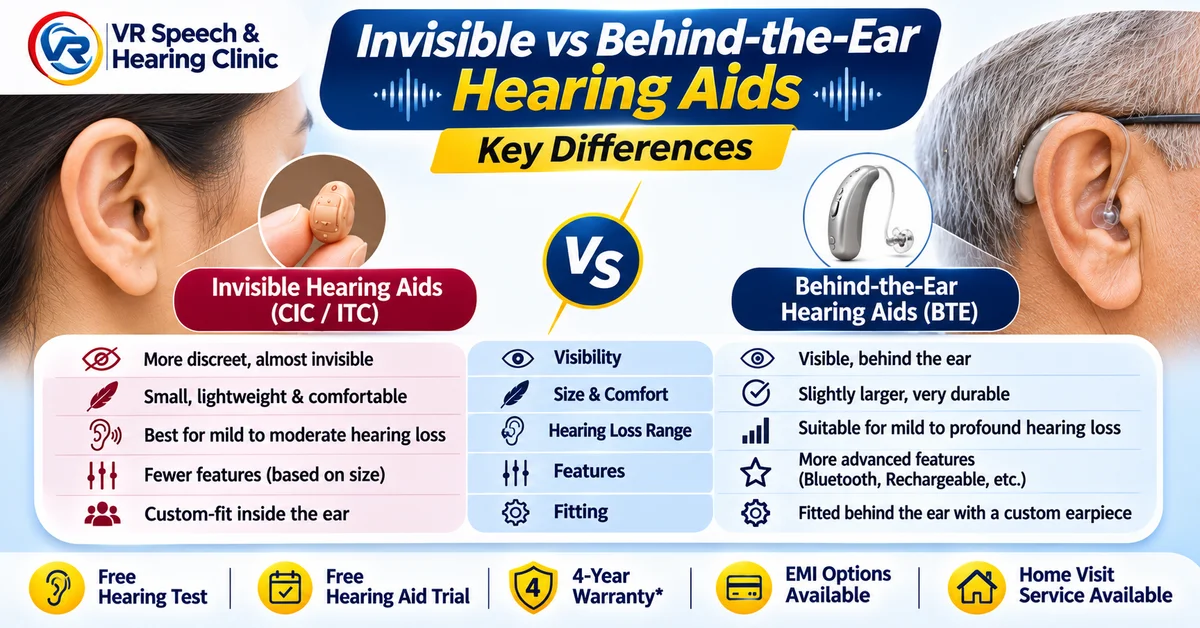
Invisible vs Behind-the-Ear Hearing Aids: Key Differences
Invisible vs Behind-the-Ear Hearing Aids: Which Is Right for You?
Choosing between invisible hearing aids and behind-the-ear (BTE) models is one of the first big decisions people face when they begin treating hearing loss. One style promises near-total discretion. The other offers more power, longer battery life and a wider set of features. Neither is better for everyone. The right choice depends on your type and degree of hearing loss, ear canal shape, daily lifestyle, hand dexterity and budget. This guide compares both styles feature by feature, so you can walk into your hearing consultation informed and confident.
What Are Invisible Hearing Aids?
Invisible hearing aids, usually called invisible-in-canal (IIC) or completely-in-canal (CIC) devices, are custom-made from an impression or digital scan of your ear. The tiny shell sits deep in the ear canal, close to the eardrum, so it is barely noticeable from the side. A small removal filament is often the only part that may be seen. Because the device is so compact, it uses a very small battery and has limited space for extra controls, sensors and wireless components.
What Are Behind-the-Ear Hearing Aids?
BTE hearing aids rest behind the outer ear. A thin tube or wire carries sound into the ear canal through a soft dome, a custom earmold or a small receiver. Popular variations include slim-tube open-fit models and receiver-in-canal (RIC) styles, along with classic power BTEs designed for greater hearing loss. The larger body leaves room for bigger batteries, stronger amplifiers and more advanced technology.
Quick Comparison Table
Feature | Invisible (IIC/CIC) | Behind-the-Ear (BTE) |
|---|---|---|
Visibility | Nearly hidden | Visible, but slim and colour-matched options exist |
Hearing loss range | Mild to moderate | Mild to profound |
Battery | Very small, shorter life | Larger or rechargeable, longer life |
Extra features | Limited | Extensive |
Handling | Fiddly for small fingers | Easier to hold and adjust |
Fit | Always custom-made | Standard dome or custom earmold |
Maintenance | More exposed to wax and moisture | Easier to clean and service |
Typical cost | Often higher | Wide range for many budgets |
Detailed Feature Comparison
Appearance and Discretion
Invisible hearing aids win on looks. If you are worried about other people noticing a device, IIC models are the most discreet option available. That said, modern BTE hearing aids are far slimmer than older designs. Thin-tube and RIC models sit close to the ear, blend with hair and skin tones, and often go unnoticed in daily life. Many users also find that once clearer hearing improves their conversations, visibility matters much less than they expected.
Hearing Loss Range and Sound Power
This is where behind-the-ear hearing aids pull ahead. Invisible devices have small amplifiers and receivers, so they suit mild to moderate hearing loss. Severe or profound loss usually needs more output power and a stronger signal, which BTE and power BTE models deliver reliably. Ear canal anatomy matters too. A narrow, curved or unusually shaped canal may not safely hold an invisible device at all, and only an ear examination can confirm this.
Sound Quality and Natural Hearing
Deep placement lets invisible hearing aids use the natural shape of the ear to collect sound, and many wearers describe the result as natural, with comfortable phone use and less wind noise. However, a fully sealed canal can cause the occlusion effect, which makes your own voice sound boomy or hollow. Venting options are limited in such small devices. BTE models with open domes keep the canal open, reducing that blocked feeling. They also tend to include multiple directional microphones, which help you follow speech in restaurants, meetings and busy streets.
Battery Life and Charging
Invisible hearing aids use tiny disposable batteries that often last only several days, and replacing them takes precision. Most BTE models offer longer battery life, and many come with rechargeable batteries that last a full day on a single overnight charge. For people who travel often or prefer less hassle, this is a major advantage.
Connectivity and Smart Features
Features such as Bluetooth streaming, telecoil, tinnitus masking, app control and manual volume buttons all need space. BTE aids can fit more of them, so you can stream calls and music, adjust programs from a smartphone app and connect to TV streamers. Invisible aids are improving every year, but some features may be limited or unavailable at that size.
Comfort, Handling and Ease of Use
Invisible aids feel light and are often forgotten once settled, yet inserting and removing them takes good dexterity and eyesight, and the removal cord is thin. BTE aids are bigger and easier to grip, clean and operate, which suits older adults and anyone with arthritis or reduced hand control. Some people find that glasses and face masks crowd the area behind the ear, but most adjust within a few days.
Durability and Maintenance
Because invisible devices sit deep in the canal, earwax and moisture can block the microphone or receiver, so cleaning must be frequent and careful. BTE aids keep most of their electronics outside the canal, which usually makes them easier to maintain and often more resistant to damage. Both styles need regular check-ups, and wax guards or filters need replacing from time to time.
Cost
Custom miniaturisation can make invisible hearing aids more expensive, and the shorter battery life can add to running costs. BTE hearing aids cover a broader price range, from essential to premium technology levels. Final prices depend on the technology level, brand, warranty and aftercare package, so ask for a clear breakdown before you decide.
Who Should Choose Invisible Hearing Aids?
Invisible hearing aids are usually a good match if:
You have mild to moderate hearing loss.
Your ear canals are wide enough for a deep, comfortable fit.
Discretion matters to you more than extra features.
You have good dexterity and eyesight for handling tiny parts.
You do not need advanced wireless connectivity.
Who Should Choose Behind-the-Ear Hearing Aids?
Behind-the-ear hearing aids are usually a good match if:
You have moderate to profound hearing loss.
You want rechargeable batteries and long daily use.
You rely on Bluetooth, telecoil or app controls.
Easy handling matters to you or your caregiver.
You prefer a device that is simpler to clean and repair.
You are choosing for a child whose ears are still growing, since earmolds can be remade as they grow.
How to Make the Final Decision
Start with a professional hearing test. An audiogram shows your hearing loss pattern, and an ear examination confirms whether your canals can support an invisible fit. Your audiologist will also discuss your work, social life, hobbies and comfort preferences. Trying demonstration devices, where available, helps you judge sound quality, comfort and handling before you commit. A hearing evaluation at VR Speech and Hearing Clinic can help you match the style to your actual needs, rather than choosing by appearance alone.
Final Thoughts
Invisible hearing aids deliver unmatched discretion for the right candidate, while behind-the-ear models offer power, battery life, connectivity and easy handling for a wider range of hearing needs. The best hearing aid is the one you will wear every day, fitted correctly and programmed precisely to your hearing. Book a hearing assessment with VR Speech and Hearing Clinic to find out which style suits your ears and your life.
Frequently Asked Questions
1. Are invisible hearing aids really invisible?
They are nearly invisible when viewed from the side, because the device sits deep in the ear canal. A small removal filament may be seen, and someone looking closely could notice the device, but in everyday situations it is very discreet.
2. Which is better, invisible or behind-the-ear hearing aids?
Neither is better for everyone. Invisible aids suit people with mild to moderate hearing loss who value discretion, while BTE aids suit a wider range of hearing loss and offer more features, longer battery life and easier handling.
3. Can invisible hearing aids treat severe hearing loss?
Usually not. Severe and profound hearing loss typically needs more amplification power and stronger signal delivery than very small in-canal devices can provide, so a BTE or power BTE model is normally recommended.
4. Do behind-the-ear hearing aids have better battery life?
Generally, yes. BTE models have more room for larger or rechargeable batteries, so they usually last longer between changes or charges than invisible hearing aids.
5. Are invisible hearing aids more expensive than BTE models?
Often they are, because each unit is custom-made and miniaturised. However, cost depends on the technology level, brand and service package, so compare complete quotes instead of looking only at the style.
6. Can I wear glasses with behind-the-ear hearing aids?
Yes. Most people wear both comfortably. Slim BTE and RIC styles sit close to the ear, and your audiologist can adjust the fit and tubing so glasses and hearing aids work well together.
7. How long does it take to get used to hearing aids?
Most people need a few weeks of regular daily use to adapt. Follow-up appointments allow your audiologist to fine-tune the settings so sound becomes comfortable and natural over time.