How to Calculate Hearing Loss Percentage: Step-by-Step Formula Guide
How to Calculate Hearing Loss Percentage: Step-by-Step Formula Guide
Millions of people live with some degree of hearing loss, and one of the most frequent questions asked after a hearing test is simple but important: "What percentage of my hearing have I actually lost?"
Whether you're applying for a disability certificate, exploring insurance benefits, planning hearing aid treatment, or just trying to make sense of your audiogram, understanding how hearing loss percentage is calculated brings much-needed clarity to a confusing topic.
Here's something most people don't realize: decibels don't translate directly into percentages. A 50 dB hearing loss does not mean you've lost 50% of your hearing. Instead, audiologists rely on standardized medical formulas that weigh different sound frequencies and compare how well both ears work together.
At VR Speech and Hearing Clinic, we regularly guide patients through this exact process. This guide breaks down what hearing loss percentage means, how professionals calculate it using the Pure Tone Average (PTA), how it differs from disability percentage, and how the official assessment process works.
What Is Hearing Loss Percentage?
Hearing loss percentage is a calculated figure that reflects how much your overall hearing ability has declined compared to normal hearing levels. Rather than focusing on a single tone or pitch, audiologists test your hearing across several frequencies and combine the results using standardized medical formulas into one overall number.
While terms like "mild" or "moderate" hearing loss describe general categories, a precise percentage serves practical purposes such as:
Guiding treatment decisions and hearing aid fittings
Supporting workplace accommodations, insurance claims, and disability certification
Tracking changes in hearing ability over time
Think of your hearing like a piano keyboard, where every key represents a different frequency. Some people hear low-pitched sounds well but struggle with higher tones, while others experience the reverse. Hearing loss percentage pulls information from multiple frequencies to create a broader, more accurate picture of your hearing function.
It's worth noting that two people with an identical percentage may still experience daily conversations very differently, depending on speech clarity, background noise, and how their brain processes sound.
Why Calculating Hearing Loss Percentage Matters
An accurate percentage helps hearing care professionals:
Recommend the right type of hearing aid
Track changes in hearing over months or years
Determine eligibility for disability benefits
Plan rehabilitation and speech therapy programs
Evaluate hearing requirements for certain occupations
Support insurance and compensation claims
Without a reliable percentage, treatment plans can become inconsistent or incomplete, which is why professional testing matters far more than online self-assessments.
Hearing Loss Percentage vs. Hearing Disability Percentage
These two terms are often used interchangeably, but they aren't the same thing.
Hearing loss percentage measures the degree of hearing reduction based purely on audiometric test results, and it's primarily used by audiologists for diagnosis. Hearing disability percentage, on the other hand, measures how that hearing loss impacts your daily functioning, based on approved government assessment guidelines, and it's used for disability certification and benefit eligibility.
In short: one is a clinical measurement, and the other is a functional and legal classification.
Hearing Impairment vs. Hearing Disability
Another common point of confusion is the difference between impairment and disability.
Hearing impairment refers to the underlying medical condition affecting the ear or auditory pathway. Hearing disability describes how that impairment limits communication, education, employment, or everyday activities. Two people with very similar hearing thresholds can end up with different disability percentages depending on functional limitations and official assessment criteria.
Hearing loss doesn't automatically qualify as a disability. Certified medical boards evaluate hearing according to established clinical guidelines before determining eligibility for a disability certificate and any associated benefits.
Understanding How Hearing Works Before You Calculate Anything
Before diving into formulas, it helps to understand how hearing actually functions, since accurate percentage calculations always start with a reliable hearing test, not math alone.
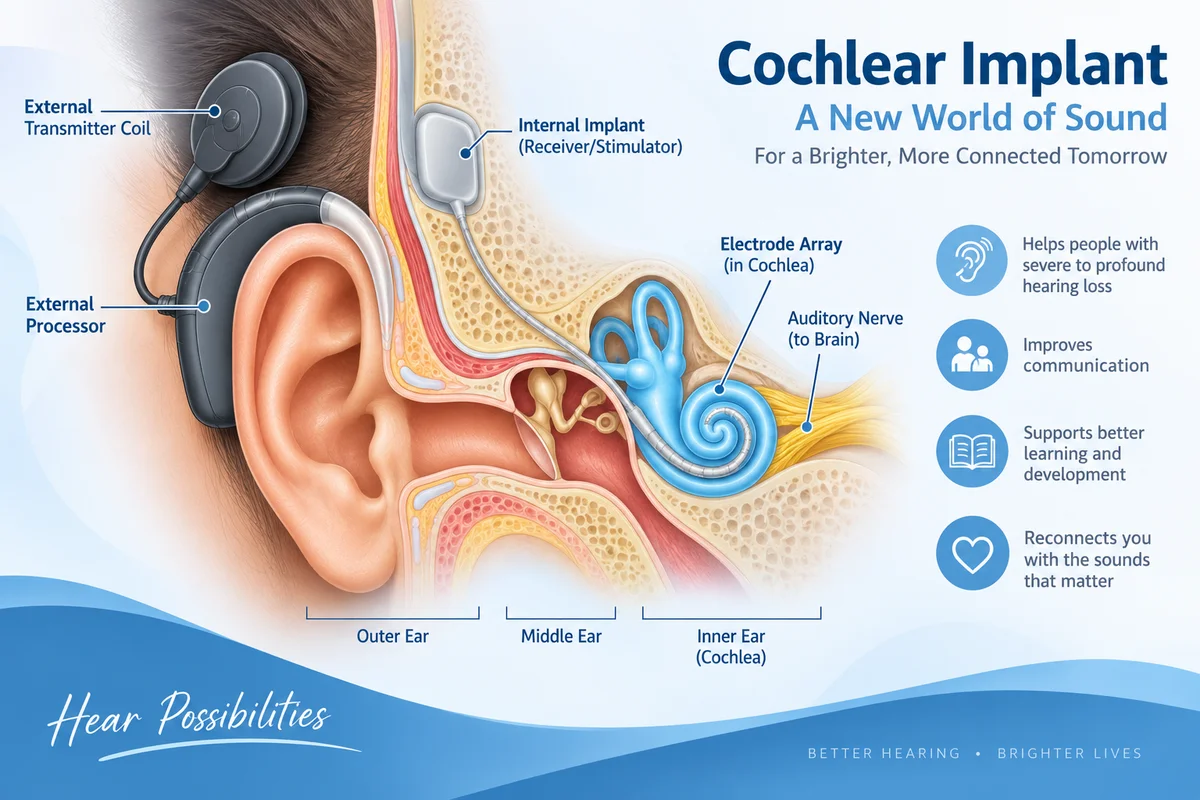
Hearing involves several parts of the ear working together: the outer ear collects sound waves, the middle ear amplifies them through tiny bones, the inner ear (cochlea) converts sound into electrical signals, and the auditory nerve carries those signals to the brain. Damage anywhere along this pathway can lead to hearing loss.
Hearing Level Classifications
Audiologists classify hearing ability based on hearing thresholds measured in decibels (dB HL):
Normal: -10 to 20 dB
Mild: 21–40 dB
Moderate: 41–55 dB
Moderately Severe: 56–70 dB
Severe: 71–90 dB
Profound: Above 90 dB
These categories help professionals determine the severity of hearing loss, recommend appropriate treatment, and monitor changes over time.
Hearing Tests Used Before Calculating Percentage
A percentage can't be calculated accurately without a proper hearing evaluation first. Depending on age, symptoms, and medical history, an audiologist may use several tests.
Pure Tone Audiometry (PTA) is the primary test used to calculate hearing loss percentage. You listen to tones at different frequencies through headphones and respond when you hear each sound, establishing your hearing threshold at key frequencies. This forms the backbone of nearly every clinical calculation because it's standardized and repeatable.
Speech audiometry evaluates how well you understand spoken words rather than simply detecting tones. While it isn't usually part of the percentage formula itself, it offers valuable insight into real-world communication ability and hearing aid performance.
Tympanometry measures middle ear function by checking eardrum movement, helping identify issues like fluid buildup, infections, or Eustachian tube dysfunction.
Otoacoustic Emissions (OAE) testing checks the function of the cochlea's outer hair cells and is especially useful for newborn screening or patients who can't respond reliably during standard tests.
Auditory Brainstem Response (ABR) testing measures how sound signals travel through the auditory nerve and brainstem, and is commonly used for infants and patients unable to complete conventional hearing tests.
If you're noticing difficulty following conversations, ringing in your ears, or reduced clarity, booking a professional hearing assessment is the first step toward getting accurate answers.
Key Factors That Affect Hearing Loss Percentage
Five variables shape your final calculated percentage:
Frequency thresholds used. Standard formulas focus on speech-range frequencies, typically 500 Hz, 1000 Hz, 2000 Hz, and 4000 Hz (or 3000 Hz under some protocols), since these carry most of the clarity of the human voice.
Better ear vs. poorer ear weighting. Your brain relies heavily on your better-hearing ear for sound localization and conversation, so official formulas give the better ear five times the weight of the poorer ear in combined calculations.
Age. Age-related hearing decline (presbycusis) naturally raises thresholds over time, particularly for high-pitched sounds. While legal formulas use raw decibel scores, clinical interpretation often factors in age-related norms.
Type of hearing loss. Conductive hearing loss stems from blockages or damage in the outer or middle ear and is often treatable. Sensorineural hearing loss involves damage to inner ear hair cells or the auditory nerve and is usually permanent, managed through hearing aids or implants. Mixed hearing loss combines both.
Bilateral vs. unilateral loss. Bilateral loss affects both ears, while unilateral (single-sided) loss involves normal hearing in one ear and loss in the other. Because the better ear is weighted five times more heavily, single-sided loss typically results in a lower overall percentage than many people expect.
How to Calculate Hearing Loss Percentage: Step by Step
Here's the actual process audiologists follow.
Step 1: Conduct Pure Tone Audiometry
The process begins with a professional pure-tone audiometry test. Hearing thresholds are recorded for each ear at the key speech frequencies: 500 Hz, 1000 Hz, 2000 Hz, and 4000 Hz.
Step 2: Calculate the Pure Tone Average (PTA)
Once thresholds are recorded for each ear, the next step is finding the Pure Tone Average, which represents the average hearing threshold across the frequencies most critical for everyday communication.
Formula: PTA = (dB at 500 Hz + dB at 1000 Hz + dB at 2000 Hz + dB at 4000 Hz) ÷ 4
Example: If the right ear thresholds are 30 dB, 40 dB, 50 dB, and 60 dB at those four frequencies, the PTA would be (30+40+50+60) ÷ 4 = 45 dB HL, which falls into the moderate hearing loss range and becomes the starting point for the percentage calculation.
Step 3: Calculate Monaural Hearing Loss
Monaural hearing loss is the percentage of impairment in a single ear. Clinical standards treat hearing up to 25 dB HL as normal, so this baseline is subtracted first. Every decibel above 25 dB then represents a 1.5% hearing impairment.
Formula: Monaural Loss Percentage = (PTA − 25) × 1.5
If the PTA is 25 dB or below, monaural loss is considered 0%. The maximum possible monaural loss is capped at 100%, reached at approximately 91.67 dB or higher.
Example: With a right ear PTA of 45 dB and a left ear PTA of 20 dB, the right ear would show a calculated moderate impairment while the left ear remains within a normal-to-mild range. These two values are then combined for a full binaural assessment.
Step 4: Calculate Binaural Hearing Loss
Since most people rely on both ears together for communication and sound localization, disability assessments generally evaluate binaural hearing rather than a single ear in isolation. The better-hearing ear receives greater weight because it plays a larger role in daily listening.
Formula: Binaural Loss Percentage = [(Better Ear Monaural % × 5) + Poorer Ear Monaural %] ÷ 6
This weighted approach, rather than a simple average, better reflects real-world listening ability. If one ear has severe loss while the other hears nearly normally, the better ear naturally compensates for much of the deficit in daily life — which is exactly why official assessments emphasize it more heavily.
Step 5: Interpret the Final Percentage
Once thresholds are analyzed, the results are interpreted according to recognized clinical and regulatory guidelines:
0–20 dB: Normal Hearing
21–40 dB: Mild Hearing Loss
41–55 dB: Moderate Hearing Loss
56–70 dB: Moderately Severe Hearing Loss
71–90 dB: Severe Hearing Loss
Above 90 dB: Profound Hearing Loss
Keep in mind that the percentage alone doesn't automatically determine disability eligibility — functional ability and government-approved criteria also play a role.
A Complete Worked Example
Let's walk through a full calculation using real clinical-style numbers.
Right ear thresholds: 500 Hz = 45 dB, 1000 Hz = 50 dB, 2000 Hz = 55 dB, 4000 Hz = 60 dB Left ear thresholds: 500 Hz = 65 dB, 1000 Hz = 70 dB, 2000 Hz = 75 dB, 4000 Hz = 80 dB
Step 1 — PTA: Right ear: (45+50+55+60) ÷ 4 = 52.5 dB HL Left ear: (65+70+75+80) ÷ 4 = 72.5 dB HL
Step 2 — Monaural Loss: Right ear (better ear): (52.5 − 25) × 1.5 = 41.25% Left ear (poorer ear): (72.5 − 25) × 1.5 = 71.25%
Step 3 — Binaural Loss: [(41.25 × 5) + 71.25] ÷ 6 = (206.25 + 71.25) ÷ 6 = 277.5 ÷ 6 = 46.25%
Final result: This patient has a 46.25% binaural hearing loss.
Common Mistakes to Avoid
Even with correct threshold readings, calculations can go wrong if you:
Select the wrong frequencies
Miscalculate the PTA
Confuse air conduction values with bone conduction values
Ignore the better-ear weighting rule
Rely on outdated formulas
Interpret results without professional clinical judgment
This is exactly why hearing disability assessments should always be handled by certified professionals rather than internet calculators alone.
How to Read Hearing Loss From an Audiogram
An audiogram is a visual chart showing the softest sounds a person can hear across different frequencies. The horizontal axis displays frequency in Hz, from low-pitched (250 Hz) to high-pitched (8000 Hz) sounds, while the vertical axis shows hearing threshold in dB HL, from 0 dB (extremely quiet) up to 120 dB (extremely loud). Red circles typically mark right-ear results and blue crosses mark left-ear results during air conduction testing.
An audiogram itself doesn't display your hearing loss percentage directly — it provides the raw threshold data used to calculate the PTA, which then feeds into the hearing loss or disability percentage formulas.
To calculate hearing loss from an audiogram: identify the thresholds for each ear, record the values at 500 Hz, 1000 Hz, 2000 Hz, and 4000 Hz, calculate the PTA, compare it against recognized hearing level classifications, and apply the appropriate assessment formula when required. Reading an audiogram accurately takes practice, so interpretation should always be confirmed by a qualified audiologist.
Estimated Hearing Loss by Category
Degree of Hearing Loss | Decibel Range (PTA) | Estimated Monaural Loss (%) |
|---|---|---|
Normal | 0–20 dB HL | 0% |
Mild | 21–40 dB HL | 0%–22.5% |
Moderate | 41–55 dB HL | 24%–45% |
Moderately Severe | 56–70 dB HL | 46%–67.5% |
Severe | 71–90 dB HL | 69%–97.5% |
Profound | 91+ dB HL | 100% |
These figures are approximate and based on commonly used clinical formulas. Your official disability percentage depends on standardized calculations applied by certified professionals under applicable medical or government guidelines.
Hearing Loss in Children and Older Adults
Children often need specialized testing approaches, such as behavioral audiometry, OAE, or ABR testing, since they may not respond reliably to standard hearing assessments. Early diagnosis is critical, as untreated hearing loss can affect speech development, learning, and social interaction.
In older adults, age-related hearing loss (presbycusis) typically affects higher frequencies first, making it harder to follow conversations in noisy environments even when overall hearing seems adequate. A comprehensive evaluation helps determine the right path forward, whether that's hearing aids, communication strategies, or other assistive technology.
What Happens After Your Hearing Loss Is Calculated
Once your percentage has been determined, your audiologist will walk you through appropriate next steps, which may include hearing aid recommendations, medical or surgical treatment where relevant, cochlear implant evaluation, auditory rehabilitation, speech therapy referrals, workplace accommodations, educational support, or disability certification if you're eligible.
Early intervention consistently leads to better communication outcomes and a noticeably improved quality of life.
Get a Professional Hearing Assessment at VR Speech and Hearing Clinic
Understanding your hearing loss percentage starts with an accurate, professional evaluation — not guesswork or online calculators. At VR Speech and Hearing Clinic, our audiologists use standardized pure tone audiometry and clinically approved formulas to give you a precise, reliable picture of your hearing health, along with guidance on treatment, hearing aids, and disability assessment where applicable.
Frequently Asked Questions
1. Does a 50 dB hearing loss mean I've lost 50% of my hearing?
No. Decibels and percentages are not the same measurement. A 50 dB threshold is converted into a percentage using standardized formulas that factor in a normal-hearing baseline, not a direct one-to-one conversion.
2. What frequencies are used to calculate hearing loss percentage?
Most standard formulas rely on 500 Hz, 1000 Hz, 2000 Hz, and 4000 Hz, since these frequencies carry the bulk of human speech clarity.
3. Why does the better ear count more in the calculation?
Because your brain relies more heavily on your better-hearing ear for everyday communication and sound localization, official formulas weight it five times more than the poorer ear.
4. Can I calculate my hearing loss percentage using an online calculator?
Online calculators can offer a rough educational estimate, but they cannot replace a professional audiometric evaluation and are not accepted for official disability certification.
5. What is considered normal hearing?
Hearing thresholds between -10 dB and 20 dB are generally classified as normal hearing.
6. Is hearing loss percentage the same as hearing disability percentage?
No. Hearing loss percentage reflects your audiometric test results, while hearing disability percentage reflects how that loss affects your daily functioning based on approved government assessment guidelines.
7. How is monaural hearing loss calculated?
Monaural loss is calculated by subtracting 25 dB from your Pure Tone Average and multiplying the result by 1.5%, since hearing up to 25 dB is considered within normal range.
8. Can hearing loss percentage change over time?
Yes. Hearing can fluctuate due to age, illness, noise exposure, or treatment, which is why periodic reassessment is recommended, especially for progressive conditions.
9. Who can officially certify a hearing disability percentage?
Only authorized government hospitals or designated medical boards can issue an official hearing disability certificate; self-assessments and private online tools are not accepted for legal or government purposes.
10. What should I do if I suspect hearing loss?
Schedule a professional hearing evaluation, including pure tone audiometry, as early diagnosis leads to better treatment outcomes and communication support.