How Long Does Speech Therapy Last for Language Development
How Long Does Speech Therapy Typically Last for Language Development Issues?
If your child is slow to talk, struggles to follow instructions, or has trouble putting words together, one question usually comes up first: how long does speech therapy last for language development issues? It is a fair thing to ask. Parents want to plan their time, budget, and expectations, and they want to know when real change might begin.
The honest answer is that it depends on the child. Some children make steady gains within a few months, while others benefit from a year or more of regular support. In this guide, VR Speech and Hearing Clinic explains typical timelines, the factors that shape them, and the practical steps that help therapy work faster and last longer.
Ebook Download स्पीच थेरपी ॲक्टिव्हिटी बुक | मुलांच्या भाषा व संवाद विकासासाठी
The Short Answer: How Long Does Speech Therapy Last?
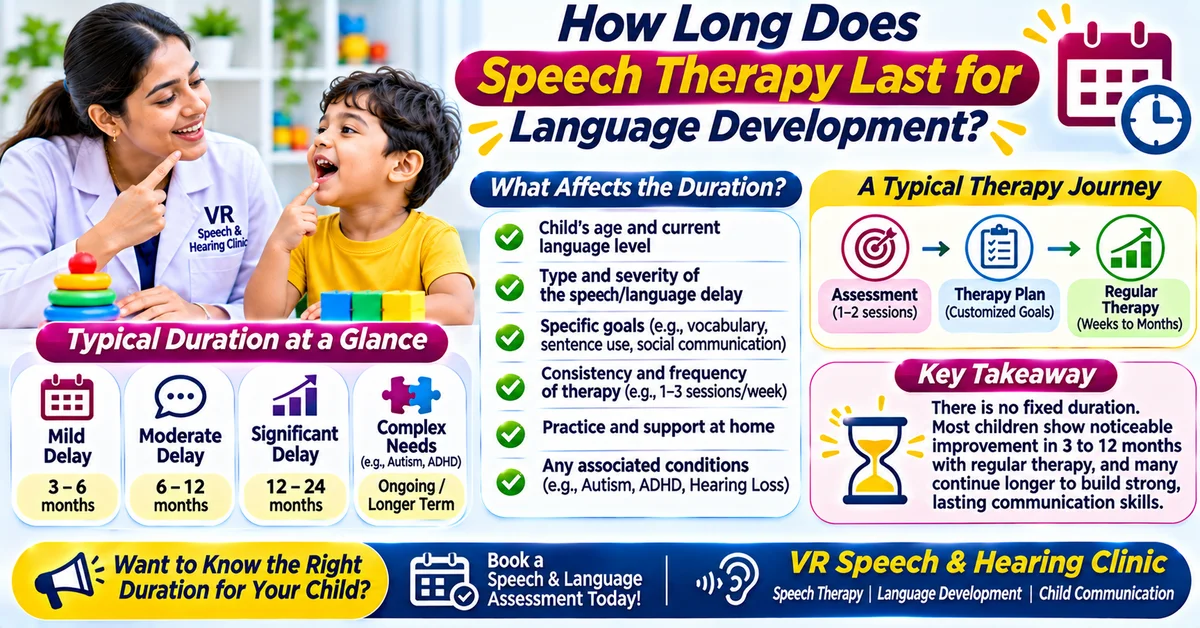
For most children with language development issues, speech therapy lasts between three months and two years. Mild delays often improve within three to six months of consistent therapy. Moderate delays commonly need six to twelve months. More complex or long-term language disorders may require support for two years or longer, sometimes with periodic check-ins through the school years.
These are general ranges, not guarantees. A qualified speech-language pathologist can only give a reliable estimate after assessing your child’s language, speech, hearing, and overall development.
What Are Language Development Issues?
Language is more than saying words. It includes understanding what others say (receptive language) and expressing thoughts through words, sentences, and gestures (expressive language). It also covers social communication, such as taking turns in conversation and using language appropriately with different people.
A child may have a language development issue if they:
Say very few words for their age
Struggle to follow simple directions
Speak in short or incomplete sentences
Make frequent grammar mistakes
Find it hard to tell a story or explain an idea
Seem frustrated when trying to communicate
Language issues can happen on their own or alongside hearing loss, developmental delay, autism, Down syndrome, or other conditions. Because the cause affects the treatment plan, an early evaluation is the best first step.
Typical Speech Therapy Timelines by Severity
Mild language delay: about 3 to 6 months. Children with a small gap between their age and their language level often catch up quickly with weekly sessions and consistent home practice.
Moderate language delay: about 6 to 12 months. When a child is noticeably behind in vocabulary, sentence building, or understanding, therapy usually needs more time. Progress tends to come in steps, with new skills building on earlier ones.
Severe or complex language disorders: 1 to 3 years or longer. Children with a developmental language disorder, or with a condition such as autism or intellectual disability, often need long-term therapy. Goals change over time as the child grows, moving from first words to conversation, and later to reading and writing.
How Age Affects the Length of Therapy
Toddlers (18 months to 3 years). Young children’s brains are highly adaptable, and therapy is often play-based and parent-led. Many toddlers who start early make noticeable gains within a few months, although some late talkers continue to need support.
Preschoolers (3 to 5 years). Therapy at this stage often targets vocabulary, grammar, and early literacy skills that prepare children for school. Six to twelve months is a common range.
School-age children (6 years and above). Language is closely tied to reading, writing, and learning in class, so goals can be broader. Therapy may run longer and often works alongside school support.
Key Factors That Affect How Long Speech Therapy Lasts
No two children progress at the same pace. These factors have the biggest influence:
Severity and type of the issue: A narrow difficulty, such as limited vocabulary, usually resolves faster than a broad one that affects understanding and expression together.
Age at the start of therapy: Earlier support usually leads to faster progress.
Underlying causes: Hearing loss, developmental delay, or neurological conditions can lengthen therapy.
Consistency of attendance: Missed sessions slow momentum.
Home practice: Children who practise daily often progress faster than those who only practise in the clinic.
Attention and motivation: A child who is engaged and comfortable learns more in each session.
Quality of the therapy plan: Clear, measurable goals that are reviewed regularly keep therapy on track.
What a Typical Speech Therapy Program Looks Like
Therapy usually begins with a full assessment. The speech-language pathologist reviews your child’s history, observes how they play and communicate, and uses standardised tools to measure understanding and expression. A hearing check is often recommended too, since even mild hearing difficulty can affect language.
Based on the results, the therapist sets short-term and long-term goals. Most children attend one to three sessions per week, each lasting 30 to 60 minutes. Progress is typically reviewed every two to three months, and the plan is adjusted as needed. As your child improves, sessions may become less frequent before therapy ends.
How Parents Can Help Shorten the Timeline
Parents play the most important role in language development, because children spend far more time at home than in a clinic. Simple habits make a real difference:
Talk about everyday routines, such as mealtime, bath time, and walks
Expand your child’s words, so “ball” becomes “big red ball”
Read together daily and ask simple questions about the story
Give your child time to respond before you jump in
Limit passive screen time and replace it with play and conversation
Practise the activities your therapist recommends for 10 to 15 minutes a day
Share what you notice with your therapist after each session
Signs Your Child Is Making Progress
Progress does not always look dramatic. Watch for a growing vocabulary, longer sentences, better understanding of instructions, more eye contact and interaction, and less frustration when communicating. If you notice these signs, therapy is likely working. If progress stalls for several months, ask your therapist to review the goals and approach.
When Does Speech Therapy End?
Therapy usually ends when your child reaches age-appropriate language skills, meets the agreed goals, or can keep progressing with support at home and school. Some children return for short check-ins during key transitions, such as starting school, because new language demands can bring new challenges.
Why Early Intervention Matters
The earlier language difficulties are identified, the more time a child has to build skills before school demands increase. Early therapy can also reduce frustration, support behaviour and confidence, and lay the groundwork for reading and writing. If you are unsure whether your child’s language is on track, an evaluation gives clarity either way.
How VR Speech and Hearing Clinic Can Help
At VR Speech and Hearing Clinic, therapy begins with a careful assessment of speech, language, and hearing. From there, we build a personalised plan with clear goals, involve parents at every step, and review progress regularly so you always know where your child stands and what comes next.
Final Thoughts
So, how long does speech therapy last for language development issues? For many children it is a matter of months, and for others it is a longer journey over a year or two. What matters most is starting early, attending consistently, practising at home, and working with a therapist who tracks progress closely. If you have concerns about your child’s language, book an evaluation with VR Speech and Hearing Clinic and take the first step today.
Frequently Asked Questions
1. How long does speech therapy take for a toddler with a language delay?
Many toddlers show noticeable progress within three to six months of consistent therapy, especially when parents take part in sessions and practise at home. Children with more complex needs may need longer.
2. Can speech therapy fix a language delay completely?
Many children with mild to moderate delays catch up fully. Others, particularly those with a developmental language disorder, may continue to need some support, but therapy still builds meaningful, lasting skills.
3. How many sessions per week does my child need?
Most children attend one to three sessions per week. The right frequency depends on severity, age, and goals, and your therapist can adjust it over time.
4. Is it too late to start speech therapy for an older child?
No. Children benefit at any age, although earlier support is usually quicker. Older children may need more time because language demands are higher at school.
5. What if my child is not improving?
Share your concerns with the therapist. A plateau may mean the goals need adjusting, hearing needs rechecking, or another professional should be involved.
6. Should I wait to see if my child outgrows a language delay?
Waiting can mean missing a valuable window. An evaluation carries little risk, and if there is no problem, you gain peace of mind.
This article is for general information and does not replace a professional evaluation by a qualified speech-language pathologist.