High-Frequency Hearing Loss: Effects on Speech Understanding
High-Frequency Sensorineural Hearing Loss: How It Affects Speech Understanding
“I can hear people talking, but I can’t understand what they are saying.” If you or someone in your family says this often, the cause may be high-frequency sensorineural hearing loss. It is one of the most common types of hearing loss in adults, and it affects clarity far more than loudness.
This article explains how speech sounds are built, why high-pitched sounds matter so much for understanding, and what happens when a person has moderate to severe high-frequency sensorineural hearing loss. It also covers the treatment options that can help.
How Speech Sounds Use Different Frequencies
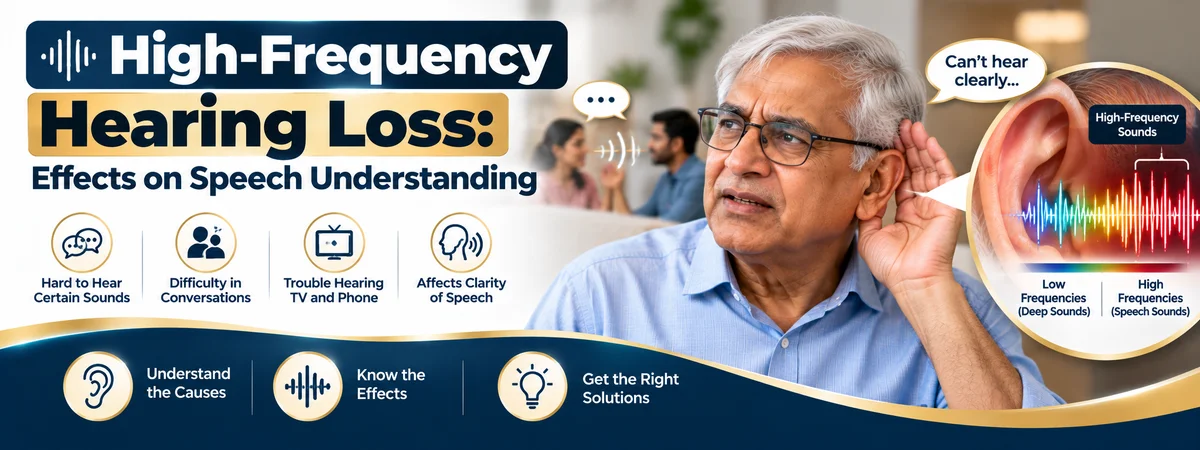
Every sound we hear vibrates at a certain frequency, measured in hertz (Hz). Low frequencies sound deep, like a drum. High frequencies sound sharp, like a whistle. Speech uses a wide range of frequencies, and each speech sound sits in its own part of that range.
Vowels (a, e, i, o, u) are low in pitch, mostly between 250 and 1000 Hz. They are strong and carry most of the loudness of speech.
Mid-frequency consonants (l, m, n, r) fall in the middle range, around 1000 to 2000 Hz.
High-frequency consonants (s, f, th, sh, k, t, p, h) sit roughly between 2000 and 8000 Hz. They are soft, short, and quiet.
Vowels give speech its power, but consonants give it meaning. The words “sat,” “fat,” “cat,” and “hat” share the same vowel. Only the high-pitched consonant at the start tells them apart. When the high-frequency consonants disappear, understanding disappears with them.
What Is High-Frequency Sensorineural Hearing Loss?
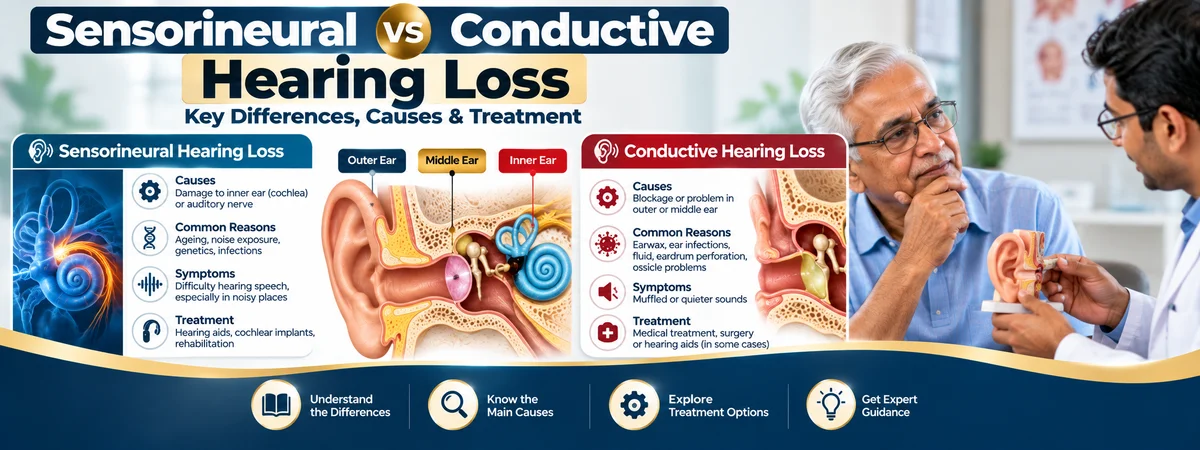
Sensorineural hearing loss is caused by damage to the inner ear (cochlea) or the auditory nerve. The tiny hair cells at the base of the cochlea respond to high-pitched sounds, and they are the first to wear out. Once damaged, they do not grow back.
In high-frequency sensorineural hearing loss, hearing for low pitches may be normal or only mildly reduced, while hearing for high pitches drops sharply. On an audiogram, this appears as a sloping line that falls toward the right.
Degrees of hearing loss are usually described like this:
Mild: 26 to 40 dB
Moderate: 41 to 55 dB
Moderately severe: 56 to 70 dB
Severe: 71 to 90 dB
A person with moderate to severe high-frequency loss cannot hear many of the soft, high-pitched consonants at normal conversation levels, even when the vowels sound perfectly clear.
How Speech Understanding Is Affected
1. Speech sounds loud enough but not clear
This is the classic complaint. Because vowels are still audible, the person feels that people are speaking and that they can hear them. But the consonants are missing, so words blur together. People often say that others “mumble,” when the real problem is the missing high-frequency information.
2. Confusing similar-sounding words
Without the high-pitched consonants, words that differ only by those sounds become hard to separate. Common mix-ups include:
“Sun” and “fun”
“Shoe” and “two”
“Pass” and “path”
“Cat” and “hat”
The person has to guess from context, and guessing is tiring and often wrong.
3. Missing word endings
Plurals (-s), past tense (-ed), and possessives (‘s) are all signaled by high-frequency sounds. A listener with this type of loss may not hear the difference between “He walks” and “He walked,” or between “cat” and “cats.” This changes the meaning of a sentence and can lead to real misunderstandings.
4. Extra difficulty in background noise
Background noise such as traffic, a fan, a crowded market, or a family gathering is mostly low-frequency, and it easily masks the weak high-frequency consonants that were already hard to hear. Restaurants, weddings, meetings, and group conversations become very difficult, even when one-to-one conversation seems manageable.
5. Trouble with women’s and children’s voices
Women and children naturally speak at a higher pitch, and their consonants are also higher in frequency. Many people with high-frequency loss find it much harder to understand a grandchild or a female colleague than a deep male voice.
6. Difficulty on the phone and with television
Telephone speech is already filtered and loses some high-frequency detail. Add a hearing loss, and phone calls become stressful. Many people turn the TV volume very high, which bothers others but still does not make the speech clearer, because loudness does not restore the missing consonants.
7. Listening fatigue
The brain works very hard to fill in missing sounds. Over a day of conversations, this extra effort causes exhaustion, headaches, poor concentration, and irritability. Some people begin avoiding social situations just to save energy.
8. Effects on the person’s own speech
When a person cannot hear their own high-pitched sounds, they may begin to pronounce “s,” “sh,” and “th” poorly, or speak louder than needed. In children, uncorrected high-frequency loss can delay speech and language development, reduce vocabulary, and affect school performance.
9. Emotional and social impact
Repeated misunderstandings can lead to frustration, embarrassment, withdrawal, anxiety, and a feeling of isolation. Research has linked untreated hearing loss in older adults to a higher risk of depression and cognitive decline. Because the loss develops gradually, many people ignore it for years, and family members often notice it first.
Common Causes
Age-related hearing loss (presbycusis)
Long-term exposure to loud noise at work, in traffic, or from loud music through earphones
Ototoxic medicines, which can damage the inner ear
Genetic factors
Head injury
Viral infections and other illnesses
Diabetes, high blood pressure, and poor circulation
Congenital or childhood causes
Signs You Should Not Ignore
Asking people to repeat themselves often
Feeling that others mumble
Struggling to follow conversations in noisy places
Not hearing birds, doorbells, or the beeps of household devices
Turning up the TV or phone volume
Tinnitus (ringing in the ears)
Feeling tired after social events
Avoiding phone calls or gatherings
How Is It Diagnosed?
A hearing evaluation by an audiologist usually includes:
Pure tone audiometry: measures the softest sounds heard at each pitch
Speech audiometry: checks how clearly words are understood
Immittance testing: checks middle ear function
Otoacoustic emissions (OAE) and other tests: assess inner ear function where needed
The results show the exact pattern and degree of loss, which allows treatment to be matched to the person’s needs.
Treatment and Management Options
Sensorineural hearing loss is usually permanent, but it is very manageable with the right support.
Hearing aids: Modern digital hearing aids are programmed to amplify the pitches a person cannot hear and leave the normal ones alone. Features such as noise reduction, directional microphones, and frequency lowering can bring missing high-pitched sounds into a range the ear can still use. Proper fitting and follow-up adjustments are essential for good results.
Cochlear implants: When the loss is severe and hearing aids no longer give enough benefit, a cochlear implant may be considered after a detailed evaluation.
Assistive listening devices: Amplified phones, TV listening systems, and remote microphones help in specific situations.
Auditory training and speech therapy: Therapy helps the brain relearn to use the sounds it now receives. It also supports speech clarity and listening skills, especially in children.
Communication strategies: Family members can help by facing the person, speaking clearly at a normal pace, reducing background noise, and rephrasing instead of just repeating or shouting. Shouting adds loudness and distorts the sound without improving clarity.
Hearing protection: Avoiding loud noise protects the hearing that remains.
Why Early Action Matters
The earlier hearing loss is identified and treated, the better the brain adapts to amplified sound. Long periods without proper hearing input can make speech understanding harder to recover. Early intervention also protects relationships, work performance, safety, and emotional wellbeing.
Hearing and Speech Care in Chhatrapati Sambhajinagar
If you or a family member struggles to understand speech, a professional evaluation is the right first step. VR Speech and Hearing Clinic is located on the Second Floor, Vasantrao Naik Chowk, opposite Hotel Deepali Executive, N-3, CIDCO, Chhatrapati Sambhajinagar, Maharashtra 431003. The clinic offers hearing assessment, speech and language evaluation, and guidance on hearing solutions for children and adults. Book an appointment to find out exactly what your hearing test shows and which options suit you.
Conclusion
High-frequency sensorineural hearing loss affects the clarity of speech, not just its volume. Vowels stay audible, but the soft, high-pitched consonants that carry meaning fade away. The result is muffled speech, confusion in noise, missed word endings, listening fatigue, and social withdrawal. With timely testing, well-fitted hearing devices, auditory training, and family support, most people can regain much of their ability to communicate confidently.
Frequently Asked Questions
1. Why can I hear people but not understand them?
You are likely hearing the low-pitched vowels but missing the high-pitched consonants, such as s, f, th, and sh, which give words their meaning.
2. Can high-frequency sensorineural hearing loss be cured?
Damage to inner ear hair cells is generally permanent, but it can be managed very effectively with hearing aids, cochlear implants, and rehabilitation.
3. Will speaking louder help?
Not really. Louder speech does not restore missing consonants and can sound distorted. Speaking clearly, facing the listener, and reducing noise works better.
4. Why is it so hard to follow conversations in noisy places?
Background noise masks the soft high-frequency consonants, which are the sounds that people with this type of loss already struggle to hear.
5. Do hearing aids help with high-frequency hearing loss?
Yes. Hearing aids programmed for the person’s audiogram amplify the missing high-pitched sounds and improve speech clarity. Fitting and follow-up are important.
6. Can children have high-frequency hearing loss?
Yes. In children it can delay speech and language development and affect learning, so early screening and treatment are very important.
7. When should I see an audiologist?
See one as soon as you notice difficulty understanding speech, frequent requests for repetition, tinnitus, or reduced hearing after noise exposure or illness.