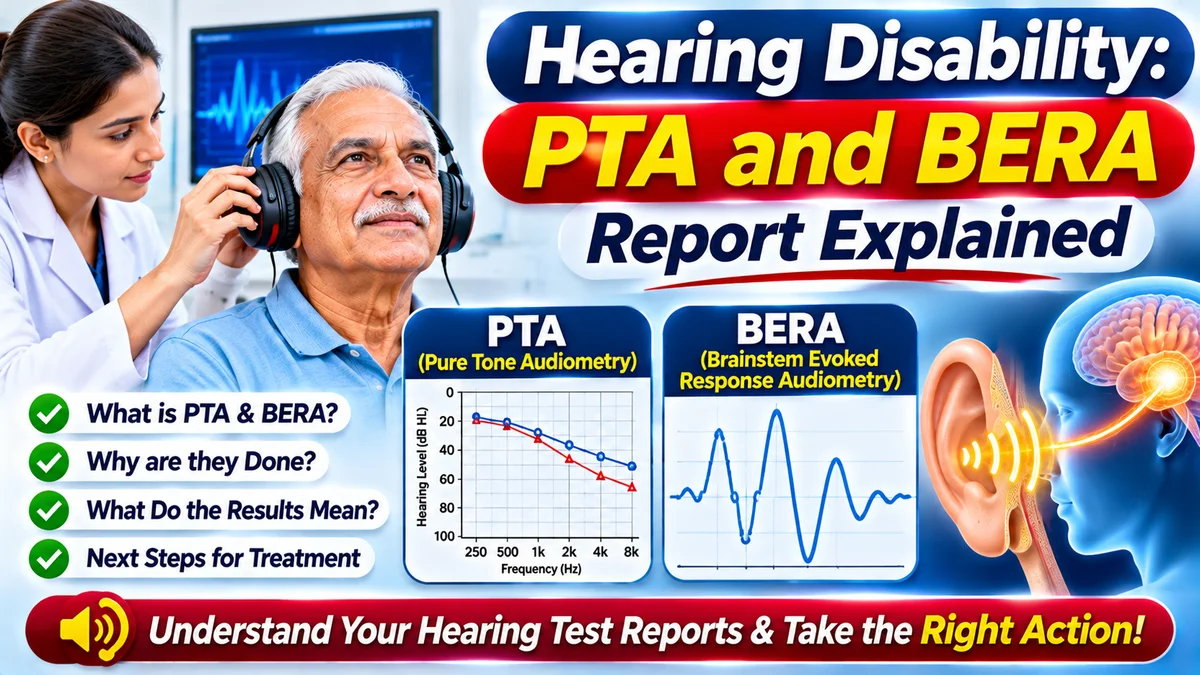
Hearing Disability: PTA and BERA Report Explained
Receiving a report that mentions “hearing disability” can feel overwhelming. The graphs, decibel numbers, and technical terms like PTA and BERA are hard to follow, especially when you are worried about your own hearing or your child’s. The reassuring part is that these two tests give audiologists a clear and reliable picture of how the ear and the hearing pathway are working, and that clarity is the first step toward the right treatment.
At VR Speech and Hearing Clinic, many families arrive holding a PTA and BERA report and asking the same question: what does this actually mean? This guide explains what each test measures, how hearing disability is graded, how to read your report, and what you can do next.
What Is a Hearing Disability?
A hearing disability means that hearing is reduced enough to affect communication, learning, work, or safety. It can involve one ear or both ears, can be present from birth or develop later in life, and can range from difficulty with soft sounds to very little usable hearing.
Hearing disability is not only about volume. Many people can tell that someone is speaking but cannot understand the words, especially in noisy places. This is why a proper assessment never depends on a single test.
In India, hearing disability is recognised under the Rights of Persons with Disabilities Act, 2016, which separates “hard of hearing” from “deaf” based on the level of hearing loss in the speech frequencies. A disability percentage on an official certificate is assigned by an authorised medical board using audiological findings, which is why your PTA and BERA reports matter so much.
What Is a PTA Report?
PTA stands for Pure Tone Audiometry. It is the most commonly used hearing test for older children and adults. The test is done in a sound-treated room. You wear headphones and press a button or raise your hand each time you hear a beep, even a very faint one. The audiologist records the softest sound you can hear at each pitch, usually from 250 Hz (low pitch) to 8000 Hz (high pitch).
Two kinds of testing are done:
Air conduction: sound travels through headphones and passes through the outer ear, middle ear, and inner ear.
Bone conduction: a small vibrator placed behind the ear sends sound straight to the inner ear, bypassing the outer and middle ear.
Comparing the two helps the audiologist work out where the problem lies. The results are plotted on a graph called an audiogram and measured in decibels hearing level (dB HL). A lower number means better hearing. Your report also shows a pure tone average, often called the PTA value. It is usually calculated from the thresholds at 500, 1000, and 2000 Hz, and sometimes 4000 Hz, to summarise hearing in the speech range.
Degrees of Hearing Loss in a PTA Report
The table below shows a commonly used classification. Some guidelines use slightly different ranges, so your audiologist will explain the one used in your report.
Pure tone average (dB HL) | Degree of hearing loss |
|---|---|
0–25 | Normal hearing |
26–40 | Mild |
41–55 | Moderate |
56–70 | Moderately severe |
71–90 | Severe |
91 and above | Profound |
Your report will also state the type of hearing loss:
Conductive: the problem is in the outer or middle ear, such as wax, fluid, infection, or a perforated eardrum. It is often treatable with medicine or surgery.
Sensorineural: the problem is in the inner ear or hearing nerve. It is usually permanent and is managed with hearing devices and therapy.
Mixed: a combination of both.
What Is a BERA Report?
BERA stands for Brainstem Evoked Response Audiometry, also known as ABR, or Auditory Brainstem Response. Unlike PTA, it is an objective test, which means the patient does not need to respond. Small sticker electrodes are placed on the forehead and behind the ears, earphones deliver clicks or tone bursts, and a computer records the tiny electrical signals produced by the hearing nerve and brainstem. The test is painless, and the patient only needs to lie still or sleep. Infants are usually tested in natural sleep, and in some cases sedation is given under medical supervision.
The report shows a series of waves numbered I to V. Wave V is the most important for hearing assessment. The lowest sound level at which wave V can still be identified gives an estimate of the hearing threshold. The report also lists wave latencies and interpeak intervals, and delays in these values may point to a problem along the nerve or brainstem pathway.
BERA is commonly advised for:
Newborns and young children who cannot take part in behavioural testing
People who cannot cooperate because of developmental delay, intellectual disability, or illness
Cases where PTA results are inconsistent or need confirmation
Suspected auditory neuropathy or nerve-related hearing problems
Follow-up after a failed newborn hearing screening
How PTA and BERA Work Together
PTA tells us what the person actually hears and responds to across different pitches in each ear. BERA tells us how the hearing nerve and brainstem respond to sound, without depending on the patient’s attention or cooperation. Using both gives a far more dependable result than either test alone.
When both tests point to the same degree of hearing loss, the diagnosis is considered reliable. A small difference between the two is common because the click used in standard BERA mainly reflects higher pitches, while PTA covers the full range. If the results differ widely, the audiologist may add further tests such as tympanometry, otoacoustic emissions, speech audiometry, or frequency-specific ABR to complete the picture.
How to Read Your Report Step by Step
Check each ear separately. On most audiograms, the right ear is shown with a red circle and the left ear with a blue cross.
Look at the thresholds. The higher the number, the louder the sound must be before you hear it.
Note the pattern. Hearing loss may be flat, sloping toward high pitches, or worse at low pitches.
Compare air and bone conduction. A gap between the two suggests a conductive component.
Read the BERA summary. Look for the wave V threshold and whether the waves appear at normal timings. A “no response” at the highest tested level usually suggests a severe to profound loss, but it must be read along with the other tests.
Read the final impression. The summary states the degree, the type, and the ear involved.
Hearing Disability Percentage and Certificate
Many families ask for a disability percentage. This figure is not decided by a single audiologist or a single number. It is calculated by an authorised medical board using the audiometric thresholds in the speech frequencies of both ears, following the government guidelines in force at the time. Bring your original PTA and BERA reports, earlier reports, and any hearing aid records to the board. Some patients may be asked to repeat the tests, so please confirm the current requirements with the issuing authority.
Treatment and Support Options
The right plan depends on the degree and type of hearing loss, age, and communication needs.
Medical or surgical care: conductive hearing loss from infection, fluid, or wax is assessed by an ENT specialist.
Hearing aids: these help most people with mild to severe sensorineural hearing loss when they are properly selected, programmed, and verified.
Cochlear implant evaluation: considered for severe to profound loss when hearing aids give limited benefit, after a team assessment.
Speech and language therapy: builds listening, speech, and language skills and is especially important for children.
Assistive listening devices and counselling: support classrooms, workplaces, phone calls, and emotional adjustment.
Regular follow-up: hearing can change over time, and devices need regular checks.
For children, timing matters. Experts recommend hearing screening within the first month, a full diagnosis by three months, and the start of intervention by six months of age, because the early years are the most important for language development.
When Should You Get a Hearing Test?
Book an evaluation if you notice that you often ask people to repeat themselves, turn the television volume up, struggle in noisy places, or have ringing in the ears, ear discharge, or ear pain. In children, watch for no response to loud sounds, delayed or unclear speech, and falling school performance. Sudden hearing loss in one or both ears needs urgent medical attention.
Get Expert Help at VR Speech and Hearing Clinic
A report is only useful when someone explains it clearly and builds a plan around it. At VR Speech and Hearing Clinic, our team reviews your PTA and BERA results, explains them in plain language, and guides you through hearing aid trials, speech and language therapy, counselling, and referrals when needed. If you or your child has a report that mentions hearing disability, book an appointment and bring all previous reports. Early, accurate guidance gives the best chance of better hearing and communication.
Frequently Asked Questions (FAQs)
1. What does hearing disability mean in a PTA report?
It means the thresholds on your audiogram are worse than the normal range, so soft sounds are not heard clearly. The report states the degree (mild to profound), the type (conductive, sensorineural, or mixed), and which ear is affected.
2. What is the difference between PTA and BERA?
PTA is a behavioural test in which the patient responds to beeps. BERA is an objective test that records the brain’s electrical response to sound, so the patient does not need to respond. PTA suits cooperative older children and adults, while BERA suits infants, young children, and patients who cannot cooperate.
3. Is the BERA test painful, and is sedation needed?
BERA is painless. Electrodes are attached with stickers and earphones are placed in the ears. Babies are usually tested while sleeping naturally. Sedation may be needed for restless older children, and it is given only under medical supervision.
4. Can a hearing disability be cured?
Conductive hearing loss caused by wax, fluid, or infection can often be treated by an ENT specialist. Sensorineural hearing loss is usually permanent, but hearing aids, cochlear implants, and speech therapy can greatly improve hearing and communication.
5. How long do PTA and BERA take?
PTA usually takes about 20 to 30 minutes. BERA can take longer, often one to two hours including preparation, depending on the patient’s age and how settled or asleep they are.
6. Do I need both PTA and BERA tests?
Not always. Cooperative adults often need only PTA with supporting tests. BERA is added for children, for patients who cannot respond reliably, when results need confirmation, or when a nerve-related problem is suspected. Your audiologist will advise what is right for you.