Hearing Clinic Near Me in Ahilyanagar (Ahmednagar): How to Choose, What to Expect and When to Go
If you are searching for a "hearing clinic near me" in Ahilyanagar (formerly Ahmednagar), you probably have a specific worry: you or someone you love is not hearing well, and you are not sure who to see, what the visit involves, or whether it will cost a fortune. This guide answers those questions in plain language, so you can decide with confidence, whichever clinic you choose.

Quick answer
Where to go first: For gradual hearing difficulty (asking people to repeat, high TV volume, trouble in noise), a hearing test with a qualified audiologist is the right first step.
When not to wait: If hearing drops suddenly in one or both ears, treat it as a medical emergency and see a doctor the same day (details below).
Who to look for: A registered audiologist who runs a full diagnostic test, offers hearing aid trials, and includes follow-up adjustments in their service.
Local option: VR Speech and Hearing Clinic, Shop No. 3, Vitthal Apartment, Pipeline Road Chowk, opposite Parvati Corner, Bhistabag, Ahilyanagar, Maharashtra 414003.
Clinic details at a glance
Clinic | VR Speech and Hearing Clinic |
Address | Shop No. 3, Vitthal Apartment, Pipeline Road Chowk, opposite Parvati Corner, Bhistabag, Ahilyanagar, Maharashtra 414003 |
Phone / WhatsApp | 9657588677 |
Hours | Monday to Saturday 9:00 AM to 9:00 PM; Sunday 9:00 AM to 12:00 PM (please call to confirm before visiting) |
Team | Dr. Vilas Rathod (BASLP, audiologist and speech-language pathologist); Vikas Rathod (audiologist) |
Services | Audiometry, impedance audiometry (tympanometry), hearing aid trial, fitting and programming, hearing aid repair, tinnitus management, speech therapy, occupational therapy, pediatric hearing assessment, counseling |
Hearing aid brands | Phonak, Signia, Oticon, ReSound, Widex, Unitron, Starkey, Hansaton |
Why hearing health deserves attention
Hearing loss usually develops slowly, which is why most people delay getting help. According to the World Health Organization, around 1.5 billion people worldwide live with some degree of hearing loss, and about 430 million of them need rehabilitation services. WHO also links hearing loss in older adults with early cognitive decline and dementia, and notes that age-related hearing loss can be managed effectively, including with hearing aids.
Common causes include ageing, long-term exposure to loud noise, chronic ear infections, ear wax blockage, some medicines, and genetic factors. Left untreated, hearing loss can lead to social withdrawal, difficulty at work, and safety risks such as not hearing traffic or alarms.
Children are affected too. WHO estimates that almost 60% of hearing loss in children is caused by preventable factors such as ear infections and birth complications. Early detection protects speech, language and school performance.
Signs you should get your hearing checked
Book a hearing test if you or a family member:
Often asks people to repeat themselves
Struggles to follow conversations in restaurants, weddings, markets or traffic
Turns the TV or phone volume up higher than others prefer
Feels that people mumble
Has ringing, buzzing or hissing in the ears (tinnitus)
Avoids group gatherings or phone calls
Hears better with one ear than the other
Has a child with delayed speech or who does not respond when called
Noticed a hearing change after an infection, head injury or a new medicine
Adults over 50, and anyone regularly exposed to loud noise (factories, construction, heavy traffic, loud music, firearms), should consider a baseline test even without symptoms.
A simple self-check: Ask a family member whether they have noticed any of the signs above. People with hearing loss are often the last to notice it, because the brain adapts gradually. An online or phone-based screening can hint at a problem, but it cannot replace a proper test in a sound-controlled room.
When it is an emergency: do not wait for a clinic appointment
Most hearing loss is gradual. Sudden hearing loss is different.
Sudden sensorineural hearing loss (sometimes called sudden deafness) is a rapid, unexplained drop in hearing, either all at once or over a few days. The US National Institute on Deafness and Other Communication Disorders (NIDCD) advises treating it as a medical emergency and seeing a doctor immediately, because many people wrongly assume it is just allergy, a sinus problem or ear wax. Treatment, commonly with steroids, works best when started early, and the first 72 hours are often described as the most important window.
Go to an ENT doctor or hospital the same day if you notice:
Hearing that drops suddenly in one or both ears, or that you notice on waking up
Hearing loss after a head injury or a very loud blast
Hearing loss together with severe dizziness, facial weakness, slurred speech, vision changes or severe headache (treat this as a possible stroke and seek emergency care)
Ear pain with discharge, fever or swelling behind the ear
An audiologist can run a quick hearing test and help confirm the type of loss, but sudden loss needs medical evaluation. Do not wait for it to "settle on its own."
Audiologist or ENT doctor: who should you see first?
These two professionals work together, and each does different things.
An audiologist measures hearing, identifies the type and degree of hearing loss, fits and programs hearing aids, and provides hearing rehabilitation and counseling. In India, audiologists and speech-language pathologists typically hold a BASLP or MASLP degree and are registered with the Rehabilitation Council of India (RCI).
An ENT doctor (otolaryngologist) is a medical doctor who diagnoses and treats ear diseases and performs surgery where needed, such as for infections, eardrum perforation, or tumors.
A practical rule: If hearing is slowly declining and there is no pain, discharge or sudden change, start with an audiologist. If there is pain, discharge, sudden loss, dizziness, one-sided loss, or an injury, see an ENT doctor first. A good audiologist will refer you to an ENT whenever the test results suggest a medical cause.
How to choose a good hearing clinic (a checklist)
Proximity matters, because hearing aids need several follow-up adjustments, but it should not be the only factor. Use this checklist for any clinic you consider, including ours.
1. Check the professional's qualifications and registration. Ask whether the audiologist holds a recognised degree (BASLP, MASLP or equivalent) and is registered in the Central Rehabilitation Register maintained by the Rehabilitation Council of India. A registered professional will be able to share their CRR number.
2. Ask what the hearing test includes. A proper evaluation includes an ear examination, pure-tone audiometry, and usually speech testing and middle-ear testing (impedance audiometry or tympanometry). Be cautious of a quick "free check" that moves straight to selling a device.
3. Ask about the range of brands and models. A clinic that works with several manufacturers can match a device to your hearing loss, lifestyle and budget, rather than pushing a single brand.
4. Ask about a trial period. Hearing aids behave differently in real life than in a quiet clinic. Ask whether you can try before committing, and what the return or exchange policy is, in writing.
5. Ask how follow-up is handled. Fine-tuning during the first weeks and months is a major factor in success. Ask whether adjustments are included in the price, how often you will be seen, and who services the device if the brand is not sold locally.
6. Ask for a clear, itemised price. You should be able to see the cost of the device, the warranty, and any service charges separately.
7. Look at how the clinic communicates. A good audiologist asks about your daily listening situations (family, work, TV, phone, noise), explains results in simple terms, and answers questions without rushing.
8. Read recent reviews with care. Look for patterns in comments about honesty, follow-up and explanation, rather than only the star rating.
Red flags: pressure to buy the same day, refusal to share credentials or the return policy, no written test report, vague answers about the price or warranty, and claims that a hearing aid will "restore normal hearing" or "cure" hearing loss.
About VR Speech and Hearing Clinic, Ahilyanagar
VR Speech and Hearing Clinic provides audiology and speech-language services under one roof for children, adults and senior citizens. The clinic is led by Dr. Vilas Rathod (BASLP) with audiologist Vikas Rathod. [Add RCI CRR registration number(s) and years of experience here.]
Services offered
Hearing tests (pure-tone audiometry): Identifies the type (conductive, sensorineural or mixed) and degree of hearing loss. This is the foundation of any recommendation.
Impedance audiometry (tympanometry): Checks how the eardrum and middle ear are working, which helps identify fluid, infection or eardrum problems, especially in children.
Hearing aid trial, fitting and programming: Devices are programmed to your individual hearing profile and fine-tuned over follow-up visits.
Hearing aid repair and maintenance: Servicing and support for existing hearing aid users.
Tinnitus management: Assessment and counseling for ringing or buzzing in the ears.
Pediatric hearing assessment: Age-appropriate testing for infants and young children.
Speech and language therapy: For speech delay, articulation problems, stuttering and voice disorders in children and adults, including communication difficulties after illness or injury.
Occupational therapy and counseling: Support for children and families, and guidance for adjusting to hearing loss or a new hearing aid.
The clinic's website also advertises a home hearing test service. Please call ahead to confirm availability for your area.
What happens during a hearing test visit
Knowing what to expect makes the visit less stressful.
Conversation and history. The audiologist asks about your concerns, when you first noticed the problem, noise exposure, ear infections, medicines, family history, and tinnitus or dizziness.
Ear examination. The ear canal and eardrum are checked, often with an otoscope, to look for wax, infection or other blockage.
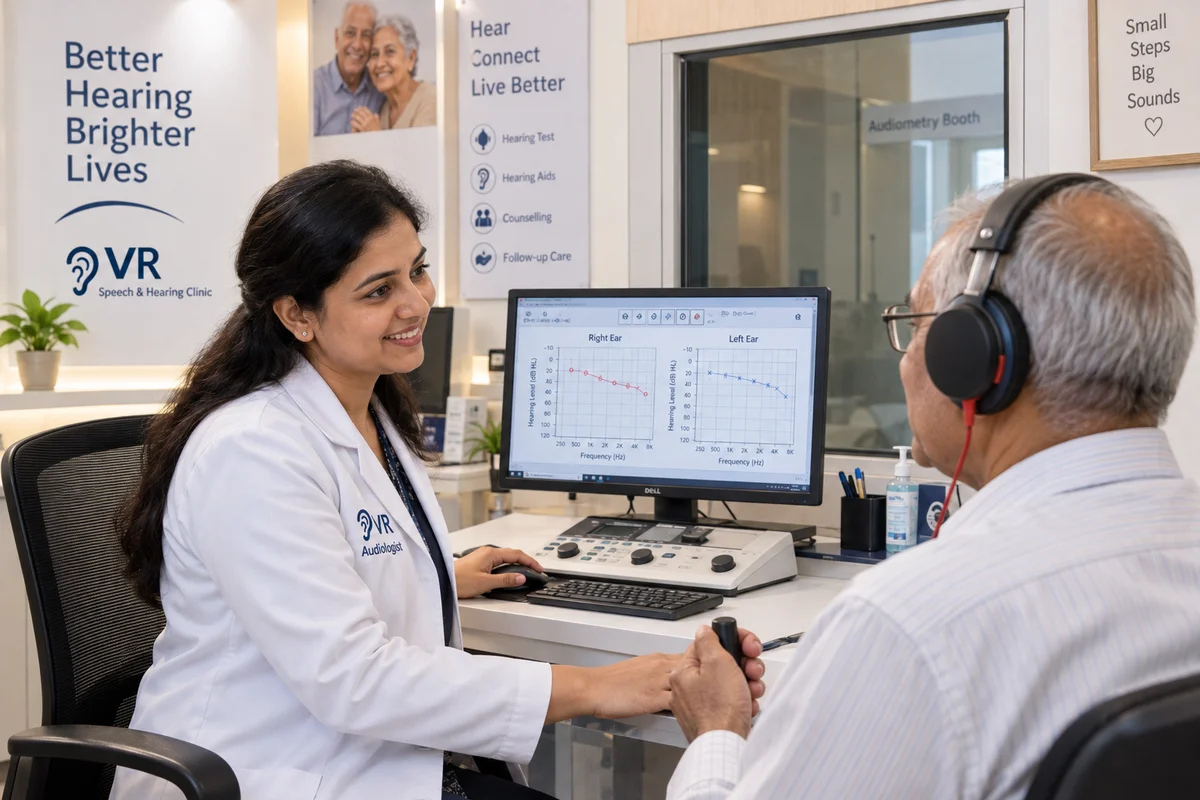
Hearing tests. You wear headphones and respond to tones of different pitches and volumes. Speech testing checks how clearly you understand words, not just whether you detect sound. Middle-ear testing (tympanometry) uses a soft probe at the ear opening and is painless.
Results explained. You are shown the audiogram (a graph of your hearing) and the findings are explained in simple terms.
Recommendations. These may include monitoring, ear cleaning, a referral to an ENT doctor, hearing aids, therapy, or a combination.
Hearing tests are painless and non-invasive.
How to prepare:
Bring any previous hearing test reports, prescriptions and a list of medicines.
Avoid loud noise for a few hours before the test, where possible.
If a family member notices your difficulty most, bring them along. They can describe what you miss in everyday situations.
Bring a list of the situations where you struggle most, such as TV, phone, family gatherings or work meetings.
For infants and young children, objective tests that need no active response, such as OAE (otoacoustic emissions) or BERA (brainstem evoked response audiometry), may be used. Ask the clinic which tests suit your child's age.
Understanding your results
Types of hearing loss
Conductive: A problem in the outer or middle ear, such as wax, fluid, infection or eardrum damage. Often medically or surgically treatable.
Sensorineural: A problem in the inner ear or hearing nerve, usually permanent. Common with ageing and noise exposure.
Mixed: A combination of both.
Degrees of hearing loss (approximate ranges in decibels; classification systems vary slightly)
Degree | Approximate hearing level | What it can feel like |
|---|---|---|
Normal | Up to 25 dB | No difficulty |
Mild | 26 to 40 dB | Trouble with soft speech and in noise |
Moderate | 41 to 55 dB | Difficulty with normal conversation |
Moderately severe | 56 to 70 dB | Needs raised voices, struggles in groups |
Severe | 71 to 90 dB | Hears only very loud speech |
Profound | 91 dB and above | Little or no speech hearing without strong support |
Your audiologist will explain which category applies to each ear. The two ears can differ, and a difference between ears is itself worth discussing with the audiologist.
Hearing aids: what to know before you buy
Common styles
Behind-the-ear (BTE): Powerful and durable, often chosen for moderate to severe loss.
Receiver-in-canal (RIC): Small, discreet and popular for mild to moderately severe loss.
In-the-canal (ITC) and completely-in-canal (CIC): Small custom devices that sit in the ear canal. Suitability depends on your ear shape and the degree of loss.
Things worth knowing
Hearing aids help you hear better, but they do not restore normal hearing. They work best when you actually wear them regularly.
There is an adjustment period. Sounds can feel loud or unnatural at first, and the brain takes weeks to adapt. Follow-up visits for fine-tuning are normal and expected.
The best device depends on your degree of loss, ear anatomy, lifestyle, hand dexterity, and budget. The most expensive option is not automatically the best for you.
Features to ask about include noise reduction, rechargeable batteries, Bluetooth connectivity for phone and TV, and whether the device can be adjusted by a local clinic.
Ask about the warranty, what it covers, and what is paid separately after it ends.
Hearing aids need routine care: keep them dry, clean them as advised, and book periodic check-ups.
For brand comparisons, see our guides on Top Hearing Aid Brands in India and Best Hearing Aid Brands in India.
Cost and financial support in India
What affects the price of a hearing aid. Technology level, brand, style, rechargeable or battery models, warranty length, and the audiologist's fitting and follow-up services. Prices vary widely, from entry-level devices to premium models costing many times more. Ask for a written, itemised quote and compare like with like. For a detailed breakdown, see our guide to the average cost of a hearing aid in India.
Government support (ADIP Scheme). Under the Assistance to Disabled Persons for Purchase/Fitting of Aids and Appliances (ADIP) scheme, eligible persons with disabilities can receive assistive devices, including hearing aids, through authorised implementing agencies. Key points from the scheme documents:
The applicant must be an Indian citizen holding a disability certificate showing at least 40% disability.
Support is either the full cost or 50% of the cost, depending on income. Income proof such as a BPL card or an income certificate is typically needed.
Devices are provided through authorised agencies and camps, not through private clinics' regular sales.
If you may qualify, ask your audiologist to help with the hearing assessment documentation, and contact your district social welfare office or district disability rehabilitation centre for current camp dates and procedures.
Clinic programs and EMI. VR Speech and Hearing Clinic's website describes a CSR-supported hearing aid program in which 50% of the cost is covered for eligible patients, and the site also lists EMI payment options. Eligibility and availability can change, so please ask the clinic for current terms.
Children: hearing and speech milestones
Early hearing problems can quietly delay speech and learning. Every newborn should ideally have a hearing screening, and any child with a family history of hearing loss, a difficult birth, jaundice needing treatment, serious infections such as meningitis, or repeated ear infections should be tested.
See an audiologist or speech therapist if your child:
Does not startle at loud sounds or turn toward voices in the first months
Is not babbling by around 6 to 9 months
Has no single words by around 12 to 18 months
Does not respond when called, or needs the TV very loud
Has speech that is hard for family to understand as they grow
Has repeated ear infections, ear discharge or frequent "blocked ear" complaints
Is falling behind at school, or seems inattentive in class
When in doubt, test. A hearing test is painless and quickly rules hearing in or out as the cause of a speech delay.
Ear wax and everyday ear care: do's and don'ts
Ear wax is normal and usually clears on its own. It becomes a problem when it blocks the canal and causes muffled hearing or fullness.
Do:
Get a blocked ear checked by a professional who can look inside the ear
Dry your ears gently after bathing
Tell the clinic if you have had ear surgery, a perforated eardrum, or ear discharge before any cleaning
Don't:
Push cotton buds, hairpins, matchsticks or keys into the ear. This often packs wax deeper and can injure the eardrum.
Use ear candles, which are not safe or effective.
Put drops or oil in the ear if you have ear pain, discharge or a known eardrum perforation, unless a doctor advises it.
Assume that muffled hearing is only wax. A hearing test confirms the cause.
Protecting your hearing
Noise is a major avoidable cause of hearing loss. Simple habits help:
Keep headphone volume moderate, and take listening breaks
Use earplugs or earmuffs in noisy workplaces, at loud weddings and processions, and around firecrackers and loudspeakers
Treat ear infections promptly, and do not ignore a child's recurring ear problems
Ask a doctor before long-term use of medicines that can affect hearing
Get hearing checked periodically if you are over 50 or work in a noisy environment
Why a local clinic matters
A hearing aid is not a one-time purchase. It needs follow-up adjustments, cleaning, repairs and periodic re-testing, since hearing can change over time. A clinic close to home makes these visits easier to keep, and a clinic that knows your history can spot changes sooner. This is especially useful for older family members who may need someone to accompany them.
VR Speech and Hearing Clinic on Pipeline Road, near Bhistabag Chowk, serves residents of Ahilyanagar city and nearby areas, so you can avoid travelling to larger cities for routine tests and follow-ups.
Frequently asked questions
Where is VR Speech and Hearing Clinic located in Ahilyanagar?
Shop No. 3, Vitthal Apartment, Pipeline Road Chowk, opposite Parvati Corner, Bhistabag, Ahilyanagar (Ahmednagar), Maharashtra 414003.
What are the clinic timings?
The clinic lists Monday to Saturday, 9:00 AM to 9:00 PM, and Sunday, 9:00 AM to 12:00 PM. Please call 9112717179 to confirm before you visit.
Is Ahmednagar the same as Ahilyanagar?
Yes. The city and district were officially renamed Ahilyanagar, and many people still search for Ahmednagar. The clinic is at the same location under either name.
Do I need a doctor's referral for a hearing test?
No. You can visit an audiologist directly for a hearing test. If the results suggest a medical cause, you will be referred to an ENT doctor.
Is a hearing test painful? How long does it take?
It is painless and non-invasive. You listen for tones through headphones and respond. Ask the clinic how long to plan for, as it depends on which tests are needed.
How do I know if I need a hearing aid or just ear cleaning?
Only an ear examination and hearing test can tell. Wax can cause temporary muffled hearing, while sensorineural hearing loss is usually permanent and may need hearing aids.
At what age should I get my hearing tested?
There is no fixed age. Test children whenever speech or response to sound is a concern, adults once they notice difficulty, and consider a baseline test after age 50 or earlier with heavy noise exposure.
Can hearing aids cure hearing loss?
No. Hearing aids make sounds clearer and louder in a way matched to your hearing loss, but they do not restore normal hearing. Regular use and follow-up adjustments improve results.
How long does it take to get used to a hearing aid?
Many people need several weeks to adapt. Sounds may feel loud or unfamiliar at first. Wear the device regularly and attend follow-up visits for fine-tuning.
Does the clinic offer hearing aids for children?
Yes. Hearing aid solutions are available for all ages, including children, after a proper pediatric assessment.
Can speech therapy help adults?
Yes. Speech and language therapy helps adults with stuttering, voice problems, or communication difficulties after a stroke, illness or injury.
Are there government schemes for hearing aids?
The ADIP scheme can support eligible persons holding a disability certificate of at least 40%, through authorised agencies. Your audiologist or district social welfare office can guide you on the process.
My hearing dropped suddenly. What should I do?
See an ENT doctor or go to a hospital the same day. Sudden hearing loss is a medical emergency, and early treatment gives the best chance of recovery.
Take the first step
Hearing loss rarely improves on its own, but it is very manageable when found early. A single test can tell you whether you need ear cleaning, medical care, hearing aids or just reassurance.
To book a hearing test at VR Speech and Hearing Clinic, call or WhatsApp 9112717179, or book an appointment online. Clinic address: Shop No. 3, Vitthal Apartment, Pipeline Road Chowk, opposite Parvati Corner, Bhistabag, Ahilyanagar, Maharashtra 414003.
Sources
World Health Organization: Deafness and hearing loss (who.int)
US National Institute on Deafness and Other Communication Disorders (NIDCD): Sudden Deafness (nidcd.nih.gov)
UCSF EARS: How to Choose a Hearing Care Provider; Sudden Hearing Loss (ears.ucsf.edu)
Rehabilitation Council of India: Central Rehabilitation Register (rehabcouncil.nic.in)
ADIP Scheme, Department of Empowerment of Persons with Disabilities (via vikaspedia.in and NIEPMD scheme documents)