How to Find Certified Speech Therapists Offering Online Sessions
If your child is slow to start talking, if you stammer in meetings, or if a family member is recovering from a stroke, you already know how much clear communication matters. The good news is that you no longer need to travel across the city, wait weeks for an appointment, or give up a workday to see a specialist. Online speech therapy lets you work with a qualified professional from your own living room.
The harder question is how to find a certified speech therapist offering online sessions that you can genuinely trust. A quick search returns dozens of names, and not every profile tells you who is properly trained. This guide walks you through what to check, what to ask, and what to avoid, so you can book with confidence.
Why Online Speech Therapy Is Growing So Fast
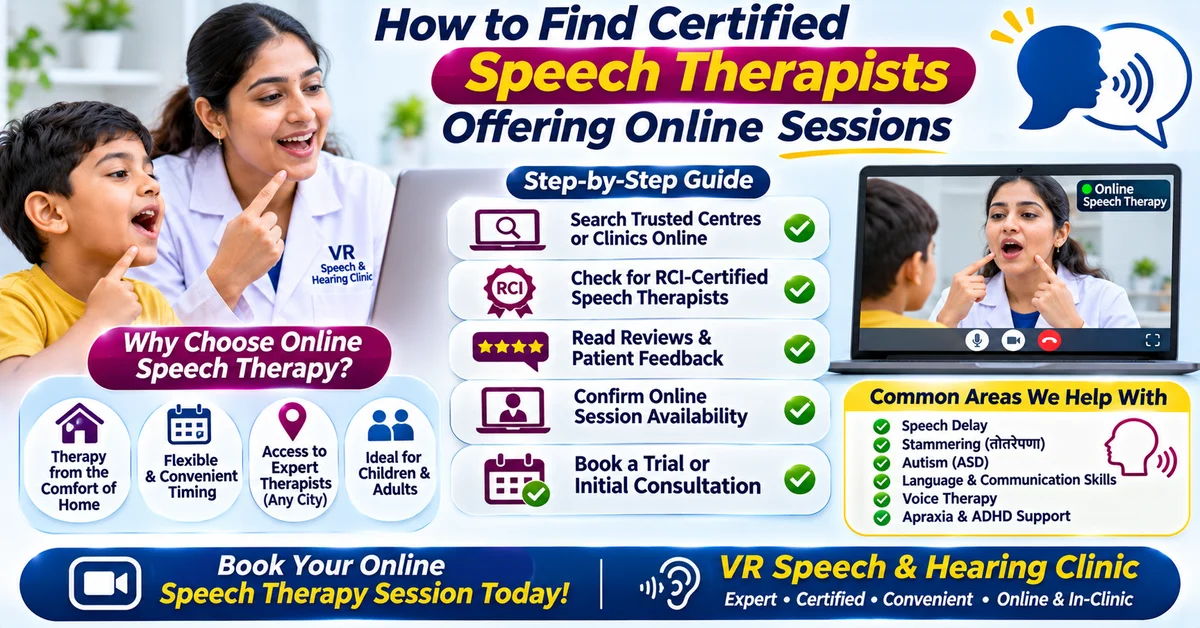
Online speech therapy, also called telepractice or teletherapy, delivers assessment and treatment through a secure video call. Families choose it for practical reasons:
Convenience: no commute, no waiting rooms, and easier scheduling around school and work.
Access: you can reach experienced specialists even when none practise near you.
Comfort: children often feel more relaxed at home, and therapists see real routines and surroundings.
Family involvement: parents sit beside the child, learn the techniques, and practise them daily.
Consistency: a weekly routine is easier to maintain when travel is not in the way.
Research on telepractice suggests it can work well for many speech, language, voice, and fluency concerns, especially when a parent or caregiver takes part. It is not the right fit for every situation, which is exactly why choosing the right professional matters.
What Certified Really Means for a Speech Therapist
Anyone can call themselves a coach or trainer online, but a speech-language pathologist is a regulated healthcare professional. When you review a profile, look for these markers of a certified speech therapist in India:
Recognised qualification: a BASLP (Bachelor of Audiology and Speech-Language Pathology) or MASLP degree from a recognised university or institute.
RCI registration: the Rehabilitation Council of India maintains a Central Rehabilitation Register, and qualified professionals are expected to hold a valid registration number. Ask for it and verify it.
Supervised clinical training: real hands-on hours with children and adults, not just classroom theory.
Ongoing learning: workshops and courses in areas such as stammering, voice, and language disorders.
If you live outside India, look for the local equivalent, such as a state licence or ASHA certification (CCC-SLP) in the United States, or HCPC registration in the United Kingdom.
Step-by-Step: How to Find a Certified Online Speech Therapist
1. Define the concern
Note what you observe: late first words, unclear sounds, repeated syllables, a hoarse voice, or difficulty finding words after a stroke. Clear notes help a therapist understand your needs quickly.
2. Search with intent
Use specific phrases such as online speech therapy for stammering or child speech delay therapist online instead of generic terms. Also ask paediatricians, ENT doctors, audiologists, neurologists, and school counsellors for referrals. They know who delivers reliable results.
3. Verify credentials
Request the therapist’s degree and registration details. A genuine professional will share them without hesitation.
4. Match the specialisation
Speech-language pathology is a broad field. Ask whether the therapist regularly treats your specific concern and age group.
5. Check the platform
Secure video calls, a stable connection, screen sharing for digital activities, and clear privacy practices are essential. Sessions should never be recorded without your consent.
6. Book an initial assessment
Good therapy begins with case history, observation, and structured tasks, followed by a clear explanation of the findings. Be cautious of anyone who promises results without assessing first.
7. Review the plan
Look for specific goals, home-practice routines, and regular progress reviews. Therapy should feel structured, not random.
Questions to Ask Before You Book
Are you a registered speech-language pathologist, and can you share your registration number?
Have you worked with my child’s age group or my specific concern?
How do you assess before starting therapy?
How long are sessions, and how often should we meet?
What will you expect from me as a parent or caregiver between sessions?
How will you measure and share progress?
What happens if online therapy turns out not to be the right fit?
Who Can Benefit from Online Speech Therapy?
Online sessions commonly support:
Children with delayed speech or language development
Articulation difficulties, such as trouble pronouncing certain sounds
Stammering (stuttering) in children, teenagers, and adults
Voice problems, including hoarseness from heavy voice use
Adults with aphasia or slurred speech after a stroke or brain injury
Parent coaching for toddlers who are late talkers
Some needs, such as feeding and swallowing difficulties, usually require hands-on, in-person care. A trustworthy therapist will tell you this honestly.
What to Expect in the First Online Session
The first session is usually an assessment. The therapist asks about developmental history, family concerns, and daily communication, then observes speech and language through play or conversation. Afterwards you receive a simple explanation of what was found, the recommended goals, and how often to meet. Keep a quiet room, a charged device, and a few of your child’s favourite toys or books nearby.
Red Flags to Avoid
No credentials, or reluctance to share a registration number
Guaranteed cures or results within a fixed number of days
No assessment before a plan is created
Generic worksheets or apps with no personalisation
Weak privacy practices or recording without consent
Pressure to pay for long packages upfront
Why Families Choose VR Speech and Hearing Clinic
At VR Speech and Hearing Clinic, therapy is led by Vilas Rathod, a BASLP-qualified speech-language professional. The approach rests on three simple ideas: assess first, personalise the plan, and involve the family. Each client receives clear goals and practical home activities, so progress continues between sessions. Because speech and hearing are closely linked, hearing concerns are considered whenever they are relevant. Online sessions make it easy for families to start therapy without travel, while still receiving attentive, professional guidance.
Final Thoughts
Finding a certified speech therapist online does not have to be overwhelming. Verify the qualification and registration, match the therapist to your concern, begin with a proper assessment, and insist on a clear plan with measurable progress. Early support makes a real difference, so do not wait if something feels off. If you are ready to take the first step, book an initial online consultation with VR Speech and Hearing Clinic and get a clear, honest picture of your next steps.
Frequently Asked Questions (FAQs)
1. Is online speech therapy as effective as in-person therapy?
For many speech, language, voice, and fluency concerns, online therapy can be very effective, particularly with active parent or caregiver involvement. Some needs, such as swallowing disorders, may need in-person care.
2. How do I know a speech therapist is certified?
Ask for their degree (BASLP or MASLP) and their RCI registration number, and verify it. Genuine professionals share these details openly.
3. At what age can a child start online speech therapy?
Many children begin around two to three years of age, often with parent coaching. A therapist decides the best approach after an assessment.
4. What equipment do I need for online sessions?
A smartphone, tablet, or laptop with a camera, a stable internet connection, and a quiet space are usually enough.
5. How long does online speech therapy take to show results?
This depends on the concern, age, and consistency of home practice. A good therapist reviews progress regularly and adjusts the plan.
6. How do I book a session with VR Speech and Hearing Clinic?
Contact the clinic to schedule an initial online assessment with Vilas Rathod, BASLP, who will discuss your concerns and recommend next steps.