Cochlear Implant vs Hearing Aid: Which One Do You Need?
Cochlear Implant vs Hearing Aid: Which One Do You Need?
Hearing loss affects millions of people across all age groups, and today there are more solutions than ever to help people reconnect with the world of sound. Two of the most common options are hearing aids and cochlear implants. While both devices are designed to improve hearing, they work in very different ways and are suited for different levels and types of hearing loss.
If you or a loved one has been advised to consider one of these devices, understanding how they differ can help you make an informed decision. At VR Speech and Hearing Clinic, our audiologists regularly guide patients through this exact choice, using detailed hearing assessments to recommend the option that best fits their lifestyle and hearing needs.
This guide breaks down everything you need to know about cochlear implants versus hearing aids, including how they work, who they are meant for, their benefits, and how to decide which one is right for you.

WHAT IS A HEARING AID
A hearing aid is a small electronic device worn in or behind the ear. It works by amplifying sound so that it is easier for the ear to detect and process. Hearing aids do not restore normal hearing; instead, they make sounds louder and clearer so that the remaining hearing ability can be used more effectively.
Hearing aids are generally recommended for people with mild to moderately severe hearing loss. They rely on the ear's natural structures, meaning the inner ear and auditory nerve must still be functioning well enough to process the amplified sound.
Modern hearing aids come in several styles, including behind-the-ear, in-the-ear, and completely-in-canal models. Many now include advanced features such as noise reduction, directional microphones, rechargeable batteries, and wireless connectivity to smartphones and televisions.
WHAT IS A COCHLEAR IMPLANT
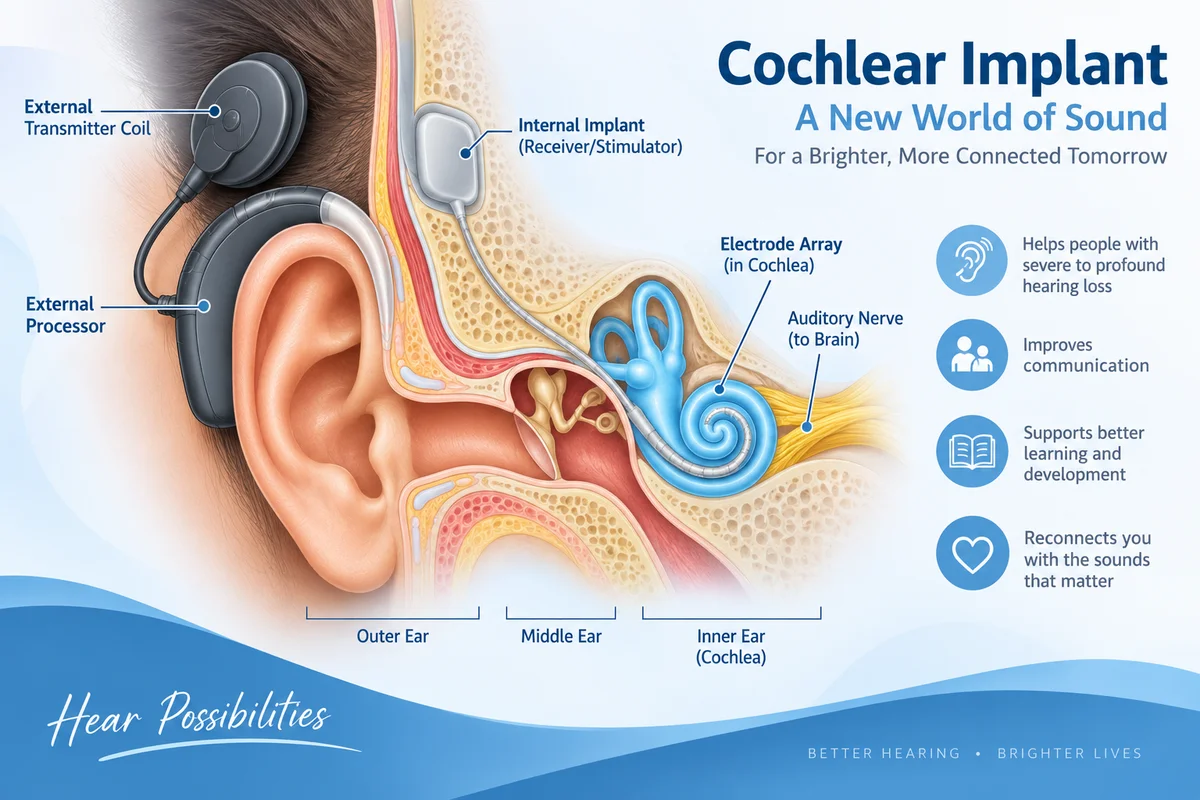
A cochlear implant is a surgically placed electronic device designed for individuals with severe to profound hearing loss who receive little to no benefit from hearing aids. Unlike a hearing aid, a cochlear implant does not simply amplify sound. Instead, it bypasses the damaged parts of the inner ear and directly stimulates the auditory nerve, sending signals straight to the brain.
A cochlear implant system has two main parts: an internal component that is surgically implanted under the skin and into the cochlea, and an external component called a sound processor that is worn behind the ear. Sounds picked up by the external processor are converted into electrical signals, which the internal implant sends to the auditory nerve.
Because it requires surgery, a cochlear implant is generally considered when hearing aids no longer provide meaningful improvement in speech understanding, even at their most powerful settings.
KEY DIFFERENCES BETWEEN COCHLEAR IMPLANTS AND HEARING AIDS
How They Work A hearing aid amplifies existing sound so damaged ears can use whatever hearing ability remains. A cochlear implant skips the damaged hearing structures entirely and stimulates the auditory nerve directly.
Degree of Hearing Loss Hearing aids are best suited for mild to severe hearing loss, while cochlear implants are designed for severe to profound hearing loss where hearing aids no longer help.
Procedure Involved Hearing aids require no surgery and can be fitted and adjusted in a single clinic visit. Cochlear implants require a surgical procedure performed by an ENT surgeon, followed by a period of healing and auditory rehabilitation.
Sound Quality Hearing aids preserve a more natural sound quality since they work with the ear's existing structures. Cochlear implants produce a different, more electronic type of sound at first, which the brain gradually learns to interpret as meaningful speech and sound through auditory training.
Candidacy Evaluation Hearing aid candidacy is generally determined through a standard hearing test. Cochlear implant candidacy requires a more detailed evaluation, including imaging, speech perception testing, and a discussion with an ENT specialist and audiologist.
Adjustment Period Hearing aids typically require a short adjustment period of a few weeks. Cochlear implants require a longer rehabilitation process, often involving months of auditory therapy to help the brain adapt to the new way of processing sound.
WHO SHOULD CONSIDER A HEARING AID
Hearing aids are usually the first recommendation for people who:
Have mild to moderately severe hearing loss Can still detect and process sound, just at a reduced volume Want a non-surgical, easily adjustable solution Are looking for a quicker fitting process with immediate results Prefer a device that can be upgraded or replaced without additional procedures
Many people find that a well-fitted hearing aid, paired with proper follow-up care, significantly improves their ability to communicate, work, and enjoy daily activities.
WHO SHOULD CONSIDER A COCHLEAR IMPLANT
A cochlear implant may be recommended for individuals who:
Have severe to profound hearing loss in one or both ears Get little or no benefit from hearing aids, even at maximum amplification Struggle to understand speech clearly, even in quiet environments Are children with congenital hearing loss who need early intervention for speech and language development Are adults who experienced hearing loss later in life and are motivated to go through surgery and rehabilitation
Cochlear implants have helped many people, including children born with profound hearing loss, gain access to spoken language and significantly improve their quality of life.
BENEFITS OF HEARING AIDS
Non-invasive, with no surgery required Immediate results once properly fitted Wide range of styles and price points Easy to adjust, repair, or replace Suitable for a broad range of hearing loss levels
BENEFITS OF COCHLEAR IMPLANTS
Can restore access to sound for those who get no benefit from hearing aids Often significantly improves speech understanding over time Long-term solution for severe to profound hearing loss Can be life-changing for children in critical language development years Continually improving technology with software and processor upgrades
COST CONSIDERATIONS
Hearing aids generally involve a lower upfront cost compared to cochlear implants, though prices vary widely based on features and technology level. Cochlear implants involve the cost of surgery, the device itself, hospital stay, and ongoing auditory rehabilitation sessions. Many insurance plans and government health schemes offer partial or full coverage for cochlear implants, especially for children, so it is worth discussing financial planning and coverage options with your clinic.
HOW VR SPEECH AND HEARING CLINIC CAN HELP
Choosing between a cochlear implant and a hearing aid is not a decision to make alone. At VR Speech and Hearing Clinic, our team of experienced audiologists and hearing specialists conducts comprehensive hearing evaluations to determine the exact type and severity of hearing loss. Based on these results, we provide honest, personalized guidance on whether a hearing aid, a cochlear implant, or another intervention is the right fit.
We also support patients through every stage of their hearing journey, from initial testing and device fitting to post-surgical rehabilitation and long-term follow-up care, ensuring the best possible outcomes for both children and adults.
CONCLUSION
Both hearing aids and cochlear implants are powerful tools designed to help people reconnect with sound, but they serve different needs. Hearing aids amplify existing hearing and work well for mild to severe hearing loss, while cochlear implants bypass damaged hearing structures entirely and are designed for severe to profound hearing loss when hearing aids are no longer effective.
The right choice depends on your specific degree of hearing loss, your lifestyle, and a thorough evaluation by a qualified audiologist. If you are unsure which option is best for you or your child, schedule a consultation with VR Speech and Hearing Clinic to get expert, personalized advice based on a complete hearing assessment.
FREQUENTLY ASKED QUESTIONS
Question: Can I use a hearing aid instead of a cochlear implant if my hearing loss is severe?
Answer: In many cases of severe to profound hearing loss, hearing aids may not provide enough clarity or volume to help with speech understanding. A detailed hearing evaluation can determine whether a hearing aid will still be effective or whether a cochlear implant is a better option.
Question: Is cochlear implant surgery safe?
Answer: Cochlear implant surgery is a well-established procedure performed by trained ENT surgeons and is generally considered safe. As with any surgery, there are some risks, which your surgeon and audiologist will discuss with you in detail beforehand.
Question: How long does it take to adjust to a cochlear implant?
Answer: Adjustment varies by individual, but most people go through several months of auditory rehabilitation after activation to help the brain learn to interpret the new signals as meaningful sound.
Question: Are cochlear implants only for children?
Answer: No, cochlear implants can benefit both children and adults with severe to profound hearing loss, including those who lost their hearing later in life.
Question: Will insurance cover the cost of a cochlear implant?
Answer: Coverage varies depending on your insurance provider and location. Many plans offer partial or full coverage, especially for children, so it is best to check with your provider and clinic for specific details.
Question: How do I know which option is right for me?
Answer: The best way to find out is through a comprehensive hearing evaluation at a certified clinic like VR Speech and Hearing Clinic, where specialists can assess your hearing loss and recommend the most suitable solution.