CGHS Hearing Aid Claim Government Subsidy
CGHS Hearing Aid Reimbursement Guide 2026: How to Claim Government Subsidy at VR Speech and Hearing Clinic
If you are a Central Government employee or pensioner dealing with hearing loss, it helps to know upfront that CGHS does not sell or supply hearing aids directly. Instead, it reimburses you after you buy an approved digital hearing aid from a provider such as VR Speech and Hearing Clinic. This guide walks you through who qualifies, how much money you can expect back, and the paperwork VR Speech and Hearing Clinic provides to make your claim as smooth as possible.
What Is CGHS Hearing Aid Reimbursement?
The Central Government Health Scheme, commonly known as CGHS, is a health benefits program available to central government employees, pensioners, and their eligible dependents. When it comes to hearing aids, CGHS works on a reimbursement model rather than a direct-supply model. That means you pay for the hearing aid upfront at a clinic like VR Speech and Hearing, and then you submit the original bill along with your prior-approval paperwork to your CGHS Wellness Centre (if you are a pensioner) or your Ministry or Department (if you are a serving employee) to receive your money back.
This is a little different from how some people imagine government health schemes working. There is no fixed "CGHS price list" that tells you exactly which hearing aid model to buy or what it should cost. What CGHS actually does is set a ceiling rate for each broad category of hearing aid, and then it reimburses whichever is lower — your actual purchase amount or that ceiling rate.

Who Is Eligible for CGHS Hearing Aid Reimbursement?
Eligibility is fairly straightforward, but it does come with a few conditions worth understanding before you start the process.
You qualify if you are a registered CGHS beneficiary, which includes serving central government employees, central government pensioners, and their dependent family members listed on the CGHS card. Beyond that, your hearing loss needs to be clinically certified by an ENT specialist through proper audiometric testing — this isn't something you can self-diagnose or skip.
Here is a quick breakdown of who is covered:
Serving Central Government employees who contribute to CGHS
Central Government pensioners, along with their CGHS-listed dependents, including a spouse
Anyone whose hearing loss has been clinically certified through audiometric testing by a government or CGHS-empanelled ENT specialist
Beneficiaries seeking a replacement, provided it has been at least 5 years since their last claim for the same ear category
One important note: employees of the Armed Forces, Railways, and Delhi Police are generally covered under their own separate healthcare schemes rather than the standard CGHS rules. If you fall into one of these categories, it's worth double-checking which scheme actually applies to you before you begin the process, since the rules and reimbursement amounts may differ.
How Much Does CGHS Reimburse for a Hearing Aid?
This is usually the first question on everyone's mind, and the answer depends on the type of hearing aid you choose.
CGHS reimburses up to ₹8,000 per ear for a digital BTE (Behind-The-Ear) hearing aid, and up to ₹9,000 per ear for a digital ITC/CIC (In-The-Canal) hearing aid. Both figures are inclusive of taxes and come with a mandatory 3-year warranty built into the ceiling rate.
Here's how the ceiling rates break down by category:
Hearing Aid Category | CGHS Ceiling Rate (per ear) |
|---|---|
Digital BTE (Behind-The-Ear) | ₹8,000 |
Digital ITC / CIC (In-The-Canal) | ₹9,000 |
Analog / Body-Worn | Not reimbursed (discontinued category) |
The logic is simple: if your device costs less than the ceiling, you get reimbursed the actual amount you paid. If it costs more, you only get reimbursed up to the ceiling, and you cover the difference yourself.
For example, imagine you purchase an approved BTE hearing aid billed at ₹7,500. In that case, you would get the full ₹7,500 back, since it falls under the ceiling. Now imagine the same category of hearing aid is billed at ₹10,000 instead. Your reimbursement would still be capped at ₹8,000, which means you would need to pay the remaining ₹2,000 out of your own pocket.
It's also worth noting that analog and body-worn hearing aids are no longer reimbursed under the current guidelines. CGHS has phased out that category entirely in favor of digital devices, so if you're shopping for a hearing aid with reimbursement in mind, you'll want to stick to digital BTE or digital ITC/CIC options.
What Is the Step-by-Step Process to Claim CGHS Reimbursement?
The overall process involves three distinct stages: getting an ENT referral and audiogram, obtaining prior approval to purchase, and finally filing your post-purchase reimbursement claim. Each stage needs to be completed in order, so it helps to know what to expect at every step.
Step 1: Get an ENT Referral and Audiogram
Your first stop is your CGHS Wellness Centre, where you'll be referred to a CGHS-empanelled or government ENT specialist. This specialist will conduct an audiometric test to assess the extent and type of your hearing loss, and based on the results, they will recommend a hearing aid category — either BTE or ITC/CIC. It's important to understand that this recommendation is for a category, not a specific brand, which gives you flexibility later on when it comes to actually choosing your device.
Step 2: Obtain Prior Approval to Purchase
Once you have your ENT recommendation and audiogram in hand, you need formal approval before making a purchase. Pensioners get this approval from the Additional Director (Zonal) of CGHS, while serving employees get it from their Head of Department. As part of this step, you'll also need to sign an undertaking confirming that you haven't already received CGHS hearing aid reimbursement within the last 5 years.
Make sure to keep your permission letter somewhere safe once you receive it, because you'll need to present it again later at the claim stage.
Step 3: Purchase and Claim Reimbursement
With your approval letter secured, you're ready to purchase your hearing aid at VR Speech and Hearing Clinic. We provide the original itemised bill and all the supporting purchase paperwork you'll need for your claim. From there, you submit the claim — along with a copy of your CGHS card, the original bill, and your permission letter — to your CGHS Zonal Office if you're a pensioner, or to your Ministry or Department if you're a serving employee. It's best to do this within 90 days of your purchase to avoid any extra paperwork.
What Documents Do You Need for CGHS Hearing Aid Reimbursement?
Having your documentation organized before you start can save you a lot of back-and-forth later. Here's what you'll typically need to gather:
A photocopy of your CGHS card
Your ENT specialist's recommendation, along with a stamped and signed audiogram report
Your prior permission or approval letter from either the CGHS Zonal Office or your Head of Department
A signed undertaking confirming that no hearing aid reimbursement was claimed in the past 5 years
The original itemised purchase bill from VR Speech and Hearing Clinic
A duly filled Medical Reimbursement Claim (MRC) form
Keeping copies of everything, both physical and digital, is a good habit in case any document goes missing during processing.
Does VR Speech and Hearing Clinic Provide CGHS-Compliant Billing?
Yes. VR Speech and Hearing Clinic provides the original itemised bill and complete purchase documentation you need to file your CGHS reimbursement claim. This means the only thing left for you to manage is the government-side paperwork — your ENT referral, your approval letter, and your MRC form.
To be clear about where our role ends: we do not process the reimbursement on your behalf. That part happens directly between you and your CGHS Zonal Office or Ministry/Department. What our team does do is guide you on exactly what documentation to request at the time of purchase, so nothing ends up missing when it's time to file your claim.
Can You Choose Any Hearing Aid Brand Under CGHS?
Yes, and this often comes as a relief to people who assume government schemes restrict them to a single brand or supplier. CGHS approves hearing aids by category — BTE or ITC/CIC — rather than by brand. That means you're free to choose any brand that fits your ENT-recommended category and still claim reimbursement up to the applicable ceiling rate.
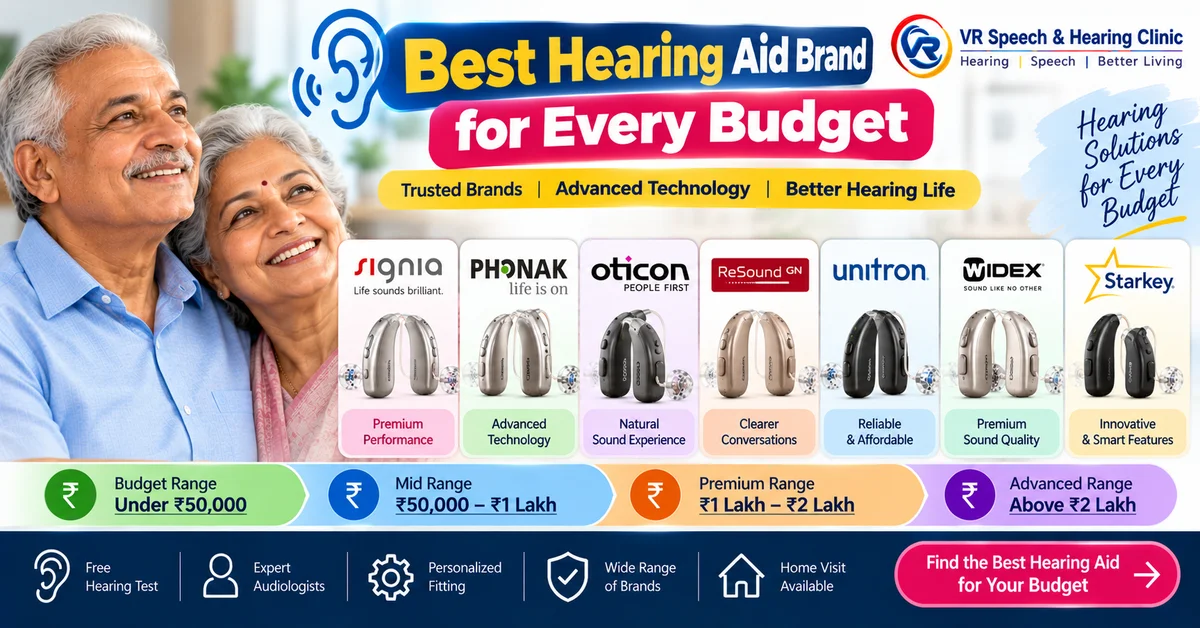
At VR Speech and Hearing Clinic, we carry all six major authorised brands, so you can select based on comfort, features, and personal preference while staying comfortably within your CGHS-approved category:
Signia, Phonak, ReSound, Oticon, Widex, and Bernafon
What's Not Covered Under CGHS Hearing Aid Rules?
While the scheme is genuinely helpful, it's equally important to understand its limits so there are no surprises later. The following are not covered:
Batteries and routine maintenance after your initial purchase
Analog or body-worn hearing aids, since this category has been discontinued
Cochlear implants, which fall under a separate surgical scheme rather than the standard hearing aid reimbursement process
Any amount that exceeds the fixed ceiling rate for your device category
A second reimbursement claim within 5 years of your last approved claim
Knowing these exclusions ahead of time can help you budget accordingly and avoid any confusion when your claim is processed.
Frequently Asked Questions
Can my spouse or dependent also claim a CGHS hearing aid?
Yes. If they are listed as a dependent on your CGHS card, they are eligible for the same reimbursement process and ceiling rates as the primary cardholder.
How much will I be reimbursed for a hearing aid priced above the ceiling?
You will only be reimbursed up to the fixed ceiling amount — ₹8,000 for BTE or ₹9,000 for ITC/CIC per ear — regardless of the actual price you paid. Any balance above that is paid by you.
Are cochlear implants covered under this CGHS hearing aid process?
No. Cochlear implants fall under a separate surgical assistance scheme, not the standard digital hearing aid reimbursement process described in this guide.
What happens if I miss the 90-day claim window?
Claims filed after 90 days from purchase are still accepted, but you will need to provide a written explanation for the delay to your CGHS Zonal Office or Department.
Does CGHS restrict which hearing aid brand I can buy?
No. CGHS approves hearing aids by device category — BTE or ITC/CIC — based on your audiogram, not by brand. This means you can choose from any authorised brand available at VR Speech and Hearing Clinic.
Can I get a replacement hearing aid reimbursed under CGHS?
Yes, but only once every 5 years per ear category. You will also need to sign an undertaking confirming that you haven't claimed reimbursement for the same purpose within that period.
Does VR Speech and Hearing Clinic handle the CGHS reimbursement filing for me?
VR Speech and Hearing Clinic provides the itemised bill and purchase documentation you need, but the actual claim submission to your CGHS Zonal Office or Ministry/Department is handled by you directly.