Best Speech Therapy Centre for Autism: Selection Guide
How to Choose the Best Speech Therapy Centre for Autism: A Complete Guide for Parents
Finding the right speech therapy centre for your child with autism can feel overwhelming. There are many clinics, many promises and a lot of conflicting advice. Yet the choice matters. Early, consistent and well-planned therapy can change how your child communicates, connects with family and takes part in school and daily life.
This guide explains what to look for in the best speech therapy centre for autism, which questions to ask and which warning signs to avoid, so you can decide with confidence.
Ebook Download स्पीच थेरपी ॲक्टिव्हिटी बुक | मुलांच्या भाषा व संवाद विकासासाठी
Why Speech Therapy Matters for Children With Autism
Autism affects communication in many ways. Some children speak late or not at all. Others speak fluently but find it hard to hold a conversation, understand tone of voice or read facial expressions. Many struggle to follow instructions, ask for what they need or express feelings without frustration.
A speech-language pathologist works on all of these areas. Therapy goes beyond spoken words. It builds understanding of language, turn-taking, play skills, gestures, picture-based communication and, where needed, assistive devices. The earlier a child begins, the more benefit therapy tends to give, although progress is possible at any age.
Signs Your Child May Need Speech Therapy
Every child develops at their own pace, but some signs deserve attention. Consider booking an assessment if your child:
Does not respond when called by name
Has few or no words by age two
Rarely points, waves or uses gestures
Repeats phrases without using them meaningfully
Struggles to play or interact with other children
Becomes very frustrated when unable to express a need
Loses words or skills they once had
An early assessment does not label your child. It simply gives you clear information and a starting point.
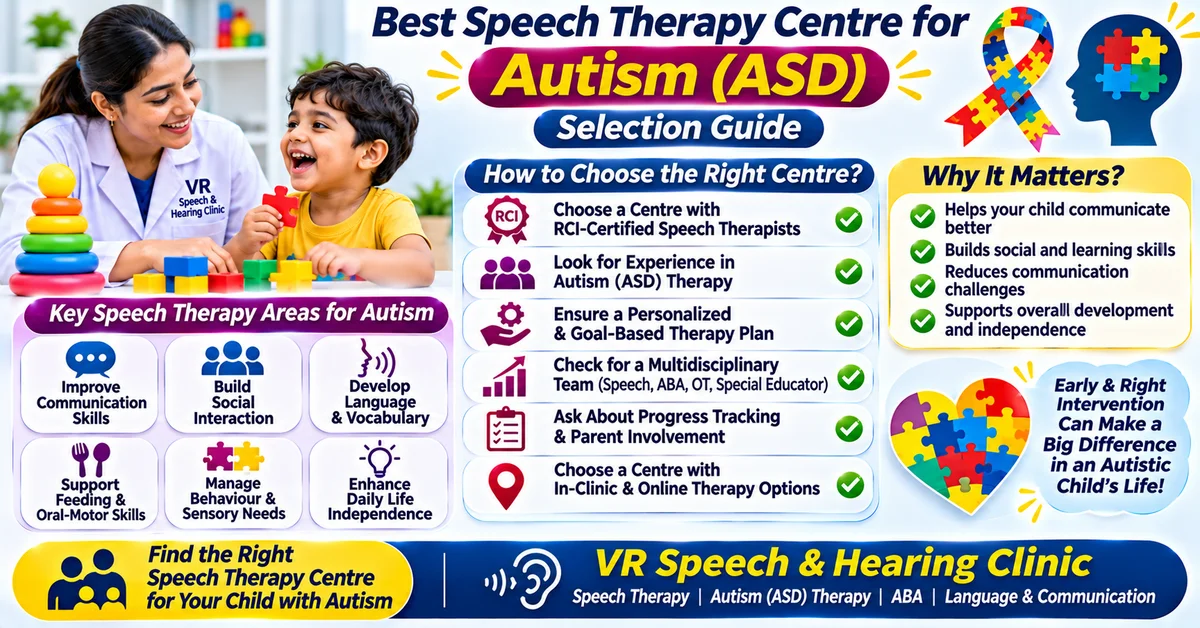
What to Look for in the Best Speech Therapy Centre for Autism
1. Qualified and Experienced Therapists
Begin with credentials. The therapist should hold a recognised degree in speech-language pathology and valid registration with the national professional council. Ask how many autistic children they have worked with and whether they attend regular training. Autism needs a different approach from a simple pronunciation problem, and experience shows in how a therapist handles a child who is anxious, distracted or non-verbal.
2. A Thorough Assessment Before Therapy
A good centre never starts blindly. Expect a detailed evaluation of understanding, expression, speech sounds, social communication, play, attention and sensory responses. The therapist should take a full history, observe your child and explain the findings in plain language. If a centre promises a programme after a five-minute chat, look elsewhere.
3. An Individualised Therapy Plan
No two autistic children are alike. One may need help saying first words, while another needs help joining a group conversation. The best centres write goals around your child’s strengths, interests and daily needs instead of handing out the same worksheet to everyone. Ask to see written short-term and long-term goals.
4. Evidence-Based and Child-Friendly Methods
Look for approaches supported by research and adapted gently to each child. These include play-based and naturalistic therapy, augmentative and alternative communication (AAC) such as picture cards or speech-generating devices, visual supports, social stories and parent-mediated strategies. Sessions should feel like purposeful play, not forced drilling. Be cautious of anyone who claims a single secret method can cure autism.
5. Focus on Real-Life Communication
Saying a word on request is not the same as communicating. Good therapy teaches children to ask for help, say no, share interests, answer questions and understand what others mean. Goals should carry over to home, school and the playground, and the therapist should explain how each activity connects to daily life.
6. Strong Parent Involvement
Children spend only a few hours a week in therapy, so what happens at home matters enormously. The best centres coach parents, demonstrate activities, allow observation when appropriate and suggest simple practice that fits into routines such as mealtimes, bath time and play. If parents are kept outside the door with no guidance, progress is usually slower.
7. A Calm, Sensory-Friendly Environment
Many autistic children are sensitive to noise, bright light and crowded spaces. Visit before enrolling. A quiet waiting area, a tidy therapy room with limited distractions and staff who respond patiently to meltdowns signal a child-first culture. Your child should look curious or comfortable, not frightened, when entering the room.
8. A Team Approach, Including Hearing Care
Autism often comes with other needs. A strong centre works with, or refers you to, occupational therapists, psychologists, special educators and paediatricians. Hearing evaluation is especially important. A child who does not respond to their name or speaks late may have a hearing difficulty alongside, or instead of, autism. A centre offering both speech therapy and audiology can rule out hearing problems early and coordinate care smoothly.
9. Clear Goals and Progress Tracking
Look for regular reviews, usually every few months, with clear updates on what has improved and what needs to change. Session notes, short videos or simple progress charts help you see the difference. An honest therapist adjusts the plan when something is not working and tells you what is realistic.
What to Expect at the First Visit
The first visit is usually a conversation and observation. The therapist will ask about birth history, milestones, hearing, health, behaviour and family routines. They will watch your child play, try simple tasks and note how your child responds to sounds, people and toys. Afterwards, you should receive feedback, a recommendation on session frequency and an outline of next steps.
Bring any previous reports, school observations and a list of your questions. Do not worry if your child is shy or unsettled. Therapists expect this and look at the overall pattern rather than one moment.
Red Flags to Avoid
Walk away, or at least ask more questions, if you notice any of these:
Promises of a guaranteed cure or very fast results
No assessment and no written plan
Reluctance to answer questions or allow parents to observe
Rigid, punishment-based methods that ignore the child’s distress
Frequent therapist changes without explanation
Pressure to pay for large packages upfront
Questions to Ask Before You Enrol
Take a short list with you when you visit:
What qualifications and autism-specific experience do your therapists have?
How do you assess a child, and will I receive a written report?
How will you set goals for my child, and how often will you review them?
Which methods and tools do you use, and why?
How will I be involved, and what will I practise at home?
Can you support my child if he or she is non-verbal?
How do you coordinate with schools and other professionals?
What are the session length, frequency and total cost?
Practical Points: Distance, Timings and Cost
Consistency beats intensity, so choose a centre you can reach comfortably several times a week. A long, tiring commute can leave your child exhausted before the session even starts. Check that timings suit your child’s energy levels and school schedule. Ask whether online sessions or parent coaching are available for days when travel is difficult.
Finally, compare fees openly, but do not choose on price alone. A slightly higher fee that includes assessment, parent training and regular reviews often delivers better value than a cheap, unstructured programme.
Why Families Choose VR Speech And Hearing Clinic
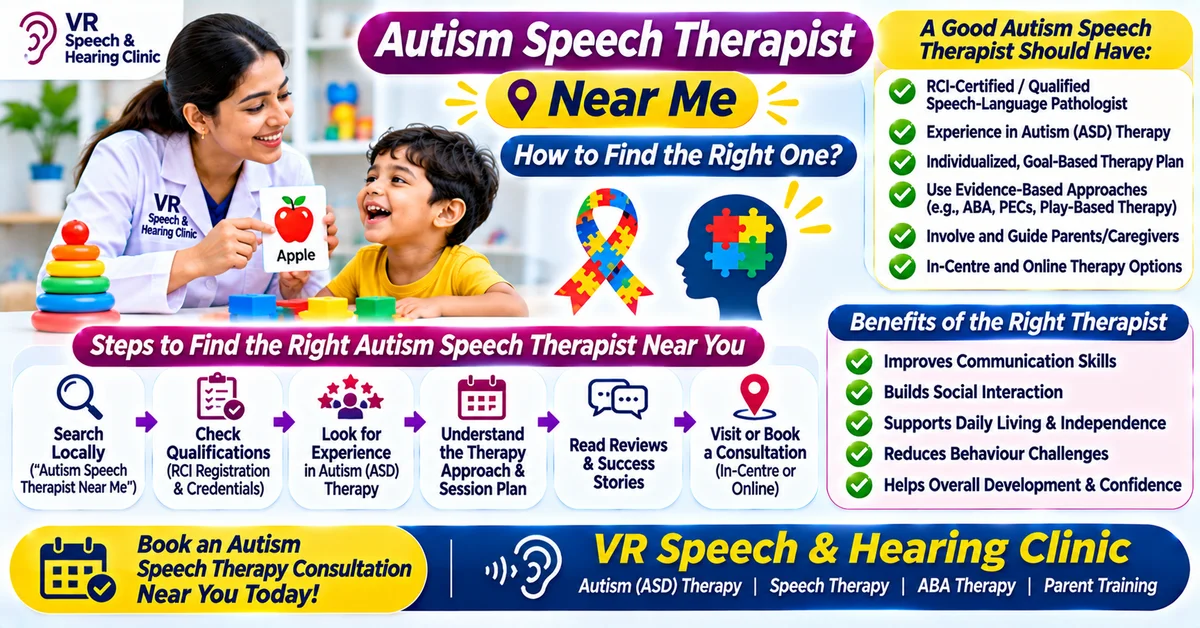
VR Speech And Hearing Clinic provides speech therapy and hearing care for children, including those on the autism spectrum. Its approach reflects the principles in this guide: a careful assessment, a personalised therapy plan, child-friendly sessions and active guidance for parents. Because speech and hearing services come together, families can check hearing, understand their child’s communication needs and begin therapy in a coordinated way.
Parents are encouraged to ask questions, understand every goal and take part in each step of the journey. That partnership, along with patience and respect for each child’s pace, is what helps communication grow.
Final Thoughts
The best speech therapy centre for autism is not the biggest or the cheapest. It is the one with qualified therapists, a thorough assessment, an individual plan, a welcoming environment and genuine partnership with parents. Visit more than one centre if you can, watch how the team interacts with your child and trust your instincts.
Every child communicates in their own way, and the right therapy helps them be understood. If you are ready to take the first step, book an assessment with VR Speech And Hearing Clinic and start building your child’s communication skills with expert support.
FAQs
1. At what age should a child with autism start speech therapy?
As soon as you notice concerns. Early intervention gives the best foundation, but children of any age can benefit from therapy.
2. How many speech therapy sessions does an autistic child need each week?
It depends on your child’s needs, age and goals. Many children attend two to three sessions weekly, but the therapist will recommend a schedule after the assessment.
3. How long does it take to see results?
Every child is different. Some parents notice small changes, such as better eye contact or more attempts to communicate, within weeks or months. Steady progress is strongest when home practice supports clinic sessions.
4. Can a non-verbal child benefit from speech therapy?
Yes. Therapists use gestures, pictures, AAC devices and play-based strategies to build communication. Research does not show that AAC prevents speech from developing.
5. Is online speech therapy effective for autism?
It can work well, especially when parents are coached to carry out strategies at home. Some young children with high support needs may do better with in-person sessions, so discuss this with your therapist.
6. Why is a hearing test important for children with suspected autism?
Hearing loss can look similar to autism, with delayed speech and limited response to name, and the two can also occur together. A hearing evaluation helps ensure your child gets the right support.
7. How do I know a speech therapy centre is right for my child?
Your child feels reasonably comfortable, goals are clear and written, parents are involved, and progress is reviewed regularly.