Best Hearing Aids for First-Time Buyers | Types & Guide
Buying your first hearing aid can feel overwhelming. Between tiny custom devices, behind-the-ear models, rechargeable options and Bluetooth features, it is hard to know where to begin. The good news is that you do not need to understand every technical detail. You only need to know which type of hearing aid matches your hearing loss, your lifestyle and your budget.
This guide explains the best types of hearing aids for first-time buyers, how each style works, who it suits, and what to check before you spend your money.
Start With a Hearing Test, Not a Product
The best hearing aid for one person can be the wrong choice for another. The deciding factor is your audiogram, the chart that shows how well you hear different pitches in each ear. Mild, moderate, severe and profound hearing loss need different levels of amplification, and that directly affects which styles are suitable.
Before you compare models, book a professional hearing test with a qualified audiologist. A proper evaluation also looks at your ear canal size and shape, your finger dexterity, and the listening situations that matter most to you, such as family conversations, office meetings, phone calls or watching TV. At VR Speech & Hearing Clinic, a hearing test can even be arranged at home, so you can begin without stepping out.
The Main Types of Hearing Aids Explained
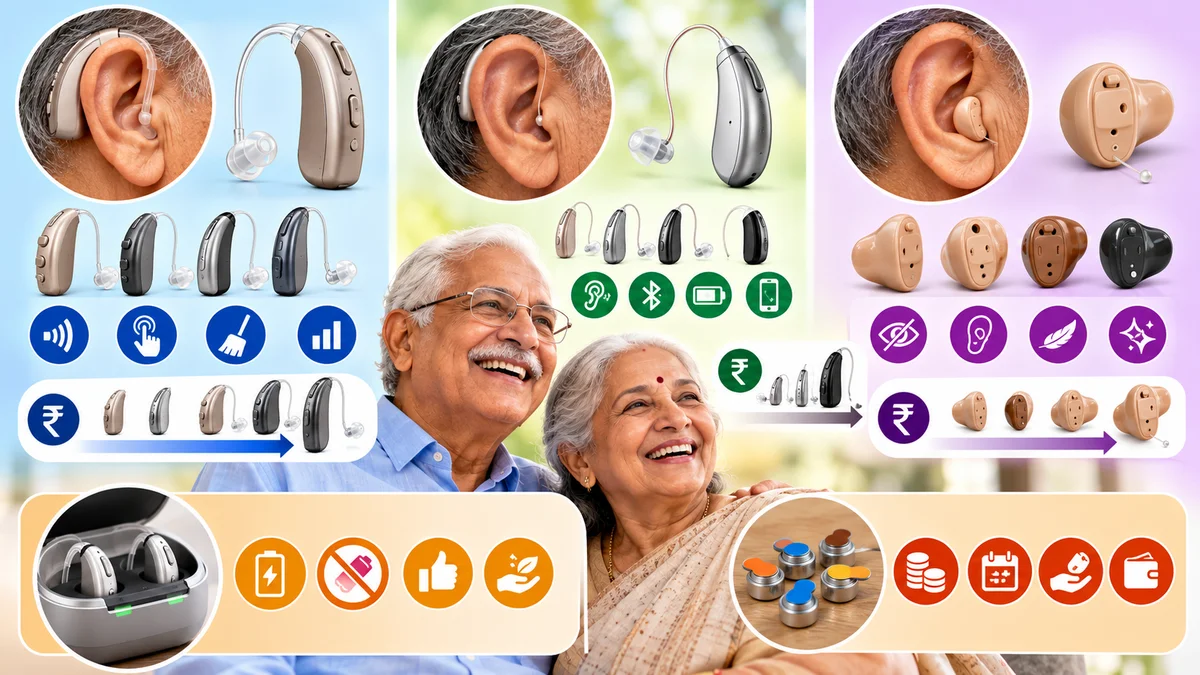
Receiver-in-Canal (RIC) Hearing Aids: The Best All-Rounder
RIC hearing aids are the most popular choice for first-time buyers, and for good reason. A small casing sits behind the ear, and a thin wire carries sound to a tiny speaker, called the receiver, placed inside the ear canal. Because the speaker sits close to the eardrum, sound is clear and natural.
Best for: mild to moderately severe hearing loss, and many people with more severe loss when a power receiver is used.
Why first-timers like them: they are slim, comfortable and discreet. Open-fit options reduce the “blocked ear” feeling, and most models offer rechargeable batteries and Bluetooth streaming.
Keep in mind: the receiver sits in the canal, so wax guards need regular changing.
Behind-the-Ear (BTE) Hearing Aids: Best for Strong Hearing Support
BTE hearing aids rest behind the ear and send sound through a tube and an earmold or dome. They are larger than RIC models, which makes them easier to handle, and they can house bigger batteries and more powerful amplifiers.
Best for: moderate to profound hearing loss, older adults, people with limited finger dexterity, and anyone who wants a durable, easy-to-operate device.
Why first-timers like them: simple controls, long battery life, strong amplification and budget-friendly entry-level options. Many reliable digital BTE models are available in India at affordable prices.
Keep in mind: they are more visible, although modern slim designs are far more discreet than older ones.
In-the-Canal (ITC) Hearing Aids: Discreet and Custom-Made
ITC hearing aids are custom-moulded to fit the lower part of your outer ear and the canal. They are less noticeable than BTE models and offer a good balance between discretion and ease of use.
Best for: mild to moderately severe hearing loss.
Keep in mind: smaller batteries need more frequent changes, the controls are small, and some models have fewer features than larger styles.
Completely-in-Canal (CIC) and Invisible-in-Canal (IIC): The Most Discreet Options
CIC hearing aids sit deep in the ear canal, while IIC models are almost completely hidden from view. They suit people who care most about appearance.
Best for: mild to moderate hearing loss and users with good dexterity.
Keep in mind: their small size limits battery life, power and wireless features. They can be harder to insert and remove, and they are more exposed to wax and moisture. They are generally not suited to severe hearing loss.
Instant-Fit Hearing Aids: Quick to Try
Instant-fit hearing aids use standard-sized domes instead of a custom mould, so you can often be fitted on the same day rather than waiting for a custom shell to be made. They are a practical way to start your hearing journey and test how amplification feels in daily life.
Which Hearing Aid Type Is Best for You?
Use this quick guide as a starting point, then confirm with your audiologist:
Mild to moderate hearing loss with a wish for comfort, clarity and features: choose a RIC hearing aid.
Severe to profound hearing loss, or a need for maximum power and simple controls: choose a BTE hearing aid.
Mild to moderate loss with discretion as the top priority: consider ITC, CIC or IIC styles.
Tight budget: look at an entry-level digital BTE or a basic RIC.
Busy lifestyle with frequent calls, video meetings and streaming: choose a Bluetooth-enabled RIC or a rechargeable BTE.
Features First-Time Buyers Should Look For
The style is only half the decision. These features make a real difference to everyday comfort:
Rechargeable batteries: convenient and easy if tiny batteries are a struggle. Disposable batteries (sizes 10, 312, 13 and 675) cost less upfront and are handy for travel, but they need replacing every few days.
Bluetooth connectivity: lets you stream phone calls, music and TV directly to your hearing aids, with support for both iPhone and Android on many models.
Noise reduction and directional microphones: help speech stand out in restaurants, markets and traffic.
Number of channels: more channels allow finer tuning to your hearing loss, and advanced devices adjust automatically as your surroundings change.
Smartphone app: lets you change volume and programs discreetly.
Tinnitus support: some models include soothing sounds for people who also experience ringing in the ears.
Setting a Realistic Budget
Hearing aid prices vary widely by brand and technology level. As a rough guide in India, basic digital BTE models start at around ₹10,000 to ₹15,000, mid-range RIC and Bluetooth models commonly fall between ₹20,000 and ₹1,00,000, and premium AI-powered devices from leading brands such as Phonak, Oticon, Widex, Signia and ReSound can cost several lakh rupees.
A higher price usually buys better sound processing in noise, more automation and more connectivity. It does not automatically mean a better fit for your hearing loss. A well-fitted mid-range device often outperforms a poorly fitted premium one, so choose based on your audiogram and daily needs rather than the price tag alone.
Tips to Get the Most From Your First Hearing Aid
Ask about a trial period. Testing a device in your real daily environment is the best way to know whether it suits you.
Plan for an adjustment period. Your brain needs time to get used to hearing sounds again, so wear your hearing aids consistently, even when the first days feel unusual.
Choose a provider with strong aftercare. Fine-tuning, cleaning, repairs and follow-up visits matter as much as the device itself.
Consider two hearing aids. If both ears have hearing loss, wearing two usually gives better balance, easier direction-finding and clearer speech in noisy places.
Look after your devices. Clean them daily, keep them dry and store them safely.
Final Thoughts
The best type of hearing aid for a first-time buyer is the one that fits your hearing loss, your ears, your lifestyle and your budget. For most beginners, RIC hearing aids offer the best mix of comfort, sound quality and modern features. BTE models remain the top choice for stronger hearing loss and simple handling, while ITC, CIC and IIC styles suit people who value discretion above all.
The smartest first step is a professional hearing test. Book a hearing test with VR Speech & Hearing Clinic, explore your options with an expert, and try before you commit, so your first hearing aid feels right from day one.
Frequently Asked Questions (FAQs)
1. What is the best type of hearing aid for a first-time user?
For most first-time users with mild to moderately severe hearing loss, a RIC (receiver-in-canal) hearing aid is the best choice because it is discreet, comfortable and feature-rich. People with severe to profound hearing loss usually do better with a BTE (behind-the-ear) model.
2. Are rechargeable hearing aids good for beginners?
Yes. Rechargeable hearing aids remove the need to handle tiny batteries, which is helpful for new users and for anyone with limited dexterity. A full charge typically lasts a whole day, but check the battery life of each model before buying.
3. Which hearing aid is the most invisible?
IIC (invisible-in-canal) and CIC (completely-in-canal) hearing aids are the least visible because they sit deep inside the ear canal. However, they are only suitable for mild to moderate hearing loss and certain ear shapes.
4. How long does it take to get used to a hearing aid?
Most people need a few weeks to adjust, and some take a few months. Wearing your hearing aids regularly and attending follow-up fine-tuning visits helps the process.
5. Should I buy one hearing aid or two?
If you have hearing loss in both ears, two hearing aids are usually recommended. They improve sound balance, help you tell where sounds are coming from and make speech easier to follow in noise. Your audiologist can advise based on your hearing test.
6. Can I try a hearing aid before buying it?
Many clinics offer trial periods so you can test a device in your daily routine. Always ask about trial terms, fine-tuning support and after-sales service before you decide.
7. Do I need a hearing test before buying a hearing aid?
Yes. A hearing test shows the type and degree of your hearing loss, which decides the right style, power level and features. Buying without one risks choosing a device that does not suit you.