Autism Speech Therapist Near Me: How to Find the Right One
Why Speech Therapy Matters for Children With Autism
Communication is one of the core areas affected by autism spectrum disorder (ASD), but it looks different from child to child. Some children have no spoken words. Some repeat phrases they have heard, which is called echolalia. Others have a large vocabulary but find conversation, tone of voice, or social cues confusing.
Speech therapy helps a child express needs, understand others, and connect with the people around them. Starting early gives a child more time to build these skills during the years when language develops fastest, so it is wise not to wait and see if you notice delays. You also do not need a formal diagnosis to ask for a communication assessment. A speech therapist can evaluate how your child communicates and begin supporting them while other evaluations are in progress.
What an Autism-Focused Speech Therapist Actually Does
A speech-language pathologist, commonly called a speech therapist, begins with an assessment of how your child understands language, uses sounds and words, plays, and interacts with others. Based on that picture, therapy may focus on:
Early communication skills such as eye contact, pointing, gestures, imitation, and turn-taking
Spoken language, from first words to longer sentences
Augmentative and alternative communication (AAC), including picture cards, communication boards, or speech-generating devices for children who are nonspeaking or speak very little
Social communication, such as starting conversations, staying on topic, and reading body language
Understanding language, including following instructions and answering questions
Reducing frustration by teaching useful ways to ask for help, a break, or a favourite item
Parent coaching, so progress continues at home and not just in the clinic
Because speech and hearing are closely linked, a hearing check is a smart early step. Untreated hearing problems can slow or mimic communication delays, so a clinic that handles both speech and hearing can save you time.
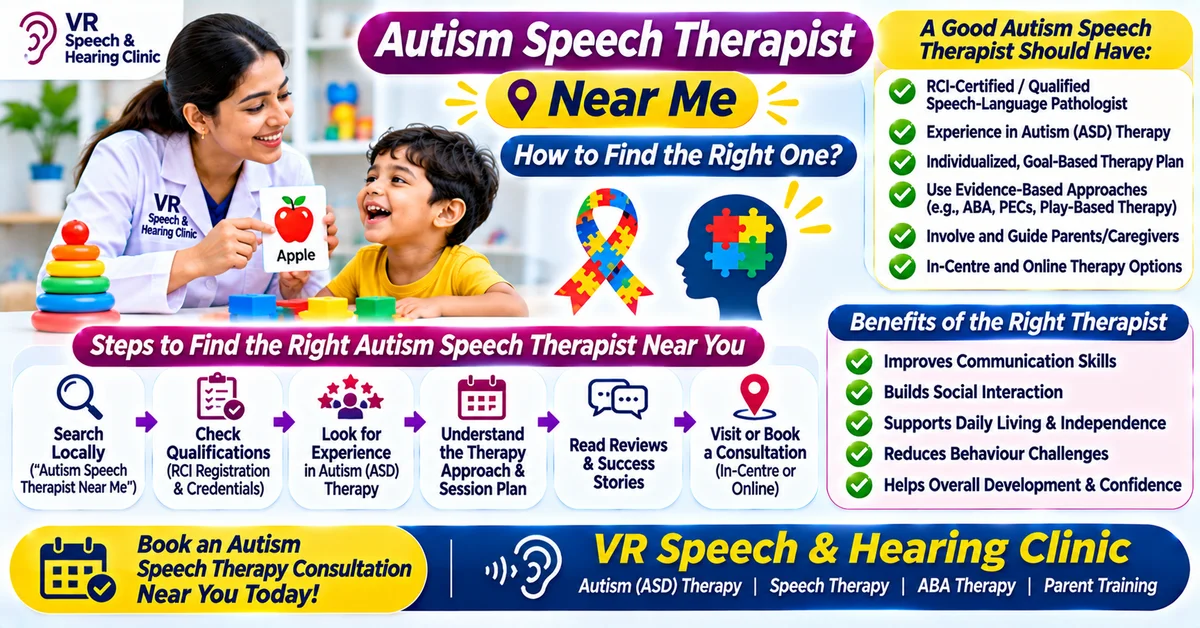
Qualifications to Look For
Not everyone who offers “speech therapy” has the same training. Check the following before you book:
Degree: A Bachelor’s (BASLP) or Master’s (MASLP) in Audiology and Speech-Language Pathology from a recognised university.
RCI registration: In India, speech-language pathologists and audiologists should be registered with the Rehabilitation Council of India (RCI) and hold a Central Rehabilitation Register (CRR) number. Ask for it and verify it.
Experience with autism: Ask how many autistic children the therapist has worked with and at what ages and communication levels.
Ongoing training: Look for continuing education in AAC, social communication, play-based and developmental approaches, and parent coaching.
A team approach: The best outcomes often come when speech therapists coordinate with paediatricians, psychologists, occupational therapists, and special educators.
Hearing services: On-site audiology or a clear referral path is a real advantage.
Be cautious about anyone who cannot clearly state their qualification or registration.
Step-by-Step: How to Find the Right Speech Therapist Near You
1. Start with your child’s doctor. Your paediatrician, developmental paediatrician, child psychologist, or school counsellor often knows which local therapists have real autism experience.
2. Search with specific phrases. Instead of a general search, try “autism speech therapy in Ahilyanagar,” “speech therapist for autistic child in Chhatrapati Sambhajinagar,” or add your neighbourhood name. Google Maps helps you compare distance, timings, and photos of the clinic.
3. Read reviews carefully. Look for parents describing communication with the therapist, how their child responded, and how welcoming the clinic felt. Patterns across several reviews matter more than one very good or very bad comment.
4. Verify credentials. Ask for the therapist’s degree and RCI number before booking, and do not feel awkward about it. A genuine professional will expect the question.
5. Book an assessment first. A good clinic evaluates your child before promising anything or fixing a plan. Be wary of anyone who offers a package without seeing your child.
6. Visit in person. Notice whether the space is calm and child-friendly, whether the therapist gets down to your child’s level, and whether sessions use play and your child’s interests rather than forced drills.
7. Check the practical details. Location, session timing, frequency, fees, and home practice plans all matter. Consistent attendance usually helps more than a “perfect” clinic that is too far to reach regularly.
8. Trust your child’s response and your instincts. If your child gradually feels comfortable and you feel heard, that is a good sign.
Questions to Ask Before You Commit
What is your experience with autistic children of my child’s age and communication level?
How will you assess my child, and how will you set goals?
Which methods do you use, and why do you recommend them for my child?
Will I be able to observe sessions, and will I receive activities to practise at home?
How often will you review progress, and how will you explain it to me?
How do you use AAC alongside spoken language? (Research does not show that AAC prevents speech from developing, and many children find it reduces frustration.)
Do you coordinate with other therapists and my child’s school?
What are the fees, session length, and cancellation policy?
Red Flags to Watch For
Promises of a “cure” or guaranteed results by a fixed date. Autism is a lifelong neurodevelopmental difference, and therapy builds skills rather than removing autism.
The same plan for every child, with no individual assessment.
No clear goals, or reluctance to share them with parents.
Inability to show a degree or RCI registration.
Forcing eye contact or compliance while ignoring signs of distress.
Dismissing your concerns or excluding you completely from the process.
If something feels wrong, it is perfectly fine to get a second opinion.
Autism Speech Therapy in Ahilyanagar and Chhatrapati Sambhajinagar
If you live in or near Ahilyanagar (Ahmednagar) or Chhatrapati Sambhajinagar, VR Speech and Hearing Clinic is one option worth adding to your shortlist. The clinic has two branches:
Ahilyanagar (Ahmednagar) branch: Shop No. 3, Vitthal Apartment, Pipeline Road, Near Bhistabag Chowk, Ahilyanagar (Ahmednagar), Maharashtra 414003
Chhatrapati Sambhajinagar branch: Second Floor, Vasantrao Naik Chowk, N-3, CIDCO, Opposite Hotel Deepali Executive, Chhatrapati Sambhajinagar, Maharashtra 431003
Because the clinic focuses on speech and hearing, it can be convenient for families who want communication and hearing concerns looked at in the same place. As with any clinic, ask about the therapist’s RCI registration, experience with autism, assessment process, and how parents are involved. Visiting the branch nearest to you is the best way to see whether the environment and the team feel right for your child.
What to Expect in the First Few Sessions
The first visit usually involves a conversation about your child’s developmental history, your main concerns, and what your child enjoys. The therapist will observe your child through play, may use structured tools, and may recommend a hearing check. You should leave with a clear explanation of your child’s strengths, the areas that need support, and the first goals.
How often your child attends depends on their needs, age, and your family’s schedule, and the plan can change as your child grows. Progress is gradual and rarely a straight line. Celebrate small wins, such as a new gesture, a picture exchanged, a shared look, or one extra word.
How You Can Support Progress at Home
Describe daily routines in short, simple sentences while you do them.
Follow your child’s lead in play, and pause to give them time to respond.
Offer two choices to encourage requests, such as “juice or milk?”
Use the same pictures, signs, or AAC tools at home that the therapist uses.
Keep routines predictable, and ask the therapist for one or two goals to practise each week.
Stay patient and avoid pressure. Communication grows best when your child feels safe.
Final Thoughts
Finding a qualified speech therapist for your autistic child comes down to a few clear steps: check credentials and RCI registration, look for real autism experience, ask for an individual assessment, and choose a clinic where you and your child feel comfortable. You know your child best, so use that knowledge when you visit and ask questions. If you are in Ahilyanagar or Chhatrapati Sambhajinagar, contact VR Speech and Hearing Clinic directly to ask about assessments and what support is available at your nearest branch.
Frequently Asked Questions (FAQs)
1. At what age should a child with autism start speech therapy?
As early as concerns appear. Many families begin when a child is around two years old or even younger, but support can help at any age. You do not need to wait for a formal diagnosis to request a communication assessment.
2. How do I know if a speech therapist is qualified to treat autism?
Ask for their BASLP or MASLP degree and their RCI registration (CRR) number. Then ask about their experience with autistic children, the methods they use, and the training they have completed in autism-related communication support.
3. How many speech therapy sessions does an autistic child need each week?
There is no single answer. The therapist will recommend a schedule after an assessment, based on your child’s needs, age, and goals, and will adjust it as your child progresses.
4. Can speech therapy help a child who is nonspeaking?
Yes. Therapy can build early communication through gestures, pictures, signs, and AAC devices, and it can also work toward spoken words where possible. The goal is to give your child a reliable way to communicate.
5. What is the difference between a speech therapist and other therapists?
A speech therapist focuses on communication, including speech, language, social interaction, and AAC. Occupational therapists focus on daily living and sensory skills, and behavioural or developmental therapists address other areas. Many children benefit from a team that works together.
6. Should I choose a clinic close to home?
Proximity helps because regular attendance matters, but do not choose on distance alone. Pick a qualified therapist you trust whose location is realistic for your family to reach consistently.
7. How much does autism speech therapy cost?
Fees vary by clinic, city, session length, and the therapist’s experience. Ask for the fee, session duration, and any assessment charges clearly before you begin.