Autism Resource Centre
Autism Resource Centre: Support, Therapy and Guidance
Finding the right support after your child receives an autism diagnosis, or when you first notice something different, can feel overwhelming. Parents often ask where to begin, whom to trust and what to do first. An autism resource centre exists to answer these questions in one place. At VR Speech and Hearing Clinic, our approach centres on communication, hearing health and family partnership, so every child gets a clear path forward.
What Is an Autism Resource Centre?
An autism resource centre is a dedicated space where families, caregivers and educators can access assessments, therapy, training and practical information about autism spectrum disorder (ASD). Instead of moving between several providers, parents find guidance, professional evaluation and ongoing support together.
A good centre does not only treat the child. It also educates parents, builds skills at home and connects families with schools and community resources. This whole-family approach leads to better, longer-lasting progress.
Understanding Autism Spectrum Disorder
Autism is a neurodevelopmental condition that affects how a person communicates, interacts with others and experiences the world around them. It is called a spectrum because every individual is different. Some children speak early but struggle with social conversation. Others are non-speaking or have limited speech and use gestures, pictures or devices to communicate. Many have strong abilities in memory, pattern recognition, music or visual thinking.
Autism is not caused by parenting, and it is not something a child can simply outgrow. With the right support, however, children can build communication, independence and confidence throughout life.
Early Signs Parents Should Watch For
Early identification makes a real difference. Signs can appear before a child turns two, though they sometimes become clearer later. Parents should consider an evaluation if they notice:
Limited or no response when their name is called
Delayed speech or loss of words the child once used
Little eye contact or limited sharing of interest by pointing or showing
Repetitive movements such as hand flapping or rocking
Strong need for routine and distress when it changes
Unusual reactions to sounds, textures, lights or tastes
Difficulty playing with other children or imitating actions
Having one or more of these signs does not confirm autism, but it is a good reason to seek a professional opinion. Acting early is always better than waiting.
Why Speech and Hearing Matter in Autism Care
Communication is at the heart of the autism experience, which is why speech and hearing specialists play a central role. Many children with autism have delayed or atypical language, and some are mistakenly assumed to be ignoring people when they actually have a hearing problem. A proper hearing evaluation rules out hearing loss and helps the team understand how a child processes sound.
At VR Speech and Hearing Clinic, we look at the whole communication picture. This includes how a child understands language, how they express needs, how they use sounds and gestures, and how they respond to everyday listening situations.
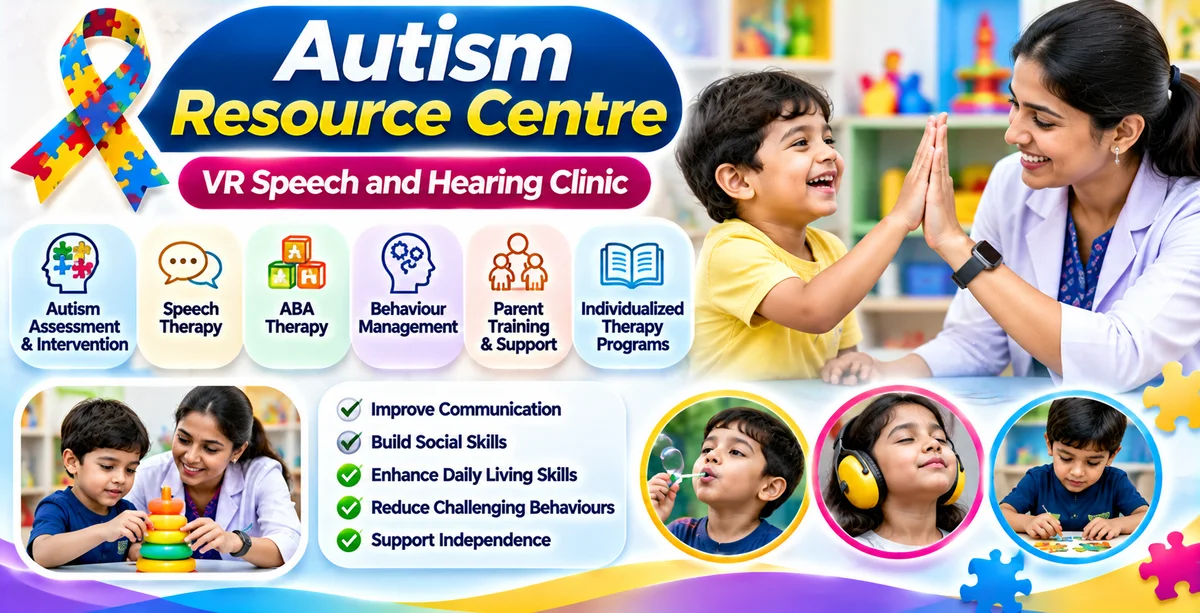
Services You Can Expect
Speech and Language Assessment
A detailed assessment shows where your child is in receptive language (understanding), expressive language (speaking) and social communication. The results shape an individual therapy plan with clear, measurable goals.
Speech and Language Therapy
Therapy sessions are play-based and child-friendly. Therapists work on first words, sentence building, conversation skills, turn-taking, answering questions and understanding social cues. Sessions are adapted to your child’s pace and interests, because children learn best when they are engaged and comfortable.
Hearing Evaluation and Audiology Support
Hearing tests help confirm that your child can hear speech sounds clearly. If hearing loss or auditory processing difficulties are found, we guide families on suitable next steps, including hearing devices and listening strategies.
Augmentative and Alternative Communication (AAC)
For children who are non-speaking or minimally speaking, AAC tools such as picture cards, communication boards and speech-generating devices can open the door to expression. Using AAC does not stop speech from developing. In many cases it reduces frustration and encourages vocal communication.
Parent Training and Counselling
Parents are a child’s most important teachers. We coach families on simple techniques to use during daily routines such as mealtimes, bath time and play. When parents feel confident, children practise skills many more hours each week than therapy alone can offer.
Social Skills and Behaviour Guidance
Small-group activities and individual coaching help children practise greeting others, sharing, waiting and understanding emotions. We also help families manage challenging behaviours by looking at the communication need behind them.
How the Process Works
Step one: Initial consultation. We listen to your concerns, review your child’s history and answer your first questions.
Step two: Comprehensive evaluation. This covers speech, language, hearing and social communication, using observation and standardised tools suited to the child’s age.
Step three: Personalised plan. You receive a clear explanation of the findings and a goal-based therapy plan.
Step four: Therapy and home programme. Regular sessions are paired with practical home activities.
Step five: Review and progress tracking. We revisit goals, celebrate progress and adjust the plan as your child grows.
Working With Schools and Other Professionals
Autism care often involves several people, such as paediatricians, occupational therapists, special educators and psychologists. A strong resource centre encourages teamwork. We share recommendations with schools and caregivers so that strategies stay consistent across home, classroom and therapy. Consistency helps children generalise new skills to real life.
Tips for Parents to Support Communication at Home
Small daily habits can make a big difference:
Follow your child’s lead and talk about what they are interested in.
Use short, clear sentences and pause to give them time to respond.
Use visual schedules and picture supports to make routines predictable.
Model words during play rather than demanding that your child repeat them.
Celebrate every attempt to communicate, whether it is a sound, gesture or word.
Reduce background noise when practising listening or speech.
Look after yourself too. A calm and supported parent is a powerful help to a child.
Why Choose VR Speech and Hearing Clinic?
Families choose us because we combine specialised speech and hearing expertise with warm, patient care. We believe every child can communicate in their own way, and our role is to help them find it. Our approach is family-centred, respectful of each child’s individuality and focused on practical results you can see in everyday life. We never use a one-size-fits-all programme, because no two children on the spectrum are alike.
Take the First Step Today
If you are worried about your child’s speech, hearing or social development, or if you recently received a diagnosis and need direction, you do not have to face it alone. Early support gives your child the best chance to grow in communication, confidence and independence. Contact VR Speech and Hearing Clinic to book a consultation and take the first step towards a brighter, more connected future for your family.
FAQs
1. What does an autism resource centre do?
It offers assessment, therapy, parent training and guidance in one place, helping families understand autism and support their child’s development.
2. At what age should I seek an autism evaluation?
Concerns can be raised as early as 12 to 18 months. If you notice delayed speech, limited eye contact or repetitive behaviours, consult a specialist without waiting.
3. Can speech therapy help children with autism?
Yes. Speech and language therapy improves understanding, expression, social communication and, where needed, the use of AAC tools.
4. Why is a hearing test needed for a child with autism?
Hearing loss can look like a lack of response or delayed speech. A hearing test ensures that sound access is not the cause of communication difficulties.
5. Will my child learn to speak?
Every child’s journey is different. Many children develop speech with therapy, and those who do not can still communicate effectively through AAC, gestures and other methods.
6. How can parents take part in therapy?
Parents are given simple home activities and coaching so they can practise skills during daily routines and play.