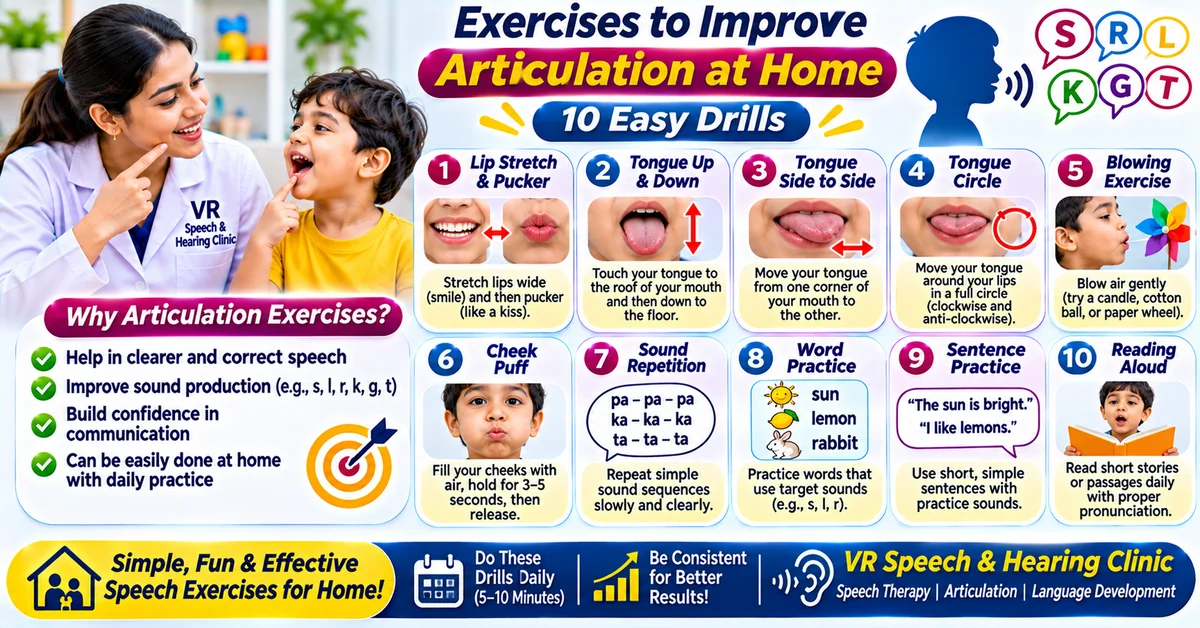
Exercises to Improve Articulation at Home: 10 Easy Drills
Clear speech helps you share ideas, build confidence, and be understood at school, at work, and at home. If certain sounds come out blurry, swapped, or missing, regular practice can make a real difference. So, what exercises can help improve articulation at home? The most effective routines combine gentle mouth warm-ups, focused sound practice, and lots of repetition in everyday conversation. In this guide from VR Speech and Hearing Clinic, you will find ten practical exercises for children and adults, plus simple tips for practising safely and knowing when to seek professional support.
What Is Articulation and Why Does It Matter?
Articulation is the way we use our lips, tongue, teeth, jaw, and palate to produce speech sounds. When these parts move accurately and in the right order, words sound clear. When they do not, listeners may find it hard to understand us. Common examples include saying “wabbit” for “rabbit,” “thoup” for “soup,” or leaving the last sound off words like “cat” and “book.”
Articulation difficulties can be developmental, meaning a child is slow to master certain sounds. They can also follow a stroke, head injury, dental changes, hearing loss, or a neurological condition. Because the causes differ, home practice works best as support alongside a proper assessment whenever you are unsure.
Ebook Download स्पीच थेरपी ॲक्टिव्हिटी बुक | मुलांच्या भाषा व संवाद विकासासाठी
Signs Articulation Practice May Help
Consider starting a home routine if you notice any of the following:
People often ask you or your child to repeat words
Sounds are replaced, distorted, or left out (for example, “t” used for “k”)
A lisp or “slushy” sound on s and z
Speech sounds younger than expected for the person’s age
Frustration, shyness, or avoiding talking in groups
Simple Rules Before You Start
A few habits make home practice far more effective:
Keep sessions short. Five to ten minutes, two or three times a day, works better than one long session.
Pick one or two target sounds at a time rather than working on everything at once.
Sit in a quiet, well-lit spot with a mirror so you can see your lips and tongue.
Aim for accuracy first and speed later.
Celebrate effort, and stop if the person is tired or upset.
Consistency matters more than perfection, so choose a regular time, such as after breakfast or before bedtime.
10 Exercises to Improve Articulation at Home
1. Mouth Warm-Ups
Warm-ups prepare the muscles and build awareness of how your mouth moves. Open and close your jaw slowly ten times, switch between a rounded “oo” and a wide “ee,” touch your tongue tip to the ridge behind your upper teeth, then move it side to side. Children can pretend to lick an ice cream or blow bubbles. Keep this to one or two minutes, then move straight into real speech sounds, because practising actual sounds is what changes speech most.
2. Practise the Sound on Its Own
Choose the target sound, such as “s,” “r,” or “k,” and say it by itself in front of a mirror. Notice where your tongue and lips are placed. Say the sound, not the letter name, and aim for ten good attempts in a row. A speech-language pathologist can show you the right tongue position if you are unsure.
3. Syllable Drills
Once the sound is steady, pair it with vowels: “sa, so, see, soo.” Then try repeating patterns like “pa-ta-ka” as smoothly as you can. These drills improve coordination and timing between the lips, tongue, and back of the mouth. Start slowly and let speed build naturally.
4. Word Practice in All Positions
Practise words where the target sound appears at the beginning, middle, and end. For the “s” sound, that could be “sun,” “pencil,” and “bus.” Use picture cards, household objects, or pictures from a magazine. Say ten words from each group, and ask a family member to give a thumbs-up for clear productions.
5. Minimal Pair Practice
Minimal pairs are words that differ by just one sound, such as “sip” and “ship,” “ten” and “den,” or “wing” and “ring.” Saying them in pairs trains your ears and mouth to notice the difference. Take turns choosing a word while a partner guesses which one you said. This makes practice feel like a game.
6. Slow Tongue Twisters
Tongue twisters such as “red lorry, yellow lorry” or “she sells seashells” challenge accuracy. Say each one slowly three times, then increase the pace only while staying clear. If you stumble, slow down again. They are a fun add-on once the basic sound is reliable, not a starting point.
7. Read Aloud Daily
Reading aloud for five minutes moves practice into connected speech. Use a children’s storybook, a newspaper article, or a favourite poem. Highlight words with the target sound beforehand, and pause to repeat any that came out unclearly. Adults can read a work email or report aloud to rehearse real-life speaking.
8. Record and Listen Back
Use a phone voice recorder to capture a short passage, then listen carefully. Most people notice mistakes more easily when hearing themselves than while speaking. Compare recordings from week to week to see progress, which is a wonderful motivator for both children and adults.
9. Breath Control and Pacing
Speaking too fast is a common reason words blur together. Take a relaxed breath, speak in short phrases, and pause between ideas. Try reading a sentence in chunks: “I would like… a glass… of water.” Slower pacing gives your tongue and lips time to reach the right positions, and listeners find you easier to follow.
10. Carry the Sound Into Conversation
The final goal is clear speech in everyday talk. Play a “sound of the day” game where the family listens for the target sound at mealtimes. Ask your child to describe a picture or tell a short story for one minute. Adults can practise by leaving a voice note or rehearsing a short talk. Gentle reminders work better than constant corrections.
Tips for Parents Helping Children
Children learn best when practice feels like play. Use board games, puppets, or toy animals whose names include the target sound. Model the correct sound instead of saying “that’s wrong,” and keep a positive tone. A sticker chart can reward effort, not just perfect answers. Most importantly, make sure your child can hear the difference between the correct and incorrect sound, because listening skills and speech go hand in hand. If you suspect a hearing problem, a hearing test is a sensible first step.
Tips for Adults
Adults may want clearer speech for work, public speaking, or after a medical event. Choose a few daily speaking moments, such as a phone call or meeting, to focus on clear, slightly slower speech. Open your mouth a little wider during practice and finish word endings. If speech changes suddenly, or comes with face drooping, arm weakness, or confusion, seek emergency medical care immediately.
How Long Does Progress Take?
Progress depends on age, the sound being targeted, how consistent practice is, and any underlying cause. Some people notice improvement within a few weeks, while others need several months. Sounds like “r” and “th” are often the most stubborn. Track progress in a notebook by writing the date, the sound practised, and a simple rating out of five. Small wins add up.
When to See a Speech-Language Pathologist
Home exercises are helpful, but they are not a substitute for assessment. Seek professional guidance if your child is still hard to understand for unfamiliar listeners by around age four, if several weeks of practice bring no change, if the person is becoming upset or avoiding speaking, or if speech has changed after illness or injury. A trained therapist can identify the exact pattern, check hearing and oral structures, and give a personalised plan that targets the right sounds in the right order.
How VR Speech and Hearing Clinic Can Help
At VR Speech and Hearing Clinic, our approach combines careful assessment with practical, family-friendly therapy. We look at how a person produces sounds, how well they hear, and how speech affects daily life. Then we create a step-by-step plan and show you which exercises to use at home, so practice between sessions supports what happens in therapy. Whether you are a parent worried about your child’s speech or an adult wanting clearer communication, early support can make progress faster and more comfortable.
Final Thoughts
Improving articulation takes patience, but small, regular practice adds up. Start with mouth warm-ups, work on one sound at a time, and gradually move from single sounds to words, sentences, and real conversation. Keep sessions positive, track progress, and reach out to a professional whenever you need guidance. With the right support, clearer speech is within reach.
Frequently Asked Questions (FAQs)
How long does it take to improve articulation at home?
It varies. Some people notice changes within a few weeks of daily practice, while others need several months, especially for tricky sounds. Consistency and correct technique matter most.
Can adults improve their articulation?
Yes. Adults can improve clarity at any age through targeted sound practice, slower pacing, and reading aloud. A speech-language pathologist can tailor exercises to your goals.
Are tongue twisters good for articulation?
They can help once a sound is fairly accurate. Practise slowly and prioritise clarity over speed. They work best alongside other exercises, not as the only method.
How often should my child practise articulation exercises?
Short sessions of five to ten minutes, two or three times a day, are usually more effective than one long session. Keep it playful and stop before your child gets tired.
Can hearing loss affect articulation?
Yes. If a child cannot hear sounds clearly, they may find it harder to produce them correctly. A hearing check is a useful step whenever speech sounds are unclear.
When should I see a speech therapist?
See one if speech is hard to understand, home practice is not helping after several weeks, speech has changed suddenly, or the person feels frustrated. Early assessment usually leads to faster progress.