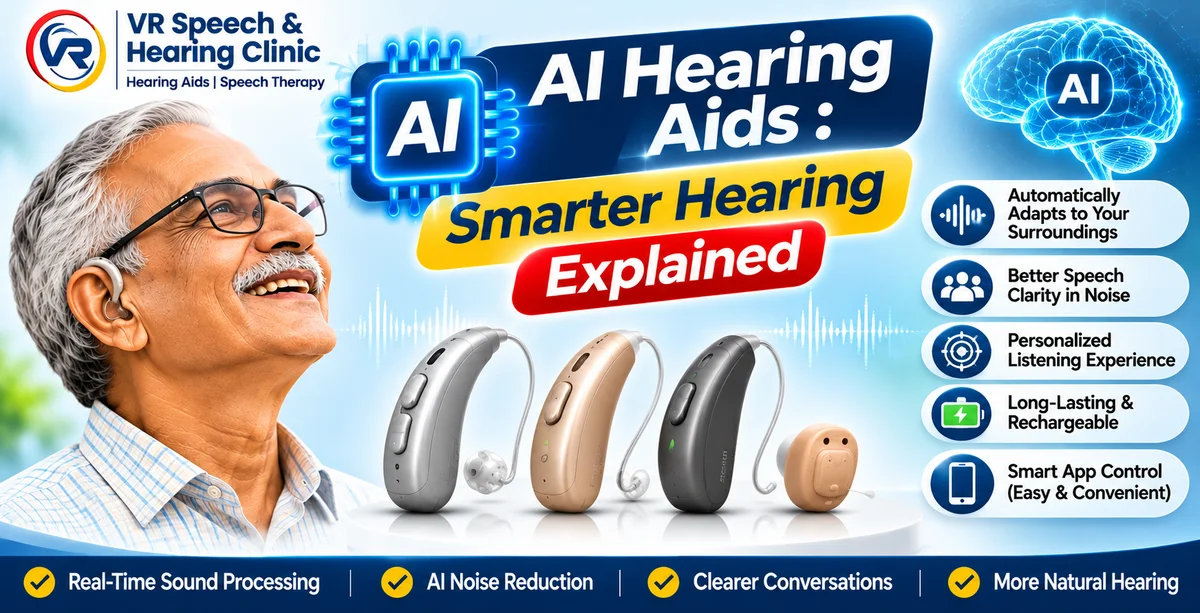
AI Hearing Aids : Smarter Hearing Explained
For many years, a hearing aid did one basic job: it made sound louder. If you wore one in a quiet room, it helped. In a busy market, a wedding hall or a family gathering, it often made everything louder at once, including the noise you wanted to avoid.
In 2026 that picture has changed. AI hearing aids are now part of everyday hearing care. They analyse your surroundings, separate speech from noise and adjust themselves as you move through your day. At VR Speech and Hearing Clinic, we see more patients each month asking whether these smart devices are worth it. This guide explains what AI does inside a hearing aid, where it helps most and how to decide if it suits you.
What Does “AI” Actually Mean in a Hearing Aid?
The term is used loosely, so it helps to be clear. AI hearing aids use a small onboard processor, and in many models a trained machine-learning system, to study incoming sound many times every second. The device works out what is speech, what is background noise and what is a sudden loud sound. It then adjusts its settings automatically.
Older digital hearing aids also adjusted themselves, but they followed fixed rules written by engineers. AI-based systems are trained on large collections of real-world sound, so they handle unfamiliar and messy situations much better. Some models also learn from your own habits. If you keep turning the volume down in a certain place, the device can learn that preference over time.
Better Hearing in Noisy Places
Noise is the biggest complaint among hearing aid users in India. Traffic, pressure cookers, television, street vendors and several people talking at once are part of daily life here.
AI helps in three main ways:
Speech focus: The device identifies the voice in front of you and brings it forward, while softening steady background sounds.
Automatic environment switching: It recognises a quiet room, a car, a restaurant or an outdoor space and changes settings without you pressing anything.
Less listening fatigue: When the device does the sorting, your brain works less. Many users tell us they feel far less tired at the end of the day.
Some premium models go further. They use motion sensors and the direction of your head to guess who you are trying to listen to. Others use dedicated AI chips to run noise reduction continuously. Brands such as Phonak, Oticon, Signia, Widex, Starkey and ReSound all offer AI-based technology in their current ranges, though the approach differs from brand to brand.
Bluetooth and Smartphone Control
AI is only part of the improvement. Modern hearing aids are also connected devices. Bluetooth hearing aids let you:
Take phone calls directly through your hearing aids
Stream music, videos and WhatsApp voice notes
Hear navigation directions clearly while walking or driving
Adjust volume, programs and settings from a phone app
Use remote support, where your audiologist can make small adjustments after you have already been fitted
For working professionals and tech-friendly seniors, this connectivity is often what turns a hearing aid from a medical device into a daily tool people actually enjoy using.
Rechargeable Batteries and Longer Wear
Another big shift in 2026 is the move to rechargeable hearing aids. Most new AI models use lithium-ion batteries that last a full day on one charge, even with some streaming. A portable charging case keeps the devices topped up overnight or while travelling. This is a real advantage for people with limited dexterity, who may find tiny zinc-air batteries hard to handle.
Health and Wellness Features
Some newer devices go beyond hearing. Certain models include step counting, activity tracking and fall detection. Others can send an alert to a family member if the wearer falls. Because hearing loss and balance problems often occur together in older adults, these features can give families real peace of mind.
Honest Pros and Cons of AI-Powered Hearing Aids
AI hearing aids are impressive, but they are not perfect for everyone.
Advantages
Fewer manual adjustments through the day
Clearer speech in crowds and noisy surroundings
Easy phone and TV connectivity
Rechargeable convenience
Better performance as technology improves through software updates
Limitations
Higher price than basic digital hearing aids
Heavy streaming reduces battery life
A short adjustment period is normal, because your brain needs time to get used to clearer sound
AI does not replace a proper hearing test and an expert fitting
That last point matters most. Even the smartest hearing aid performs poorly if it is programmed incorrectly.
Who Benefits Most from AI Hearing Aids?
AI technology is especially useful for:
People who attend social events, meetings or religious gatherings regularly
Working professionals who take frequent calls
Active seniors who travel, walk outdoors or enjoy time with grandchildren
People who have been disappointed with older hearing aids in noisy places
Anyone who wants a device that needs very little daily fiddling
If your hearing loss is mild and your days are mostly quiet, a simpler digital hearing aid may serve you well at a lower cost. A good audiologist will tell you honestly which category you fall into.
Why a Proper Hearing Evaluation Comes First
Before choosing any technology, you need to understand your own hearing. A complete evaluation, usually starting with Pure Tone Audiometry (PTA), shows the type and degree of your hearing loss. The right device then depends on your lifestyle, budget, ear shape and personal goals.
At VR Speech and Hearing Clinic, our audiologist Vilas Rathod, BASLP, guides each patient through this process. We are a multi-brand clinic, which means our advice is based on your needs, not on a single manufacturer’s catalogue. You can compare different technologies, listen to them in real conditions and understand the trade-offs before you decide.
Try Before You Buy
Reading specifications only tells you so much. Real-world testing is where you learn whether a hearing aid suits you. At our clinic you can:
Have a free hearing evaluation
Listen to AI-enabled models in a realistic sound setting
Compare features, comfort and cost across brands
Get a personalised fitting and programming session
Receive follow-up care, cleaning and adjustments as your needs change
Find Us Across Maharashtra
VR Speech and Hearing Clinic’s headquarters is at Vasantrao Naik Chowk, N-3, CIDCO, opposite Hotel Deepali Executive, Chhatrapati Sambhajinagar, Maharashtra 431003. We also serve patients at our branches in Ahmednagar, Aurangabad, Pune, Nashik, Beed and Jalna, so expert hearing care is never far away.
Conclusion
AI has changed hearing aids from simple amplifiers into intelligent listening partners. In 2026, the best devices separate speech from noise, connect to your phone, charge overnight and adapt to your daily life. The technology is only as good as the fitting behind it, so start with a professional hearing test and an honest conversation with an audiologist.
If you or someone in your family struggles to follow conversations, do not wait. Visit VR Speech and Hearing Clinic, test the latest AI hearing aids for yourself and take the first step toward clearer, more confident hearing.
FAQs
1. What is the difference between AI hearing aids and regular hearing aids?
Regular digital hearing aids follow fixed rules to adjust sound. AI hearing aids use machine-learning technology to analyse your surroundings continuously and adapt in real time, which gives better speech clarity in difficult environments.
2. Do AI hearing aids work in noisy places like markets and weddings?
Yes. They are designed to separate speech from background noise and focus on the voices you want to hear. Results vary by model and hearing loss, so a trial in real conditions is the best test.
3. Are Bluetooth hearing aids worth buying?
For most people, yes. They let you take calls, stream media and control settings from your phone, which makes daily life simpler.
4. Are AI hearing aids suitable for senior citizens?
Absolutely. Rechargeable batteries, automatic adjustments and optional family-alert features make them practical for older adults, provided they are fitted and programmed correctly.
5. Are AI hearing aids more expensive?
They usually cost more than basic digital models because of their advanced processors and features. Prices depend on the brand, technology level and whether you need one ear or both. Visit the clinic for current, personalised pricing.
6. Do I need a hearing test before buying an AI hearing aid?
Yes. A hearing evaluation shows the type and degree of your hearing loss, which decides which device and technology level will work for you.
7. Where can I try AI hearing aids in Chhatrapati Sambhajinagar?
You can visit VR Speech and Hearing Clinic at Vasantrao Naik Chowk, N-3, CIDCO, for a free evaluation and a trial of the latest hearing aids.