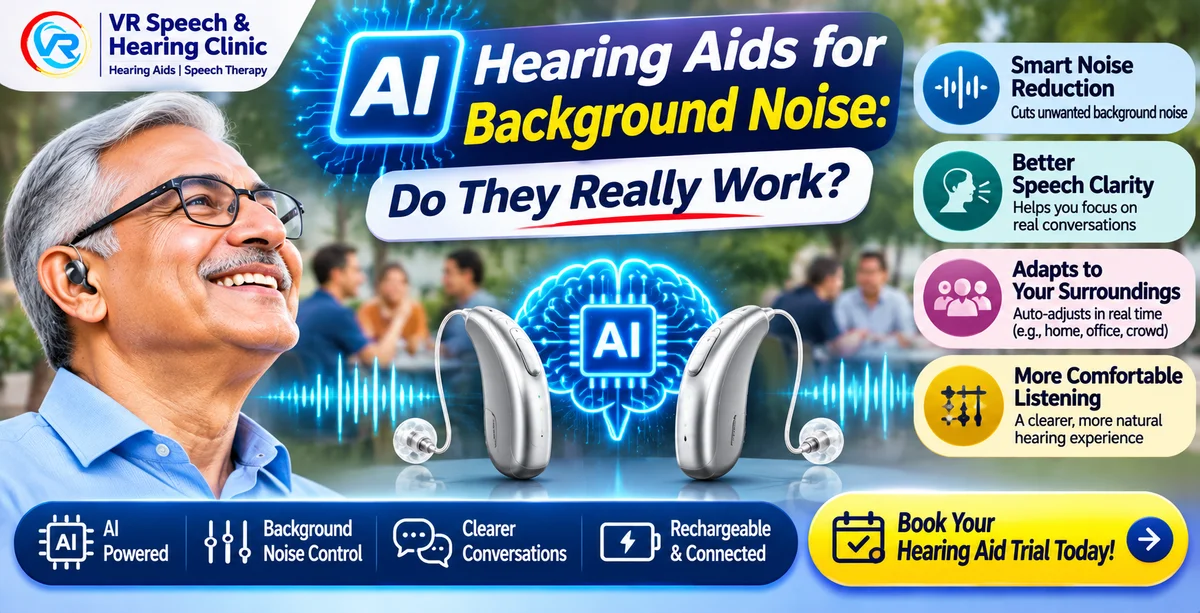
AI Hearing Aids for Background Noise: Do They Really Work?
AI Hearing Aids and Background Noise: Can Smarter Technology Finally Help You Follow Conversations?
You sit down at a busy restaurant and the person across from you is speaking, yet their words dissolve into clattering plates, background music, and nearby chatter. If that sounds familiar, you are far from alone. National health survey data shows that roughly one in five adults in the United States has trouble following conversation in noise, and the problem grows steadily with age. For many hearing aid wearers, noise is still the one complaint that never fully goes away.
A new generation of AI hearing aids claims to change that. This guide explains what the technology does, what independent testing suggests, and what you should weigh before upgrading.
Why Background Noise Is So Hard for Hearing Aids
Hearing loss is not just a volume problem. Inner ear damage also blurs the fine detail the brain uses to separate one voice from another. Making everything louder lifts speech, but it also lifts cutlery, traffic, and air conditioning. The sound becomes audible but still exhausting to decode.
Real rooms add more complications. Voices bounce off walls, glass, and tabletops. People turn their heads, lean in, or talk while walking. Several conversations overlap at once. Any technology that hopes to help must handle all of this in real time with almost no delay, or the sound feels unnatural.
The Ceiling of Directional Microphones
For many years, the main solution has been directional microphones. By comparing signals from two or more microphones, a hearing aid can emphasize sound from in front of you and soften sound from behind or beside you. This works well when the talker stays put and the noise comes from elsewhere.
Everyday life rarely cooperates. Engineers who study realistic listening conditions report that conventional beamforming delivers about five to seven decibels of useful noise reduction in the best case. That may sound small, but in speech testing even one decibel of improved signal-to-noise ratio can raise understanding by roughly ten percentage points. Still, once manufacturers had squeezed nearly everything out of directionality, the industry needed a different approach.
How AI Hearing Aids Handle Noise Differently
Instead of just aiming microphones, AI hearing aids use deep neural networks, a form of machine learning trained on huge collections of speech and noise recordings. The network learns what speech looks like inside a messy sound mix and what it does not. In a complicated scene, the hearing aid can estimate which parts are speech and turn down the rest, even if the talker is off to one side.
The obstacle has always been computing power. Neural networks need far more processing than a tiny device behind the ear can normally provide, and the battery is about the size of a grain of rice. Phonak spent several years developing a dedicated chip, called DEEPSONIC, to run this processing inside its Sphere hearing aids. A separate AI processor working alongside the main chip is what sets these devices apart from hearing aids that use AI only for general automatic adjustments. Other manufacturers are also moving toward on-board machine learning, so expect this category to grow quickly.
What Independent Testing Suggests
Marketing claims are one thing, and measurements are another. The independent lab HearAdvisor rated the Phonak Sphere highly for speech in noise in its standard testing, giving it 4.4 out of 5. With the dedicated neural network mode switched on, the score rose to 4.7. At the time of that report, this was the strongest speech-in-noise result the lab had recorded. Phonak itself reports a signal-to-noise benefit of around 10 decibels for the AI mode, well beyond what directional microphones alone are expected to offer.
Real-world stories point the same way. One long-term wearer with severe to profound hearing loss described catching a flight attendant’s question while bent over and facing away, in a noisy cabin. Without the technology, that moment would have been lost. One story proves nothing, but combined with measured data it suggests the benefit is real in tough settings such as restaurants, airports, meetings, and family gatherings.
The Trade-Offs Worth Knowing About
No hearing aid makes every noisy place easy, and AI is not a magic switch. Here are the practical compromises.
Size. A dedicated AI chip takes up room, so these devices tend to be larger than slim receiver-in-canal models. People with small ears, people who wear glasses, and people who value discretion may find them less comfortable.
Battery life. Neural network processing uses a lot of power. Most people will not run the intensive mode all day, because it is meant for difficult listening situations. Still, anyone who spends long hours in loud places should ask about battery performance. A recent software update reportedly stretched the intensive mode from about seven hours to roughly ten or eleven.
Custom earpieces. People with more severe hearing loss often need custom-molded earpieces for a secure seal and enough power. Clinicians report that these can be awkward with bulkier devices and compact charging cases, and the wiring on custom shells can be a reliability concern.
Cost. Premium AI devices carry a premium price, so value matters as much as performance.
Where the Technology Is Heading
Manufacturers are investing heavily in energy efficiency. More efficient chips and, eventually, better battery chemistry such as solid-state cells could shrink the size and power compromises over the next several years. The direction is clear. The future of hearing technology is not just sharper microphones but smarter on-board processing that separates speech from noise automatically.
Is an AI Hearing Aid Right for You?
An AI hearing aid may be worth exploring if you:
Struggle most in restaurants, meetings, vehicles, or crowded gatherings
Already wear hearing aids but still miss words in noise
Are comfortable with a slightly larger device
Want the strongest speech-in-noise performance available
A smaller or simpler device may suit you better if you value discretion above all, have a mild loss that is mostly quiet-environment related, or have a tight budget. A technically excellent hearing aid is still the wrong choice if it does not fit your ears, hands, and lifestyle comfortably.
Tips for Hearing Better in Noise With Any Device
Technology works best when paired with good habits and professional care.
Choose seating with your back to a wall, away from kitchens and speakers.
Face the talker so you can use visual cues like lip movements and expressions.
Ask your audiologist about verified fitting, which confirms that your devices are tuned to your hearing loss.
Use a trial period to test devices in the places where you struggle most.
Return for follow-up adjustments, since fine-tuning often makes the biggest difference.
Final Thoughts
AI hearing aids represent a real step forward for speech in noise, an area where progress has been slow for decades. Lab results and user feedback both suggest meaningful gains in the situations that frustrate people most. The trade-offs in size, battery life, fit, and price are just as real, so the right choice depends on your hearing, your anatomy, and your daily life.
At VR Speech and Hearing Clinic, our team can evaluate your hearing, explain your options in plain language, and help you test different technologies before you commit. If background noise is keeping you out of conversations, book a hearing assessment and find out what modern hearing technology can do for you.
FAQs
1. What is an AI hearing aid?
An AI hearing aid uses machine learning, often a deep neural network, to recognize speech and reduce competing noise automatically, instead of relying only on microphone direction and basic settings.
2. Do AI hearing aids really work better in noisy places?
Independent testing and user reports suggest that devices with dedicated AI processing can improve speech understanding in noise more than traditional directional microphones. Results still vary from person to person and from environment to environment.
3. Will an AI hearing aid remove all background noise?
No. It aims to make speech clearer relative to the noise, not to silence the surroundings. Very loud or chaotic environments can still be challenging.
4. Do AI hearing aids have shorter battery life?
The intensive AI mode uses more power, so battery life can be shorter when it is running continuously. Most people only use it in difficult listening situations, and manufacturers continue to improve efficiency.
5. Are AI hearing aids bigger than regular ones?
Some models are larger because they house an extra AI chip. Smaller designs are expected as processors and batteries improve.
6. Who benefits most from AI hearing aids?
People who already wear hearing aids but still struggle in restaurants, meetings, travel, and group conversations are often the best candidates. An audiologist can confirm whether the technology suits your hearing loss.
7. How do I know which hearing aid is right for me?
A full hearing evaluation, a conversation about your daily listening needs, and a trial period are the best ways to choose. VR Speech and Hearing Clinic can guide you through each step.