What Is the 60/60 Rule in Audiology? Complete Guide
What Is the 60/60 Rule in Audiology?
In today's world, headphones, earphones, and personal listening devices have become an inseparable part of daily life. From music and podcasts to video calls and online classes, most people spend several hours every day with something plugged into their ears. While this convenience has changed how we work, learn, and relax, it has also quietly introduced a new and growing health concern: noise-induced hearing loss caused by personal audio devices. This is exactly where the 60/60 rule in audiology comes in.
At VR Speech and Hearing Clinic, we frequently meet patients, especially young adults and teenagers, who unknowingly damage their hearing simply because they are unaware of safe listening practices. The 60/60 rule is one of the simplest, most practical guidelines audiologists recommend to prevent this damage. In this article, we will explain what the 60/60 rule means, why it exists, the science behind it, and how you can apply it in your everyday life to protect your hearing for years to come.
Understanding the 60/60 Rule
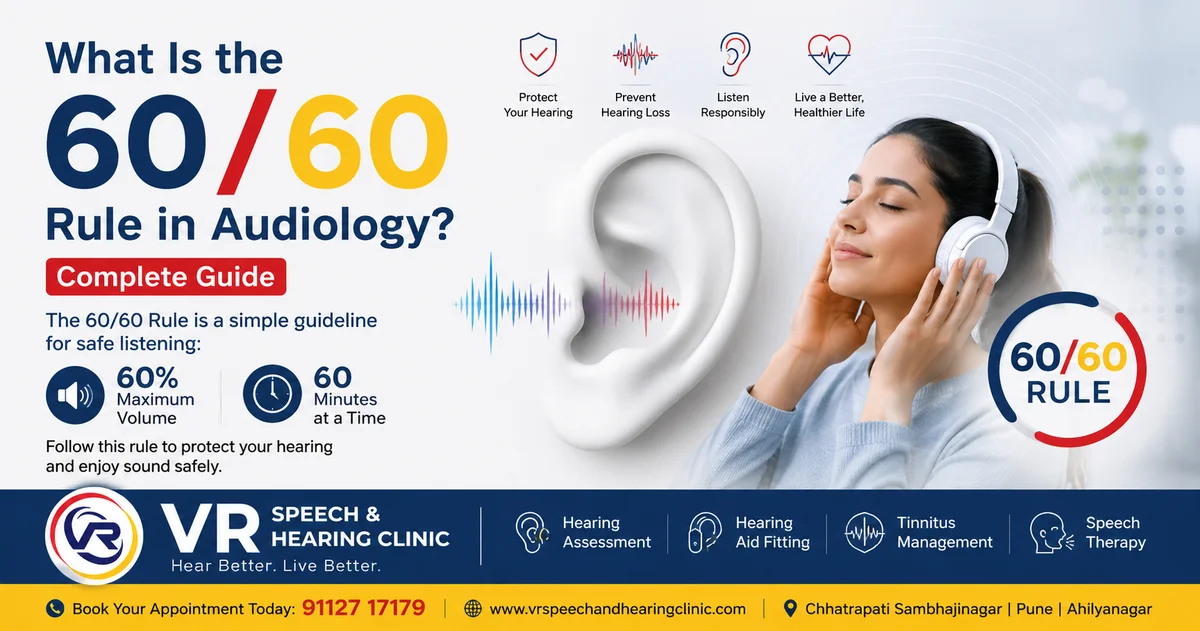
The 60/60 rule is a hearing health guideline that states you should listen to audio through headphones or earphones at no more than 60 percent of the maximum volume for no longer than 60 minutes at a stretch. After 60 minutes of continuous listening, it is recommended to take a break of at least a few minutes before resuming.
This simple formula, 60 percent volume and 60 minutes of listening time, was developed to help people enjoy music and audio content without exposing their ears to harmful sound levels for extended periods. It is not a strict scientific law but rather a practical, easy-to-remember benchmark that audiologists use to educate the public about safe listening habits.
The rule essentially addresses two important variables that determine hearing damage: loudness (intensity of sound) and duration (how long the ear is exposed to that sound). Both factors work together, and even a moderately loud sound can cause damage if the exposure continues for too long.
Why Does the 60/60 Rule Matter?
Our ears are remarkably sensitive organs. Inside the cochlea, there are thousands of tiny hair cells that convert sound vibrations into electrical signals the brain can interpret. Unfortunately, these hair cells do not regenerate once they are damaged. Prolonged exposure to loud sounds, especially through headphones placed directly in or over the ears, can permanently damage these hair cells, leading to a condition known as noise-induced hearing loss.
Unlike age-related hearing loss, which develops gradually over decades, noise-induced hearing loss from personal listening devices can occur much earlier in life, sometimes even in teenagers and young adults. This is a growing concern for audiologists worldwide because it is largely preventable.
The 60/60 rule matters because it gives people a clear, actionable boundary. Most individuals do not intentionally harm their hearing; they simply do not realize how loud their headphones actually are or how long they have been listening. By following this rule, you create a natural checkpoint that limits both the volume and the duration of exposure, significantly reducing the risk of long-term damage.
The Science Behind Safe Listening Levels
To understand why the 60/60 rule is so important, it helps to look at how sound intensity is measured. Sound levels are measured in decibels (dB), and the scale is logarithmic, which means even small increases in decibel level represent large increases in actual sound energy.
Generally, audiologists agree that:
Sounds below 70 dB are considered safe for extended periods of listening.
Sounds between 85 and 90 dB can cause damage after prolonged exposure, typically several hours a day over many years.
Sounds above 100 dB can cause damage in a matter of minutes.
Sounds above 120 dB can cause immediate pain and potential permanent damage.
Most smartphones and personal audio devices can produce sound levels between 100 and 110 dB at maximum volume. This means that listening at full volume, even for a short period, can push your ears into the danger zone. Keeping the volume at 60 percent typically brings the output down to a safer range, often between 70 and 85 dB, depending on the device and headphone type.
The 60-minute time limit works alongside this volume reduction. Even at a moderate volume, continuous exposure without breaks can fatigue the auditory system. Short breaks allow the tiny structures inside the ear to recover, reducing cumulative strain.
Who Is Most at Risk?
While anyone who uses headphones or earphones regularly can be affected, certain groups are more vulnerable:
Teenagers and young adults who use personal listening devices for many hours daily, often for music, gaming, or streaming content.
Students who use earphones for long online classes or study sessions.
Working professionals who wear headphones throughout the day for calls, meetings, or focus music.
Commuters who increase volume to block out background noise on buses, trains, or busy roads.
Gamers who use headsets for extended gaming sessions, often at high volumes for immersive sound effects.
At VR Speech and Hearing Clinic, we have observed a noticeable rise in early signs of hearing strain among younger patients, largely linked to unsafe listening habits. This trend highlights the importance of spreading awareness about guidelines like the 60/60 rule.
Signs You May Be Listening Too Loudly or Too Long
Many people do not realize they are damaging their hearing until symptoms appear. Some common warning signs include:
Ringing or buzzing in the ears after using headphones, a condition known as tinnitus.
Difficulty understanding speech in noisy environments.
Needing to increase the volume gradually over time to hear the same content clearly.
A feeling of fullness or pressure in the ears after extended listening sessions.
Temporary muffled hearing that returns to normal after some time, which can be an early warning sign of damage.
If you notice any of these symptoms regularly, it is advisable to consult a qualified audiologist for a hearing evaluation.
How to Apply the 60/60 Rule in Daily Life
Adopting the 60/60 rule does not require any special equipment or drastic lifestyle changes. Here are some practical ways to incorporate it into your routine:
Set your device volume manually to around 60 percent and avoid increasing it out of habit.
Use built-in volume limit features available on most smartphones, which allow you to cap the maximum output level.
Set a timer or reminder for every 60 minutes of headphone use to prompt a short break.
Choose noise-cancelling headphones in noisy environments instead of raising the volume to compete with background sound.
Take listening breaks during long study or work sessions, allowing your ears to rest.
Avoid falling asleep with headphones or earphones playing continuously through the night.
Encourage children and teenagers to follow the same guideline, as their ears are equally, if not more, susceptible to damage.
These small adjustments can make a significant difference in protecting your long-term hearing health without compromising your listening experience.
Common Myths About the 60/60 Rule
There are several misconceptions surrounding this guideline that are worth clarifying:
Myth: The 60/60 rule applies only to music.
Fact: It applies to any audio content played through headphones or earphones, including podcasts, videos, games, and calls.
Myth: Noise-cancelling headphones make the rule unnecessary.
Fact: While noise-cancelling headphones reduce the need to raise volume in noisy settings, the same principles of moderate volume and limited duration still apply.
Myth: If it does not hurt, it is not damaging my ears.
Fact: Hearing damage from noise exposure is often painless and gradual, which is why many people are unaware of the harm until symptoms like tinnitus or hearing loss appear.
Myth: Only very loud music causes hearing damage.
Fact: Even moderate volumes can cause harm if the exposure duration is long enough, which is precisely why both factors, loudness and time, are addressed in the 60/60 rule.
Why Hearing Protection Should Start Early
Hearing health is often overlooked until problems become noticeable, but prevention is far more effective than treatment. Encouraging safe listening habits from a young age can prevent long-term damage that may otherwise affect speech understanding, communication, and quality of life later on.
Parents, teachers, and caregivers play an important role in this process. Educating children and teenagers about the 60/60 rule, along with setting reasonable screen and headphone time limits, can help build lifelong habits that protect their hearing well into adulthood.
Employers can also contribute by promoting awareness among employees who use headsets for extended work hours, particularly in call centers, customer support roles, and remote work environments where headset use is nearly constant.
When to Consult an Audiologist
While the 60/60 rule is an excellent preventive guideline, it does not replace professional hearing evaluations. If you experience any of the following, it is important to schedule a consultation with an audiologist:
Persistent ringing or buzzing in the ears.
Difficulty following conversations, especially in group settings or noisy places.
Frequently asking others to repeat themselves.
A noticeable change in how loud you need to set the volume to hear clearly.
Family history of hearing loss combined with regular headphone use.
At VR Speech and Hearing Clinic, our audiologists conduct comprehensive hearing assessments using advanced diagnostic equipment to detect even early or subtle changes in hearing function. Early detection allows for timely intervention, whether through lifestyle changes, hearing protection devices, or further treatment if needed.
How VR Speech and Hearing Clinic Can Help
Our clinic is dedicated to promoting hearing health awareness and providing comprehensive audiological care for individuals of all ages. Our services include detailed hearing evaluations, tinnitus assessments, counseling on safe listening practices, and guidance on selecting appropriate hearing protection when needed.
We believe that education is the first step toward prevention. By understanding simple guidelines like the 60/60 rule and applying them consistently, individuals can significantly reduce their risk of developing noise-induced hearing loss while still enjoying the audio content they love.
Whether you are a student who spends hours on online classes, a professional who wears a headset throughout the day, or a parent concerned about your child's headphone habits, our team is here to provide expert guidance tailored to your specific needs.
Final Thoughts
The 60/60 rule in audiology is a simple yet powerful reminder that how we listen matters just as much as what we listen to. By keeping headphone volume at 60 percent or below and limiting continuous listening sessions to 60 minutes, followed by a short break, you can meaningfully reduce your risk of noise-induced hearing loss.
Hearing is a precious and often underappreciated sense, and once damaged, it cannot be fully restored. Taking small, mindful steps today, like following the 60/60 rule, can help preserve your hearing health for the years ahead.
If you have concerns about your hearing or would like a professional evaluation, the team at VR Speech and Hearing Clinic is here to help. Protecting your hearing starts with awareness, and awareness starts with understanding guidelines like the 60/60 rule.
Frequently Asked Questions (FAQs)
1. What exactly does the 60/60 rule mean in audiology?
The 60/60 rule recommends listening to audio through headphones or earphones at a maximum of 60 percent volume for no more than 60 minutes at a time, followed by a short break before resuming.
2. Why is the 60/60 rule important for hearing health?
It helps prevent noise-induced hearing loss by controlling two key risk factors, loudness and duration of exposure, both of which contribute to damaging the delicate hair cells inside the ear.
3. Does the 60/60 rule apply to all types of headphones?
Yes, it applies to earphones, over-ear headphones, and headsets alike, regardless of the brand or design, since the risk comes from volume and duration rather than the device type.
4. Can following the 60/60 rule completely prevent hearing loss?
While it significantly reduces the risk of noise-induced hearing loss, it does not guarantee complete prevention, especially if other risk factors like genetics or existing ear conditions are present. Regular hearing checkups are still recommended.
5. Is the 60/60 rule only meant for young people?
No, it applies to anyone who uses personal listening devices regularly, including teenagers, adults, and working professionals who wear headsets for long hours.
6. How do I know if my headphone volume is too loud?
A general guideline is that if someone standing next to you can hear your headphone audio clearly, or if you struggle to hear conversations around you while listening, your volume may be too high.
7. What should I do if I already have symptoms like ringing in the ears?
If you experience tinnitus, muffled hearing, or difficulty understanding speech, it is advisable to schedule a hearing evaluation with a qualified audiologist as soon as possible.
8. Can VR Speech and Hearing Clinic help with noise-induced hearing loss?
Yes, VR Speech and Hearing Clinic offers comprehensive hearing evaluations, tinnitus assessments, and personalized guidance to help identify, manage, and prevent noise-induced hearing loss.